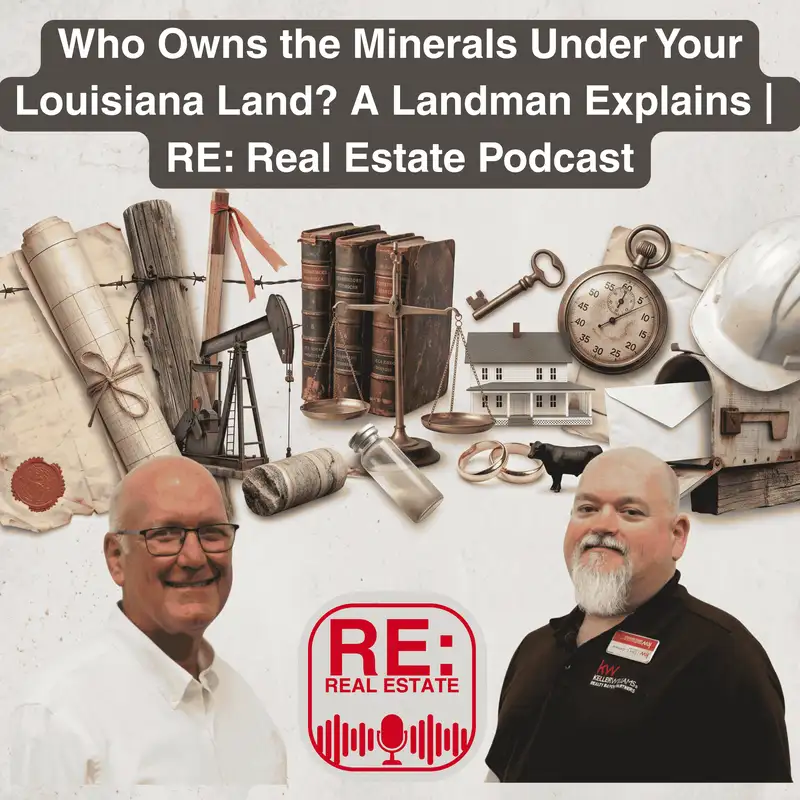
Who Owns the Minerals Under Your Louisiana Land? A Landman Explains | RE: Real Estate Podcast
Ben Harang (00:00)
Everything we talked through today is general framework, not advice. For your specific property and your specific situation, talk to a landman or an Arling gas attorney.
Hello everybody and welcome to another episode of the RE Real Estate Podcast. I'm Ben Harang and with me as usual is my co-host, Galliano. Clint, how are doing today, man?
Clint C. Galliano (00:40)
I'm doing wonderful, Ben. How you doing?
Ben Harang (00:43)
I'm doing terrific. We got an early start this morning or a little earlier than in the day than we usually do this. And that's good. And for those of you watching on YouTube, we have a little different format. We have a guest with us today, Chris McGuirt If I said that right,
Chris McGuirt (01:02)
Right.
Ben Harang (01:04)
Chris is an all in gas is a land man out of Lafayette and he's agreed to join us.
Tell us what we're talking about today.
Clint C. Galliano (01:12)
So that tells us the who. Now we're going to talk about the what. So reason why we're talking with Chris today is for him to give us a land man's perspective on how mineral rights and property rights affect property owners and some common things that he sees in relation to property rights and mineral rights.
So Chris, why don't you tell us a little bit about yourself and what you do as a land man?
Chris McGuirt (01:48)
Sure,
Clint. Well, first of all, thank you guys for having me. my name is Chris McGuirt I'm from Lafayette, Louisiana. got my start about eighteen years ago h here in Lafayette as a field landman and that's essentially a person that goes to the courthouse, does the title research, whether it be mineral or surface or both. you might negotiate oil and gas leases or other agreements. and then from there I went over to Houston, moved to Houston where I met my wife there, and
Worked at Conico Phillips, worked at Energy Transfer, what we would consider more in-house positions where you're dealing with bigger picture things, whatever that may be, if they're trying to sell big big assets or or purchase them or or whatnot. So kind of had a wide range of of experience and now I'm back in Lafayette as a landman, just doing as as broad of things as as as needed.
Ben Harang (02:44)
Okay, Chris, you and I were talking before we started about mineral reservations and the prescription period, the 10 years, and there's a lot of misconception and confusion in Louisiana about who actually owns it, how long you can reserve them. Can you do just a brief overview on how that works?
Chris McGuirt (03:07)
Sure. So typically what what we do to determine who owns the minerals, because that's the million dollar question, do I own my minerals or not? The right way to determine it is to go back to patent when the state of Louisiana issued out land to landowners for the first time. And what you go to the courthouse or nowadays online is you find every transaction that's occurred with that property from patent from 1900 or even earlier, and you bring it forward to present day and it tells a story and you put it together.
And as far as prescription is involved, Louisiana is very unique in that it has something called prescription, which is essentially just a pause. And so if somebody owns the minerals and they choose to sell their property and they choose to reserve that minerals, then the clock starts, kind of like a stopwatch. That stopwatch is going to keep going until it hits 10 years. And after 10 years, it's going to revert to the current landowner.
But in the case that there is some production, let's say, in that 10-year period, the stopwatch is gonna stop. And until that production is done, it's just gonna stay stopped. And then once the production is ended, once there's no longer oil and gas coming out of that land, then they'll reset that stopwatch and another 10 years begins. So that's that's essentially all prescription is. It's just a stopwatch that pauses the ownership of the minerals for a period of time.
Clint C. Galliano (04:30)
Interesting.
Ben Harang (04:31)
we talked briefly earlier about subdivisions. Every place has a subdivision in Louisiana used to be one track to land with or without mineral reservations. And then when it was sold, you indicated that that's not a pleasant thing for an oil and gas company to try to figure out.
Chris McGuirt (04:53)
Typically the path to least resistance is the way they want to go. They prefer to deal with one landowner or five or ten, but you start getting into a subdivision where the minerals have have resorted reverted back to every single owner. You typically don't want to deal with 40, 50, 60 people if you don't have to.
If there's oil there and there's enough production they believe they're gonna go forward, but as a general rule of thumb, I would say they they they try to stay away from subdivisions at a as best they can. It's also hard to get a drill site location in a subdivision. So look at
Ben Harang (05:25)
You
Chris McGuirt (05:26)
you're looking at directionally drilling from quite a bit and that can get expensive, so
Ben Harang (05:30)
So talk about royalty, a working interest, and an override interest. Who has what? And somebody says, my mineral rights. What do I actually own? Are there different levels of ownership?
Chris McGuirt (05:45)
So this can get quite complicated over time, but in general I use an analogy. If you have a landowner with with a hundred acres, let's call him John Smith.
An oil and gas company is going to come to him. And there's two ways you get paid from the oil and gas company generally. The first time you get approached is for an oil and gas lease. since you are the mineral owner, you have the executive rights to sign an oil and gas lease. And so they'll pay you for an oil and gas lease. And then subsequently, if they choose to drill a well, then the second time you get paid is something we call royalties. And a royalty is a term that's used in the oil and gas lease for how much money you receive and how much
Much money the oil and gas company receives. So if you have a hundred acres of land and it starts producing, 25% of what comes out of the ground, whatever that dollar amount is, is gonna show up on in your mailbox every every month, and they're gonna receive 75%, the oil and gas company. And the reason the
That it's weighted the way it is, is because the oil and gas company takes on all the risk. They have to go drill probably a four or five million dollar well. they have to obviously negotiate these leases and pay for that. There's a lot of upfront costs up front that they endure. And so you talk about working interest. What a working interest is, is all the investors with the oil and gas company.
So, you know, it's common for these big oil and gas companies to not need other working interest partners, but when you start getting into multiple different areas and so forth, these oil and gas companies work together. And there's a term for that, and it's called farm out. And it would be company A talking to company B saying, we've got some assets you like, and vice versa. And so let's get together. Well
How we going break down the percentage of ownership? Well, we're gonna we're gonna have these working interests. So company A may have 70%, company B may have 30%, and they get paid out no different than an than if you have multiple mirror owners. it's just a whole different side of the of the lease, the 25% versus the 75%.
Ben Harang (07:56)
So the working interest is in the 75 % side, not in the mineral
Chris McGuirt (08:00)
Correct.
Ben Harang (08:01)
owner's name. How about an, what about the override?
Chris McGuirt (08:04)
And then there's also this thing called override.
Yeah. So an override, you'll commonly see an override when let's just say you have a geologist that finds this great area of land that's that's they're very strong on. They've looked at the data, the seismic data that they've accumulated, and they feel very confident in this play right here. So they put everything together, how far down they're gonna drill, how big this unit's gonna look like.
And they bring it to the oil and gas company and they say, look, this is what we think is here. And they say, tell you what, we're going to give you something called an override. It's usually 1%, 2%, something like that. And that override is going to be money that the geologist will receive almost like a royalty. And that money is coming from the oil and gas side.
So in our analogy, your mineral owner is going to have his 25%. And now the oil companies, instead of having 75%, they may only have 72%, because 3% is the override that's given to the geologist.
Ben Harang (09:10)
Okay.
Clint C. Galliano (09:10)
It's almost
like a bonus.
Chris McGuirt (09:13)
It's a great thing to have. there's everybody wants them, they're hard to get. because at the end of the day it does bring down your you know, the line when you're looking at your your balance sheet for for the oil and gas company, you want all the revenue you can bring in.
every time they assign that oil and gas lease to another company, they're probably gonna ask for an override. So it just shrinks the amount of net profit, I guess, that the oil and gas companies are left with. Essentially how
Clint C. Galliano (09:46)
And I guess
Ben Harang (09:46)
Okay.
Clint C. Galliano (09:46)
it depends on the strength of the play on whether it's worth it or not.
Chris McGuirt (09:51)
Louisiana right now,
you've got one of the biggest plays in North America going on. And that's a huge topic right now. the Highlander wells down there in South Louisiana. So the oil and gas industry, regardless of what anybody will tell you, is extremely strong in Louisiana right now, currently.
Ben Harang (10:12)
So where's that play going on in South Louisiana?
Chris McGuirt (10:15)
St. Martin Paris, the southern portion of that. I'll have to double check that and and correct myself if I'm wrong, but I believe it's it's South Louisiana in that in that area. And it's one
Ben Harang (10:26)
Okay.
Chris McGuirt (10:27)
of the deepest drilled, deepest wells ever drilled. I believe the cost is somewhere near 200 million just to drill
Ben Harang (10:33)
Whoa.
Chris McGuirt (10:34)
it. And then you still have to complete it. And that could be another 200 million dollars. So they're going down extremely far.
It's it could be extremely lucrative if it works or it could be a very, very expensive trial and error. So and I think
Clint C. Galliano (10:51)
interesting.
Chris McGuirt (10:52)
they'll find out this year where that sits.
Ben Harang (10:55)
Okay. So if somebody inherits some property and there's a whole bunch of mineral paperwork and they have no idea what they own, daddy, grandpa, great grandpa, whoever had it, it's now inherited it, how do they even figure out what they own?
Chris McGuirt (11:17)
Yeah,
so so going back to the the the whole patent, right, you the true way of knowing how this all comes out is you've got go back there and bring it forward. But in general, let's just say you have somebody with a hundred acres and it's it's John Smith again. If he leaves a will, or if he doesn't leave a will, that's where it all starts. If he leaves a will and tells you his intentions of how he wants it to go, the land, then it's all decided at that point.
It's when he it's when he doesn't have a will, it's when it's intestate that you run into the problem. So there
Ben Harang (11:48)
Mm-hmm.
Chris McGuirt (11:49)
is a chart called testacy that is used because they've got to have some precedent of how this is gonna turn out. And the first thing that you're gonna find is does the family agree or disagree on what they wanna do? And so if they agree, well.
Testacy is great and all that. It'll tell you exactly how it's supposed to go, whether it's community property or has sold in separate property. Typically, if you inherit land, it's going to be separate.
Ben Harang (12:16)
Mm-hmm.
Chris McGuirt (12:16)
Buy land, you're commingling your money with your wife, it's going to be community property. And so from there, if you have kids, there's an actual chart depending on the date of death, how many kids are involved, and all that, of how it breaks down for their ownership. And
Once you once you inherit land, let's just say f a hundred acres, you really have two choices at that point. You can sell it or you can keep it.
And you know, a lot of times the the wife is still living maybe on the house, right? So you you've had this hundred acres, your mom and dad lived there forever, your dad just passed away, but your mom still wants to live in the house. Well, of course, you're gonna allow her to do so, I would imagine. And she's gonna have something we would call usufruct. It's the full use of the land. So maybe with this chart, she doesn't have a hundred percent of it, right? But most children would admit that.
Don't want their mother to be homeless and have to leave the family house. So now she's gonna get something called usufruct, which means she can use the land freely, even though she doesn't own 100% of it. And at that point, like I said, you can sell it if you'd like. Sometimes you'll see that happen because families disagree. Maybe it's just because all the kids live in different cities. They don't want to live on the family, you know, 100-acre ranch when mom dies. So they just choose to sell it.
And there is absolutely no downside to reserving the minerals. I don't know why anybody wouldn't reserve their minerals at that point. and so that's what happens when you choose to sell it. What gets interesting is when you choose to keep it. Because now you've got
Mom that's still alive living in the house and you got three kids and everybody knows what percentage they own now. Let's just make it simple. The mom has half and the kids each have a sixth. So three kids, three sixths, the other half. Now we gotta
Ben Harang (14:14)
Mm-hmm.
Chris McGuirt (14:14)
decide what we're gonna do with it. So
We can just put it in a trust and name a trustee at a bank. We can throw it in an LLC and maybe one of the kids wants to manage that LLC and signs all the documents for it. You can go that route. That's very common, probably the most common, honestly. But the other options you have is if you want to partition it.
So now you've got this hundred acres. Mom's living on the 50 acres to the left. The other 50 acres, what are we gonna do with it? Well, let's make three partitions inside of that. So every kid has his own, you know, 16.3 acres. So you can go that route.
And then I think your third option is you can still partition that, but you can reserve the minerals undivided. So the way that would look is oil and gas company comes in, they're only interested in mom's fifty acres for an oil and gas lease. No big deal. All the kids are still gonna get their percentage of the money, even though it's not their quote unquote side of the of the the a hundred acres anymore.
And so a lot of families will do that because now everybody's getting treated fairly from an oil and gas standpoint in the family. Nobody gets a better or a worse deal. but your surface can still be partitioned. So if you want your space from living next to your mother, so be it. It doesn't affect your minerals. So you'll see those three most common
situations whenever you get to that point where it's it's a matter of what do we do with this land. And as far as finding out who who owns it, the only shortcut I can tell you, which we would never use legally, but the shortcut is if you want to know if you own the minerals, just figure out when your family acquired the property. And as long as you know that's been 10 years, then you have The only reason you don't is if there is a servitude or an
you have some form of production that is holding that land. and then it's just a matter of f for that to go away before you come into it. So that that's the only shortcut I know of. But
We obviously take every document from patent all the way to present. We print we prepare it in a a run sheet format and we present it to attorneys and their attorneys do a title opinion from there and they ultimately give it their stamp of approval. And once they do so, then an oil and gas company will feel comfortable enough to go drill it because now they they've they've had a landman review it, they've had a an attorney review it, and everybody has come to the same conclusion.
Ben Harang (16:50)
Okay,
so.
Clint C. Galliano (16:50)
So
this is typically a lot more detailed than a normal title search for a piece of property that we encounter. Because typically those will go back three to four generations. You might be looking at, well, I guess two to three, because you might be looking at 40 to 50 years is the furthest that they'll go back unless they see some things that are questionable.
Here's a personal question, or a question I have a personal interest in. How do you handle undivided interests in tracts of land from, say, three, four generations ago that may have upwards of 100 heirs?
Chris McGuirt (17:42)
So obviously it's real difficult. the the the best real world situation I can think of on my street in Lafayette, Louisiana, there was an open lot. Now the the the the street had been developed for decades. Every single lot was taken for all this time, but there was this one lot that's been available forever. And I would always wonder why? Why is nobody built on this land? They have this lot. Well, it's because they inherited it.
And at this point, now you've got kids and grandkids and great-grandkids. And one, you've got to go find all these people. That's that's half the task. How do I how do I even know if I can reach all these 40 people? Much less get 40 people to agree to one thing, which is the price I'm asking to sell it. And if we're talking about a 30,000-acre lot, excuse me, a $30,000 lot.
I mean you can break you break that down 40 ways. It's not that much money. So you're you run into these problems and what I have seen happens is they set up an escrow account. So let's say that that $30,000 lot, they wanted to sell it. You got you got 40 kids and grandkids and stepkids and all that.
But you got one you got the majority of them are like, look, we're just trying to sell this. We we don't want it anymore. We're tired of arguing over who owns it. We can't do anything with one lot with 40 people. What are we supposed to do? So they'll sell it. And then it's my understanding that the money goes into an escrow. So everybody's paid accordingly. And when they come forward, they're paid just like lost funds in in a state. that's their money. but they can't hold up the sale because they've gotten to the point where.
know, at some point, I don't wanna use the term imminent domain, but at some point it's the property has been built on and lived on for over a period of time, and a judge is just simply gonna say, look, you guys clearly own that land. You've you've made every good faith effort to contact who owns the the surface of this land, and we have to move forward at some point. So that's that's typically what'll happen when you have that many people involved.
And one, you can't find them and two, you can't get them all to agree.
Ben Harang (19:51)
So that's, isn't that referred to as an act of petition?
Chris McGuirt (19:55)
well you can you can convey it any way you like. If it if it's a a straight general warranty deed, they'll warrant the title or they'll they'll have a vendor's lien, obviously, where you're gonna have a note that's paid. So until that note is paid in full, you don't technically own it. So or you can do there's there's a bunch of ways that you can convey that, yes. Obviously that'd be a legal, that'd be an attorney's determination, a title attorney.
Would determine how they want to best formulate that agreement.
Clint C. Galliano (20:31)
That makes sense.
Ben Harang (20:32)
All right, Chris, if if somebody owns a property and whether they bought it or inherited it, how do they go about determining what they actually own, whether or not they own the mineral rights?
Chris McGuirt (20:44)
So I believe from from a real estate standpoint, typically you guys go back thirty, forty, fifty years in title. That's as far as you need to go back to confirm that you can warrant or or you can
confirm that the surface does in fact they do in fact own the surface and it goes present. You know, who pays the taxes on a piece of property also has a lot of impact as well. If somebody goes delinquent on their taxes for a period of time, then you've got a tax sale and there's all these different things that can happen in time.
I typically wouldn't be concerned whether or not I own the minerals in Louisiana, honestly, truthfully, until I got approached by an oil and gas company. Because just having the minerals, I don't know that you're really going to be able to do anything with it, right? You you still need the oil and gas company to come in, have an interest, bring in the money that it's gonna cost to drill for oil and gas. So, you know, if you just wanna know if you own the minerals, you of course can contact the landman.
Ask them to do that. You can contact an attorney. It it would be pricey because you know nowadays we can go online. We don't have to go to a courthouse. We can
Ben Harang (21:51)
Mm-hmm.
Chris McGuirt (21:52)
get back to this this patent date online for the most part.
so it's a lot quicker than it used to be ten, fifteen, twenty years ago. You know, COVID really changed that where so many of these courthouses chose to spend the money to put all their documents online. And by doing so, it really allows you to run this title from anywhere in the country, anywhere in the world for that matter. you can go on there. Now not every county's the best or or every parish is the best in Louisiana, but they're all working their way to to getting there. And there's some
There's some third party companies, like for example, Texas File or Drilling Info. Those kind of companies go into these courthouses, they scan all these documents and they make it a subscription-based or a pay to pay as you go for every document. so you don't always have to go to the courthouse anymore to find out this information.
So I believe the cost probably would come down. But at the end of the day, if an oil and gas company comes to you and says, we believe you own the minerals, whether true or not, it's their responsibility to get that right. And
Ben Harang (23:03)
Mm-hmm.
Chris McGuirt (23:03)
by them I mean the landman that confirmed that for them. so
The research that it takes to go in and make sure you're on the minerals, you can do a quick version, as I said previously, whereby you just go back and see how long ago did we acquire this land? If it's 10
Ben Harang (23:19)
Mm.
Chris McGuirt (23:20)
years, and you know, and and especially if you if your family has ever received any oil and gas money or revenue, then you obviously own it. to what percentage do you own it? In Louisiana, usually it gets back to 100% because of the prescription. That's the beauty of it.
Ben Harang (23:38)
Okay. So if somebody's gonna buy a house in a subdivision, we talked about subdivisions before. in my mind, correct me if if you think I'm wrong, but you're buying a a a house on a lot in a subdivision, being concerned about minerals on that is significantly less important than if you're buying a hundred acres or a thousand acres of
Chris McGuirt (24:00)
Absolutely.
Ben Harang (24:01)
of land. Well you should you probably should wanna know you probably wanna know.
Whether or not the minerals are being conveyed.
Chris McGuirt (24:09)
Right. I I'll put it this way, if if I was a cu if I was buying a hundred acres in that negotiation, we're determining if you're reserving the minerals or not. Because that's ten years
Ben Harang (24:18)
Mm-hmm.
Chris McGuirt (24:18)
of my life that I will not have the minerals. It and then so that may factor into the price. Versus if I'm buying a house in a subdivision, I mean what three two thirds of an acre, you know, even an acre, it's just not enough to to worry about. It and and and the difficulties of the oil and gas company, you know.
going into a subdivision, a big subdivision, because they're gonna have to directionally drill. You know, nobody's nobody's gonna ask somebody to tear down their house so we can drill an oil and gas well.
Ben Harang (24:48)
Mm.
Chris McGuirt (24:49)
so you run into that, but I wouldn't be concerned with minerals for anything in a subdivision, personally. I mean, you're gonna get them after years, but
Ben Harang (24:56)
Okay. What
Clint C. Galliano (24:57)
Yeah and
Chris McGuirt (24:58)
it's gonna it's not gonna matter if we're being honest.
Clint C. Galliano (25:01)
There there's a couple of locations or at least that I'm aware of just because of my previous experience in the oil and gas industry. that you you may want to be concerned about getting the mineral rights just because of the history of reservoir being below it, but ninety-five percent of the time, it's not really an issue just because there's no
No reservoir below the property, and no one's coming to to find oil or gas below the property.
Chris McGuirt (25:35)
Right. I I think everybody can can recall the Hainesville shale right? North Louisiana and the spike and revenue it brought to the state of Louisiana was a great thing. Tons of wells were drilled. you know, a lot of people have a misconception that n if they haven't drilled in my area, it's because there's no oil and gas. Well
Maybe it's the fact that it's not economic to go there and get that. It's it's there's better options for investors for their money than to go on something that has a low probability. But I'll tell you something that's that's really going to start changing even Louisiana is this lithium stuff. So Southern Arkansas, North Louisiana,
Clint C. Galliano (26:12)
Strong.
Chris McGuirt (26:14)
this lithium is is just gonna it's it's a game changer because
It hasn't been lit litigated, to my knowledge, at this point, exactly how how you handle lithium. So lithium is a is is a product that comes out of the ground, yes, but it's not by definition an oil or gas. and so does at least cover it. Well, is it a hydrocarbon? Yes. Okay, is that gonna be covered? And you know, there could be a whole different process for extracting lithium.
than oil and gas. And and and and we know that the highest concentrate of that is in a formation called SmackOver, which is North Louisiana and South Arkansas. It's it's kind of like a horseshoe above the state, and that's the highest content that we know of in in the United States, one of the highest in the world, if I'm not mistaken. So that's a lot of revenue. And how is that revenue gonna get broken down? Is it gonna be the twenty five seventy-five split that we talked about before in a lease? I don't know.
But that's that's gonna be a topic for probably generations behind us.
Ben Harang (27:20)
Yeah.
Clint C. Galliano (27:20)
Yeah. I was I saw something I think it was on TikTok. There's a content creator in Mississippi talking about it because some of that touch reaches over into Mississippi and he was bringing up, you know, kind of similar questions about how does this break down? What's the legal structure for
Revenue sharing, you know, is there even revenue sharing on this? How will it be harvested? What will be the impact on the state? Things like that.
Chris McGuirt (27:52)
Right,
and who who owns it? So so is it is it the mineral owner or is it the surface owner? Because if it's water that comes out of the ground, the surface owner may have have be entitled to that. And there's an attorney out of San Antonio that I've I've heard speak and really every state is handling it differently right now. So New Mexico, Texas, Louisiana, Arkansas, every one of them has their own, you know, who do you sign? Is it the surface owner or the mineral owner?
Who do you pay? How does this work? Does an oil and gas lease cover it? Does the oil and gas company own it
Clint C. Galliano (28:23)
Interesting.
Chris McGuirt (28:23)
now? Do I have to start working on a deal with the oil & gas company? Because they technically have a lease. It's it's gonna take some time to iron iron out the whole thing.
Clint C. Galliano (28:34)
Wow. That's interesting.
Ben Harang (28:37)
Okay, let's let's get back to a subdivision. That's that's that's deep.
Chris McGuirt (28:40)
Yeah.
Clint C. Galliano (28:40)
Yeah.
Ben Harang (28:43)
so if I buy a house in a subdivision, and I don't own a mineral right should I be concerned about somebody coming in and putting putting a well in my backyard?
Chris McGuirt (28:53)
No, I don't I don't think any I mean, I've seen some crazy things and I've heard some s crazy stories, but no judge is gonna is gonna allow that.
You know, it and and no oil and gas company wants to fight that battle. Nobody wants to be part of a lawsuit. 'cause the first people or to go after are the deepest pockets. That's your oil and gas company. They
Ben Harang (29:13)
Mm-hmm.
Chris McGuirt (29:13)
they do not want to be part of a lawsuit, I can assure you. if you're in a subdivision, the only thing I would say that can be frustrating is if they're gonna drill an oil and gas well, they're gonna offset it, you know, probably not very far from that subdivision. In in whatever open land they can find five acres to to put a rig down and those.
things are very loud. it's not the most convenient thing to have to listen to. And if if your mailbox money is five ten dollars a month, it's it's probably not worth it. But there's not
Ben Harang (29:44)
Mm.
Chris McGuirt (29:44)
a whole lot you can do either. You know, they're operating in in in the best term, the best way they know how to do it. So it's going to be inconvenience for somebody. There's there's just there's no form of energy that doesn't inconvenience somebody at some level. And so
Clint C. Galliano (30:03)
And it it's not just the
Chris McGuirt (30:04)
You're gonna start very tight.
Clint C. Galliano (30:05)
the noise and the the sight of it, but it's also the the traffic for the deliveries.
Chris McGuirt (30:12)
The ingress egress to get to that rig, you know, they're gonna probably wanna put a road out to it. Now you're creating a road, it's
It c it can get difficult to to be around. It's it's kinda like everybody in your neighborhood building a house all at once, right? Nothing you can do. I mean it's just it's part of the progress of of of energy development.
Ben Harang (30:36)
So let's just split up our mineral rights and surface rights. if w you have a tangled mess for surface rights, you can't sell the property. If you have a tangled mess of undivided interest in the minerals, whether the oil and gas company decides to deal with it or not, if the owners have an undivided interest in the mineral rights,
they'll
split down the mineral payments and if the owners can agree to sell the surface, they can sell the surface without affecting the undivided interest in the mineral rights.
Chris McGuirt (31:13)
Absolutely. So it's it's just two different you know, Louisiana commingles it with this ten Year prescription stuff and it kinda all comes back together. It's a lot more simplified in my opinion to explain it in terms of Texas. But in any case, you've got your surface, you've got your minerals. The surface owner can always sell. I mean the
Regardless of who owns the minerals, they can always sell their surface. And as I said earlier, if you can't get all the surface owners in agreement, a judge can rule and you can put the money in an escrow and so you can still sell that lot.
Ben Harang (31:45)
Mm-hmm.
Chris McGuirt (31:45)
But when it comes to the minerals, you know, in a hundred acres, let's just say you had a hundred mineral owners inside of it.
E each person has an undivided interest in that hundred acres. They can sell their interest at any time. They don't need the other 99 to agree to sell. So if I'm if I'm the buyer and I want to buy those minerals under 100 acres, then you know, I'd love to get 100%, but I might only get 85%. I might not be able to get the other 15 to agree, or I can't find them. Same problem with surface. So you just don't acquire them, is what happens. And and
And and that gets that starts getting difficult when you're the oil and gas company because now we got to figure out if we're gonna put a unit here, do I have everybody in agreement? If I don't have everybody signed here, then then we got a whole nother discussion to have, which is unleased mineral owners when they're trying to drill for oil and gas. And the easiest explanation for that would be if you have a hundred acres and you have 80 people that have agreed.
And they all sign an oil and gas lease. We already talked about 25% to the mineral owner, 75% to the surface, to the oil & gas company. What happens to the rest of those people? Well, you're not gonna drill this well with it with 20 people missing, but what you could do if it was only a couple, is you could still drill the well, but instead of that twenty-five seventy-five split, they get the whole thing. So you've pretty much drilled a well and made no profit off of the
the unleased interest that you couldn't obtain. So that's
Ben Harang (33:18)
So who gets who gets the whole thing?
Chris McGuirt (33:20)
the mineral owner. So in our analogy,
Ben Harang (33:23)
wow.
Chris McGuirt (33:24)
if instead of saying 80 people signed, if 95 people signed and you still have five more people and you can't get them to sign, you really, really want to drill as well, you can do so, but just know those five acres, you're not receiving any revenue from an oil and gas company. all
The oil and gas company is not receiving any revenue. All that revenue goes to their owner. So instead of getting 25% of what comes out of the ground, they get 100.
Ben Harang (33:46)
And and if they if you how do you what what happens to the the money? What happens to the the proceeds?
Chris McGuirt (33:55)
So the the money's I mean, they still they're gonna find those people and they're gonna pay when you can't
Ben Harang (34:01)
Okay.
Chris McGuirt (34:01)
find them, then the money gets put in an escrow again and I believe it goes to c like a collections type thing for the state. So you can always go w you know, Google your name with the state's office and find out if you're
Clint C. Galliano (34:13)
Yeah.
Chris McGuirt (34:13)
owed any money. That'd probably be the first way you'd find out.
Clint C. Galliano (34:17)
Unclaimed property and stuff
like that.
Ben Harang (34:22)
All right.
Chris McGuirt (34:22)
And it happens every day.
Clint C. Galliano (34:23)
Interesting.
Chris McGuirt (34:25)
I would add one more thing too. If you happen to be a a mineral owner and you happen to sign an oil and gas lease,
And there's tons of provisions within a lease that could be discussed. if something were to happen that you sell it or or or somebody passes away, you always want to notify the oil and gas company. And by doing so, it helps those payments continue because they don't know. They've got tens of thousands of people throughout the country that property changes hands, mineral ownership changes hands every day. They have whole floors of people that do nothing but try to keep that intact. So the more you can let them know,
the better chance you're gonna continue to get paid or or or the person purchasing it will.
Ben Harang (35:09)
Okay. All right. Clint, you have anything else?
Clint C. Galliano (35:15)
I guess the the other thing we'd probably look at is
How you handle taking this on. you know, we've we've covered a good bit and kinda touched on a lot of the the questions that we're looking to discuss.
If you could get every buyer and seller in our area to do one thing about mineral rights, what would that be?
Chris McGuirt (35:41)
I I look at I look at negotiations regardless of what side of the table you're on, as it has to be win-win for everybody. How does everybody win? How does the oil and gas company with their investors go into an area, develop oil and gas development, and make a lot of money by doing so for their investors and and and and subsequently also provide
the the re the amount of oil and gas back into, you know, what we daily use. So how do they win? How does the surface owner win if all they have is the surface? And how does the mineral owner win on their end? So, you know, a landman, their job is the liaison between it all. Their job is to make sure that it's a win-win for everybody.
Some people would argue that they're they're paid by the oil and gas company and that's their obligation. But truthfully, you have an ethical obligation to make sure that you're doing what you're you're giving everybody the advice, the all the sound advice so that they can make a decision. And so I'll go to the surface owner and tell them, here's the deal, guys, they're gonna drill regardless. Okay.
Let's
work together. Let's make it so that you can make some money out of it. You can tell us where you really don't want this well to go. Give us some options so we can put it in the place that least affects what your surface operations are going on. If it's cattle, if it's crops. Just tell us what would hurt you the least amount. And then I'll go to the mineral owner and I'll say, look.
What's the deal we're gonna have to to get for you to sign? Is it 25% royalty? What what kind of bonus money up front are we gonna need to pay you? And we got to make sure that's fair, right? Everybody wants to to make the most amount of money, but it you know, let's be honest, if you have five acres or five hundred acres, the offer's different. You know, we need a whole lot more out of that 500 acres. So, and then of course the oil and gas company has to make the best deal for them. So it's just gotta be a win-win for all three parties. If you got everybody in the same town hall, a town hall.
meeting, you kind of explain to them what the whole process is. look, it's it's it's it's also in the best interest of your small community sometimes. Sometimes, you know, look at look at West Texas and how much revenue they've brought to West Texas to these small towns because of oil and gas development. It's not just selfishly, you know, the mineral owner pocketing this money. It's also the the the restaurants. It's the hotels.
It's it's the chamber. Like all all these other force sources of revenue come in that was unexpected. And so it can be a win-win for literally everybody. You just have to
Ben Harang (38:10)
Mm-hmm.
Chris McGuirt (38:10)
you have to get everybody kind of understanding where that where they play a part in it. And if you do that correctly, then you can you can have a lasting development in an area with a good relationship with landowners that trust you and
It you know, you probably see situations where it goes the opposite way, but I tell you, 90% of the time those things fix themselves and they're very grateful for oil and gas companies coming in and spending the money to help them out. Best best example is in in East Texas, not long after one of the hurricanes, we came in and a guy had tens of thousands of acres.
problem was when the hurricane hit it knocked out a lot of his fence. And so he lost a lot of cattle. And that's a lot of that's that's his sole source of revenue. So you know this company comes in, they write a $300,000 check to the guy, and now all of a sudden he can repair all of his his fencing. It I mean it's a game
Ben Harang (39:04)
Mm-hmm.
Chris McGuirt (39:05)
changer. Now he doesn't have to sell the the family farm because they don't have a farm. It's just you you hear stories of this all the time.
Clint C. Galliano (39:15)
Nice.
Ben Harang (39:15)
Okay.
Well, Chris, thank you for joining us, man. It's been enlightening to me. I've I've certainly learned some things this morning and being in the in the business for thirty two years, it's always fun to learn something new. but we appreciate you you joining us, Clint. we got another one in the can. We're gonna ask people if if you get some value out of the content, like, share, subscribe. You get
get the podcast wherever you get your podcast. It would be all of them are centered on RE Real Estate Podcast dot com. That's RE Real Estate Podcast dot com. Whether you want the YouTube video to see two guys with faces for radio or if you want to listen to the the audio on Spotify or Apple or wherever you get your podcast.
Clint C. Galliano (40:08)
make sure to like, share, and subscribe wherever you find it. And we'll see you next time. Thank you, Chris.
Chris McGuirt (40:16)
Thank you guys. Have a great day.
Ben Harang (40:18)
You too. Thank you, Chris.
Creators and Guests