What Are the 4 Stages of Property Ownership for South Louisiana Families? | RE: Real Estate Podcast
Clint C. Galliano (00:00)
10 episodes, 50 concepts, one framework. If you followed the series, you now know more about property, ownership, and wealth than most homeowners will learn in a lifetime. Today, we finish. This is Built to Own.
Ben Harang (00:36)
Hello everybody and welcome to another episode of the RE Real Estate Podcast. I'm Ben Harang with my co-host Clint Galliano. Good afternoon Clint, how you doing today man?
Clint C. Galliano (00:49)
I'm doing wonderful, Ben. How are you doing?
Ben Harang (00:52)
I'm doing terrific. We sitting here in the middle of July sometime. It's hot and rainy. Today we get a little break from the rain it looks like. But the heat is back. We had some, had a day yesterday in the 80s that didn't get out of the 80s. With a little overcast and a breeze, you could actually get outside and do some things.
we're talking about
Clint C. Galliano (01:21)
This is the 10th and final episode of Built to Own. It's 10 weeks of framework installation. Today's job is different from every previous episode. It's synthesis, not introduction. Today, we tie the whole arc together. Act one was property rights, what you own. Act two was ownership, how you get it. And act three was wealth building, how ownership pays off and how portfolios get built.
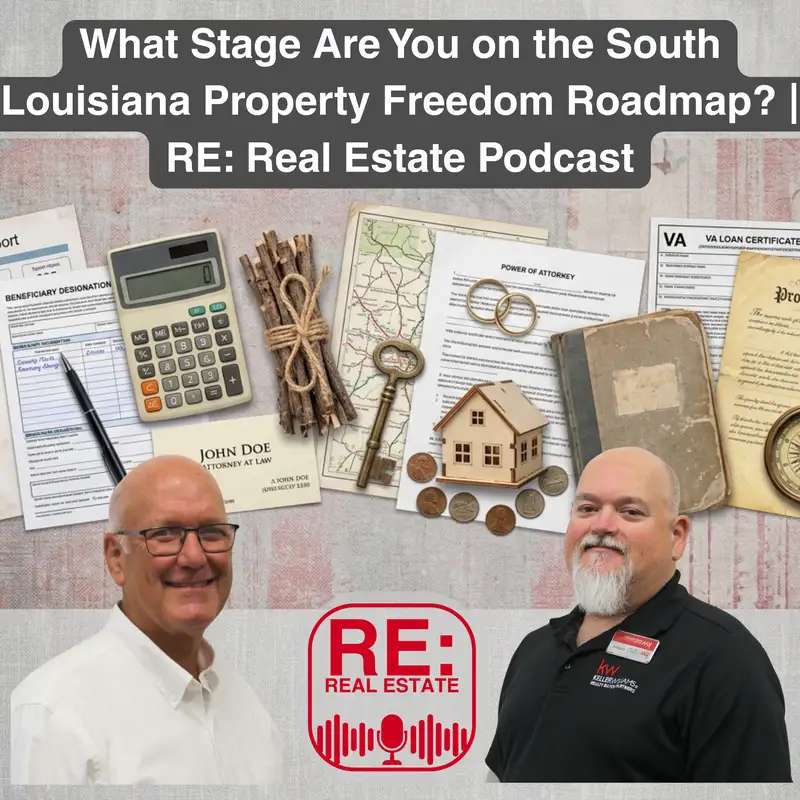
Act 4 opened with protecting and passing on last week. Today closes Act 4 with the Freedom Roadmap that ties it all together. So it's three segments. First through line is what the series was really about. The second is the four stages of financial freedom through property, a roadmap where each listener locates themselves. And third,
your next week and your next chapter, the one action this week and what continued engagement looks like beyond the series. This finale is not a pitch. There's no new products, no new offers, no contact us to work with our team moment. This framework has been the whole gift for 10 weeks.
out the same way. And now for the disclaimer.
Before we go further, nothing in this episode is legal tax, financial or lending advice. This is a synthesis of concepts we've talked over for the last 10 weeks. For your specific situation, the professionals that we've been routing to for 10 weeks are still the right calls. A Louisiana Estate Planning Attorney for succession questions, a CPA for tax questions, a lender for financing questions, a HUD approved housing counselor for buyer education.
and a fee-only certified planner for integrating property into an overall financial strategy. This series was framework. Application is yours and your professionals. All right, Ben, take it away one last time.
Ben Harang (03:32)
Right, let's see if we can wrap this up. Clinton kind of put a bull around it for everybody. In this segment, we're going to talk about the through line. The framework has always been available. The bundle of sticks from episode two has been legal doctrine for hundreds of years. It's not new. It just isn't taught to working families in any structural way.
Clint C. Galliano (04:01)
five engines from episode seven have been running on American real estate for the entire lifetime of every listener. Every homeowner in this region has had those engines running on their house since the day they closed. Most didn't know they had them.
Ben Harang (04:18)
So Louisiana Civil Law from episode three goes back to French colonial law adopted at statehood in 1812. Forced heirship, community property, usufruct of fruct. These have been the rules here for over 200 years. Not obscure, just under explained.
Clint C. Galliano (04:40)
loan programs from episode 6 like FHA have been around since 1934. VA loans have been around since 1944. The USDA rural development loans have been around since 1949. Every single one of them has been available to working families for at least 75 years. The programs aren't new. What's changing is you knowing about them.
Ben Harang (05:06)
So what's actually changed? The world didn't change over the last 10 weeks. You did. What changed is that you now have a framework where you didn't have it before. And framework is what turns disconnected information into personal strategy.
Clint C. Galliano (05:27)
The gap between working families and multi-generational wealth isn't usually income, it's framework. Wealthy families pass the framework down alongside the assets. Working families pass the assets down, but not the framework, and then wonder why the wealth got lost in the next generation. That's not a coincidence.
Ben Harang (05:51)
These 10 episodes don't make anybody an expert, but 10 episodes is enough to make someone framework literate. And framework literacy is what makes the difference between drifting through housing decisions and making them with your eyes wide open. That's not a small thing. That's the entire point of what we've been doing.
Clint C. Galliano (06:21)
So now we're moving on to cover the four stages of financial freedom through property. Stage one is the aware renter. If you're currently renting and you've listened to this series, you're not just a renter anymore. You're an aware renter. You now understand what ownership actually is and what you're not currently accessing. That awareness itself is the beginning. Like G.I. Joe used to say,
knowing's half the battle.
Ben Harang (06:53)
That is. The aware renter phase has one primary task, information gathering with the goal of accessing ownership when it makes sense for you. That means understanding your credit score, understanding what loan program fits your situation, understanding the local market, and understanding what house hacking FHA, VA, and USDA actually make possible.
Clint C. Galliano (07:25)
The typical AWARE renter is 6-24 months away from their first ownership move.
Not because they can't do it faster, some can. But because the framework installed at this stage prevents the mistakes at the transition, and those mistakes are expensive.
Ben Harang (07:44)
So the different episodes
that speak directly to this stage episode one was mindset episode two was a bundle of sticks episode six was the four on ramps to ownership and episode nine Understanding the devise stick before you have anything to devise Protection habits start before wealth arrives
Clint C. Galliano (08:11)
The next stage, the first time owner. If you've bought your first home, whether last month or 10 years ago, you're a first time owner. The framework changes for you. You no longer need to know how to get in. You need to know what to do with what you have.
Ben Harang (08:32)
The first time owner phase is where the five engines from episode seven become personal. You need to see your home as five wealth building mechanisms running simultaneously. Not as a place to sleep. That reframing is the entire mental shift of this stage.
Clint C. Galliano (08:55)
From a practical point of view, this is where you review your beneficiary designations, run your rent avoided calculation, understand the tax implications of your current mortgage,
and start thinking about what your first move and keep decision might look like eventually, even if you're not planning to move for a decade.
Ben Harang (09:17)
So episodes that speak most directly to this stage, episodes three, four, and five, Louisiana property rights, understanding what you actually own. Episode seven, the five engines running on your house right now. And episode nine, protecting what you have.
Clint C. Galliano (09:40)
next stage is the compounding owner. If you own your home and one or more rentals or you're actively planning your first move and keep or investment purchase, you're a compounding owner. This is a stage where the portfolio actually gets built.
Ben Harang (10:00)
The compounding owner phase is where you graduate from thinking about one property to thinking about a small portfolio. That mental shift changes how you evaluate deals, how you use financing, how you structure ownership, and how you think about your time.
Clint C. Galliano (10:21)
Practically, this is where you talk to a lender about DSCR loans, evaluate whether to hire a property manager, think about LLC structures for asset protection, and start planning your next acquisition. Or honestly, evaluate whether more properties is even the right move for you in your situation.
Ben Harang (10:43)
The episodes that speak most directly to this stage, episode six, the loan programs from an investor lens, episode seven, the five engines running on multiple properties simultaneously, episode eight, the four on-ramps and the 20-year story, and episode nine, multi-property real estate planning gets meaningfully more complex than single property.
Clint C. Galliano (11:14)
And the next stage is the legacy builder. If you're 60 or older with property assets,
at any age with aging parent who has property, you're in legacy builder territory.
framework shifts fundamentally from building to protecting to transferring.
Ben Harang (11:36)
The legacy builder phase is where the estate planning conversation from episode nine stops being theoretical and becomes urgent. Every year of delay compounds the risk. Every out-of-date document is a potential family conflict. Every unnamed beneficiary is a bureaucratic mess waiting to happen.
Clint C. Galliano (12:00)
Practically, this is where you'd have the Louisiana Estate Planning Attorney meeting we talked about in episode nine. Not next year, this month. You'd also be thinking about how to communicate the framework to the next generation, so what you built doesn't get lost in the transition. Framework transfer matters as much as the asset transfer.
Ben Harang (12:23)
Alright, episodes that speak most directly to this stage. Episode 2, the Bundle of Sticks, this time from the giver's perspective. Episode 8, portfolio that got built. And episode 9, protecting and passing on. The whole episode was written for you.
Clint C. Galliano (12:46)
Okay, so we've recapped all of that. Now let's talk about what you do next. So your next week and your next chapter. Regardless of your stage, there's one specific action you can take this week that moves you forward. For the aware renter, pull your credit score. Just log in, look at the numbers. 10 minutes, that's the entire task.
Ben Harang (13:14)
For the first time owner, review your beneficiary designations on every retirement account, life insurance policy, and transfer on death brokerage account. 20 minutes total. This is a single lowest cost, highest leverage action in the entire series.
Clint C. Galliano (13:33)
For the compounding owner, run the rent avoided calculation on your primary residence and separately on any rentals you own. Get the number, feel it. That's a compound proof of what you've been doing without necessarily seeing the total.
Ben Harang (13:53)
For the legacy builder, schedule the Louisiana estate planning attorney consultation this week, not this month, not this year. If you don't know where to start, the Louisiana State Bar Association directory is at lsba.org. This is the highest stakes action in the whole series.
Clint C. Galliano (14:17)
So what comes next?
Framework installation is the first act. Framework application is the rest of your life. You'll make dozens of property related decisions over the next 30 years. This series exists so that when those decisions come up, you have a mental structure to evaluate them.
Ben Harang (14:40)
The framework doesn't age. What we walk through will still be true in 20 years. Some specific numbers will change, interest rates, loan limits, tax exemptions. The framework itself doesn't.
The five engines will still be running. The four on ramps will still exist. And the bundle of sticks will still be six.
Clint C. Galliano (15:05)
The series is finite. Your ownership journey isn't. The RE Real Estate Podcast continues past this series with weekly episodes on current real estate topics.
Some episodes will circle back to built-to-own concepts. Some will move on to new material. Subscribe and stay in the conversation.
Ben Harang (15:26)
And share the series. Send it to the family member you'd want to have the framework. Working family wealth transfer is limited by framework transfer more than by asset transfer. If this series gives you something worth having, the highest value action you can take is give it to someone else in your life. That's how framework spreads.
Clint C. Galliano (15:52)
All right, it's homework time.
Ben Harang (15:54)
No, I'm not doing that stuff, Clint.
Clint C. Galliano (15:59)
And you don't have to, Ben.
Ben Harang (16:00)
the
Clint C. Galliano (16:02)
Here's the homework for this week, which is also the last homework we'll assign in this series. First, identify your stage. Are you the aware renter? The first time owner?
the compounding owner or the legacy builder. Just pick the one that fits. If you're between two, pick the one that describes what you're preparing for next and then take the one action from segment three that belongs to your stage. Aware renters pull credit. First time owners review beneficiary designations. Compounding owners run the rent avoided calculation. Legacy builders book the Louisiana Estate Planning Attorney consultation.
That's the first part. The second part is share the series, not the finale, the whole series. And we're going to set it up as a separate playlist on YouTube. Send it to the one person in your life who'd benefit from the framework. a family member, a friend, an adult child, a colleague. Just one. Working family wealth transfer is limited by framework transfer more than by asset transfer.
If this series gave you something worth having, giving it to one other person is how it spreads. That's the whole homework. Identify your stage, take you one action, share the series with one person. 10 weeks of framework installation ends this week, but the framework is portable and the people around you deserve to access it just like you did.
Ben Harang (17:39)
Okay, that's episode 10 of Built to Own, and that closes the whole series. 10 episodes, four acts, one framework. Thank you to everyone who followed along across the last 10 weeks. The RE: Real Estate Podcast continues past this series with weekly episodes on current real estate topics.
same re real estate podcast dot com same youtube channel same wherever you get your podcast but built to own that's a wrap
Clint C. Galliano (18:14)
Ten weeks ago, the goal was simple. Put a framework in front of people who had never been given one. That's done. What you do with it is yours. If you've heard everything in this series and moved from where you were on episode one to something different today, that's the whole thing working. The framework has always been available. Now more people know it. That's the point. Subscribe wherever you get your podcasts, share the series with someone in your life who needs it.
and we'll keep the conversation going on the main show.
Ben Harang (18:49)
Okay, every episode is that RE Real Estate Podcast, audio and YouTube from Ben Harang and Clint Galliano. Thank you for listening.
Clint C. Galliano (19:03)
built to own.
Creators and Guests