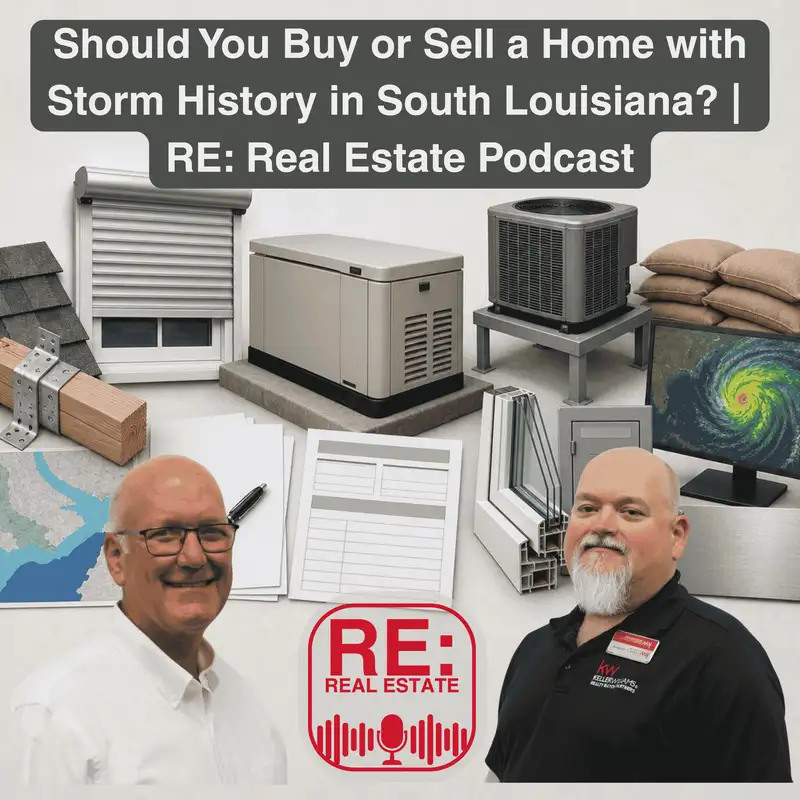
Should You Buy or Sell a Home with Storm History in South Louisiana? | RE: Real Estate Podcast
Clint C. Galliano (00:00)
Every time a storm rolls through South Louisiana, some homeowners are scrambling, and some are sleeping fine. The difference between these two groups almost always comes down to decisions they made long before the storm showed up on the radar. Today we're talking about storm preparedness, what it does to your home's value, and what buyers and sellers in this market need to know before the next one hits. Let's talk about it.
Ben Harang (00:40)
Hello everybody and welcome to another episode of the RE Real Estate Podcast. My name is Ben Harang, and with me as usual is my co host, Clint Galliano. How you doing today, Clint?
Clint C. Galliano (00:53)
I'm doing wonderful, Ben. How you doing?
Ben Harang (00:56)
I'm doing terrific, man. Life is wonderful. Is as hot as it gets in South Louisiana outside right now. we're in a in a little dry spell. we're supposed to get a little rain this weekend, but we could use it. We could use it now. I cut my grass and we haven't had any rain since I cut it last, and I could tell it was not nearly as long as it was the last time I cut it.
So anyway, what what are we talking about today, Clint?
Clint C. Galliano (01:33)
Well, Ben, we're talking about something that every single person in South Louisiana deals with. Storm season. We had a little episode of that last week. But
Ben Harang (01:43)
We did.
Clint C. Galliano (01:44)
we're not just we're not just talking about boarding up windows. We're talking about what storm preparedness actually does to your home's value, what sellers need to disclose and what buyers need to be asking before they sign on a dotted line.
Ben Harang (02:01)
So that's a topic we know a little something about. Let's get into it.
Clint C. Galliano (02:05)
this episode's relevant to every homeowner, buyer and seller in South Louisiana. Storm season's a fact of life for us, and it's pretty much half the year. you know, so we're it's ever present. And it's got real financial implications. So we're not here to scare anybody. We're here to inform. A well prepared home is a more valuable home, and that's good for everybody.
Both buyers and sellers have different stakes in this conversation and we're going to address both of them. So Ben, let's start with the big picture. How much does storm history and storm readiness actually factor into a real estate transaction down here?
Ben Harang (02:50)
Well, outside of flooding clint or documented lack of adequate w adequate repairs after their storm damage, storm history alone does not typically impact the saleability of a home in our market. What matters is the condition of the home today. Buyers and agents are trained to look for evidence of of unresolved damage and insurers will find it if it's there.
Clint C. Galliano (03:20)
That's for sure. So storm repairs keep a home at market value. They're not upgrades. You know, th this also kind of ties in. We've mentioned a couple of times how, well, we need to add twenty thousand dollars to the price of my home
Ben Harang (03:35)
Mm-hmm.
Clint C. Galliano (03:36)
because I just changed the roof. It's like, no,
Ben Harang (03:38)
Yeah, good luck with that.
Clint C. Galliano (03:39)
that's that's that's the baseline. doesn't
Ben Harang (03:42)
Mm-hmm.
Clint C. Galliano (03:42)
add to the value. It's what it should be. What adequate repairs do
Is prevent that discount. the risk is on the other side. Inadequate repairs drag values down. So take
Ben Harang (03:56)
Mm-hmm.
Clint C. Galliano (03:56)
a roof that was patched instead of replaced. Buyers looking at subtracting value for the repair costs and paying more in homeowners insurance because of the compromised roof age and facing a wind deductible that'll likely be right around the cost of replacing that roof, anyways. So you're paying for it one way or another.
Ben Harang (04:17)
No doubt, no doubt. In the insurance angle is everything in South Louisiana. A house with a new roof, hurricane straps, and a favorable wind mitigation report can command significantly lower insurance premiums, and that directly affects buyer affordability, which affects what your house will sell for.
Clint C. Galliano (04:42)
And then there's also the fortified home designation. Now for existing homes, it's a little tougher to get, but your house may have been built with some of the components of a fortified home or fortified roof, and that can be helpful. So the fortified home designation is offered through the Insurance Institute for Business and Home Safety. It has the potential to be a meaningful differentiator in South Louisiana.
And again, fortified roof or fortified home can qualify for meaningful premium discounts on your insurance. And as more buyers become aware of it, that designation will carry more weight. And when it comes time to replace your your roof, if you go with a fortified roof when you replace it, then that's gonna give you that fortified roof discount and it'll be very helpful. And there's also some grants available.
on a first come, first served basis from the state. So if you are replacing your roof, you can get some help in covering that cost. one of the things I learned, I guess it was about a month ago, is that the to get some wind mitigation discounts that if you've got so one of the common things is and that code calls for is the hurricane straps over your rafters.
Ben Harang (06:10)
Mm-hmm.
Clint C. Galliano (06:11)
And what I found out was is that if you if you have straps present, that is the question, not if you have a strap present on every rafter.
Ben Harang (06:20)
Okay.
Clint C. Galliano (06:21)
And when I built my house, the builder put a strap on every other rafter. And
Ben Harang (06:27)
Mm-hmm.
Clint C. Galliano (06:27)
so according to the inspector, I may qualify for some wind mitigation discounts. So I'm definitely looking at spending that $400 or so give or take.
in getting that wind mitigation inspection because if I can knock my insurance down, that will save me money in the long run.
Ben Harang (06:49)
If it if it knocks down what you cost for the what the inspection costs you after the first year you you're saving that every year.
Clint C. Galliano (06:57)
Exactly.
Ben Harang (06:59)
So let's let's talk about about flood history now. flood history matters separately from wind and and storm history. A home that's flooded, especially more than once, carries a stigma and insurance challenges that don't go away easily, regardless of how well it's repaired.
Clint C. Galliano (07:19)
So Ben, have you have you run across a transaction where the home storm history, good or bad, meaningfully changed what it's sold for?
Ben Harang (07:29)
No, unless it's not repaired. Flooding does change it. Storm history does not. If you if you have roof damage, water damage from the top, once it's repaired, you get a a freshened up house. if it floods, you know what I've seen over the years, if if a house floods and then it has new flooring, new paint on the inside, everything's dealt with.
And next door there's a house that did not flood and it needs to be updated. it's got carpet and paneling and older appliances. Those two houses sell for the same price. So once the house once the flooded house is repaired versus the house that did not re did not flood that's not repaired, sell for the same price, essentially. and that's a
That's just an observation over time.
Clint C. Galliano (08:26)
Yeah.
Makes sense.
Ben Harang (08:29)
So Clint, as an investor, how do you evaluate a property that's been through a major storm? What are you looking for?
Clint C. Galliano (08:38)
So the main things are, you know, the to to use a colloquialism, look at the bones. Make sure that structurally the property's sound and evaluate on whether the level of repairs that are needed is worth the investment based on what the market price could be.
But from an investor perspective, you kinda look for those those homes that repaired are worth a lot more than what you can pick it up for in current condition. that one of my rentals in Thibodaux while it didn't have storm damage, it needed updating and had you know, need needed some some repairs. Let's l just leave it at that.
Ben Harang (09:31)
Mm-hmm.
Clint C. Galliano (09:31)
And so
I was able to get that at a significant discount to what its value is now.
Ben Harang (09:38)
Yeah. And I and I tell I tell people all the time, if you don't make the repairs before you sell it, the discount you're gonna have to give usually costs more than it costs to repair it before you sell it.
Clint C. Galliano (09:52)
Yes indeed.
Ben Harang (09:53)
So
the the buyer expects a bigger discount 'cause he has the the problem of dealing with the repairs.
Clint C. Galliano (10:01)
Exactly. It's that convenience factor that that runs that bill up. All right. Next
Ben Harang (10:03)
Mm-hmm. That's right. That's right. So
Clint C. Galliano (10:08)
we're gonna go over what sellers need to know. covering things like disclosure and preparation. So first things first, Louisiana requires sellers to disclose all known defects and storm damage falls squarely in that category.
Trying to conceal previous flood or wind damage isn't just ethically wrong. It can expose a seller to serious legal liability after closing.
Ben Harang (10:41)
And that's a fact. the Louisiana Residential Property Disclosure Form asked specifically about flooding, roof condition, and previous insurance claims. The sellers need to answer these these questions honestly. It's not optional. I get asked all the time, Well, what about so such and such? I said, the way you need to think about it is if i if
it makes you wonder if you should disclose it. It means you should disclose it. if you don't have anything to disclose, the answer's no. If you have to ask, do I need to disclose such and such, the answer is yes.
Clint C. Galliano (11:26)
And smart sellers will get ahead of the game. They'll pull their claims history from their insurer and they'll they'll go find what's on their clue report. That's a comprehensive loss underwriting exchange. And you can pull that anywhere.
Ben Harang (11:44)
Mm-hmm.
Clint C. Galliano (11:44)
And we're gonna have the links in the show notes for that. and ultimately they need to address anything that's going to surface in the inspection anyway.
'Cause surprises kill deals. You know, buyers
Ben Harang (11:58)
That that is true.
Clint C. Galliano (12:01)
buyers will kinda seem like chicken little, but at the same time, they don't want unless they're specifically looking for a deal and willing to put some elbow grease in, they don't wanna have to repair anything.
Ben Harang (12:18)
So the roof's age and condition is the single biggest insurance and value factor for homes in South Louisiana right now. Sellers with roofs over ten or fifteen years old should seriously consider replacing the roof before listing the property for sale, or price it accordingly and be transparent about it.
Clint C. Galliano (12:43)
Yeah, definitely. I always advise, you know, if you're not gonna make the repairs, then we need to adjust that list price to take this into account. So storm shutters, a whole home generator, elevated HVAC equipment, those are genuine selling points in this market. If you have make sure your agent is marketing them. They're not just conveniences.
Their insurance and peace of mind factors that buyers notice.
Ben Harang (13:16)
That's true.
So next up is what buyers need to know. The due diligence before you close.
Before you make an offer, research the property storm in flood history. The FEMA flood map is your starting point, but also ask the seller directly about past claims and request the clue report as part of your due diligence. You want to know what happened to the house before you owned it.
Clint C. Galliano (13:46)
And like I mentioned, that I need to do get a wind mitigation inspection. This is a s this is separate from a standard home inspection and specifically evaluates how well the home is built to resist wind damage. That report can unlock insurance discounts and will tell you a lot about the home's construction quality. Now I that's something that I've never recommended to buyers, but it may be worth the extra.
you know, four hundred dollars or so if you think that it's gonna
Ben Harang (14:18)
Mm-hmm.
Clint C. Galliano (14:19)
gonna get you a discount on your insurance, especially in some of our more southern properties that buyers are looking at because the
Ben Harang (14:29)
Mm.
Clint C. Galliano (14:29)
insurance rates are really up there.
Ben Harang (14:32)
Right. So you also need to ask about the roof, the age, the material, the installer, and whether it was replaced right after a storm or proactively. A roof replaced after a claim should have permits on file. If it doesn't, that's a conversation worth having before you close.
Clint C. Galliano (14:54)
For sure. And now, after the new laws of last year, it has to have been done by a licensed contractor. another thing as a buyer you want to look at is factor your insurance costs into your affordability calculation before you fall in love with the house.
In South Louisiana right now, wind and flood insurance combined can run three to six hundred dollars a month at the low end, and in some cases well over a thousand dollars a month on top of the principal and interest for your note. Run those numbers before you're emotionally committed.
Ben Harang (15:33)
And there's no reason to get do a deep dive into a a house before you know those numbers. investigate whether the house has a generator hookup or transfer switch, storm shutters or impact windows, and elevated mechanicals. These aren't just conveniences. They're indicators of how seriously the previous owner took storm preparedness and they'll matter to your insurer too.
Clint C. Galliano (16:02)
So the insurance reality in South Louisiana right now is that after Hurricane Ida, we had several carriers that exited the Louisiana market and that's not even counting the ones that went bankrupt and just disappeared.
Premium spiked sharply across the board, which if you're already a homeowner, you're well aware of that. if you're not, it's what happened. The good news is that the environment's been improving. Rates have stabilized and in some cases have actually dropped from the post-I to highs. Still not where it was, but it's moving in the right direction.
Ben Harang (16:45)
Right, with that said, it's it's not just a homeowner problem, it's a real estate market problem. Higher insurance costs reduces the buyer's purchasing power. And that affects what sellers can get for their homes. Everybody in the transaction feels it.
Clint C. Galliano (17:06)
Buyers should always get an insurance quote before making an offer. And I was saying it again because it's important
Ben Harang (17:12)
Mm-hmm.
Clint C. Galliano (17:12)
and it it's a prudent strategy to follow. Get it before you make an offer, not after. Surprises at the closing table are avoidable, and insurance costs you didn't budget for can turn an affordable home into an unaffordable one fast. Quick
story related to that.
While it's not exactly like that, we have a I have a listing that was supposed to close last week, but we had a storm that came through the area. And because the closing was delayed for repairs, the insurance quote that the buyer had w expired. And so they had to requote. Well, there was a storm in the Gulf approaching Louisiana, actually making landfall,
Ben Harang (18:02)
Mm-hmm.
Clint C. Galliano (18:02)
and they couldn't bind
insurance on the house. And on a requote, the insurance was three thousand dollars a year higher.
Ben Harang (18:12)
Wow.
Clint C. Galliano (18:13)
Yeah, that's that's a big change.
Ben Harang (18:16)
Yeah.
Clint C. Galliano (18:16)
And so now they're scrambling to find comparable cost insurance that still fits the buyer's budget so that we can close. And the lender's comfort comfortable with, you know
doing that and he he doesn't feel like it's gonna be an issue finding it, but at the same time, we're gonna wind up closing a week later.
Ben Harang (18:39)
Mm-hmm. Because of the storm in a gulf.
Clint C. Galliano (18:42)
Storm in the Gulf.
Ben Harang (18:44)
Yeah,
yeah. Name storm and the Gulf people are scrambling to get closed before it hits. So the wind mitigation report and roof age are the two biggest levers buyers and sellers have to to influence insurance costs. Everything else is mostly geography. If you can control those two things, you're ahead of most other people.
Clint C. Galliano (19:10)
And I always talk to an independent insurance agent who represents multiple carriers, not just one company. The difference in quotes can be significant and you want someone shopping to market for you, not just selling you what they have. And I
Ben Harang (19:24)
Mm-hmm.
Clint C. Galliano (19:24)
also recommend that in addition to that, you get quotes from three to five lenders. I'm I'm sorry, not lenders, that too, but get quotes from three to five insurance agents.
to make sure that you're getting coverage that suits you and your budget.
Ben Harang (19:42)
Yes, absolutely. And if you get if you get multiple quotes you'll have a real good idea where where the premium's gonna land, and whether you're comfortable with it or not, before you really get into the negotiation.
Clint C. Galliano (19:58)
Exactly.
Ben Harang (20:00)
and and if you if you have it just a a tip, if you have the premium before you may be able to use that as a negotiation point to get a better deal. So
Clint C. Galliano (20:14)
That's true.
Ben Harang (20:15)
that's a that's a freebie for you. So I'm
Clint C. Galliano (20:20)
All right. Well guess what time it is?
Ben Harang (20:22)
I'm not doing it, Clint. Not gonna do it.
Clint C. Galliano (20:28)
All right. Your home
Ben Harang (20:28)
I don't do homework.
Clint C. Galliano (20:30)
your homework for this week is to pull your home storm profile. Whether you're a homeowner, a buyer, or a seller, do three things.
First, pull your clue report, and you can get that at LexisNexis.com It's available at no charge and shows your home's insurance claim history for the past seven years. Second, if you don't know your roof's age, find out. Check your closing documents, call your insurer or ask a roofer to take a look.
As far as that goes, the roof age is one of the items listed in the property disclosure that sellers have to fill out. So if you're a buyer looking to buy, you can reference that. Ask your agent for that property disclosure. Third, if you don't have a wind mitigation inspection on file, call a licensed inspector and get one. The insurance savings alone can pay for it within the first year.
Knowledge is your best storm prep.
Ben Harang (21:34)
All right. So Storm Prep isn't just about sandbags and generators. It's about protecting the biggest investment most of us will ever make. If this episode helped you think about your home a little differently, hit like, leave us a comment, subscribe wherever you get your podcast, and share it with a neighbor who could use it. Because down here we're all in this together. You can find every episode and our full YouTube channel.
at re realestatepodcast dot com. That's rerealestate podcast dot com. If you have a question you want us to tackle, hit the ask a question button on the site and we'll see you next time.
Clint C. Galliano (22:19)
All right, Ben. That's another one in the can.
Ben Harang (22:23)
All right, Clint. Enjoyed it, man. Have a good one.
Clint C. Galliano (22:26)
Yeah,
Creators and Guests