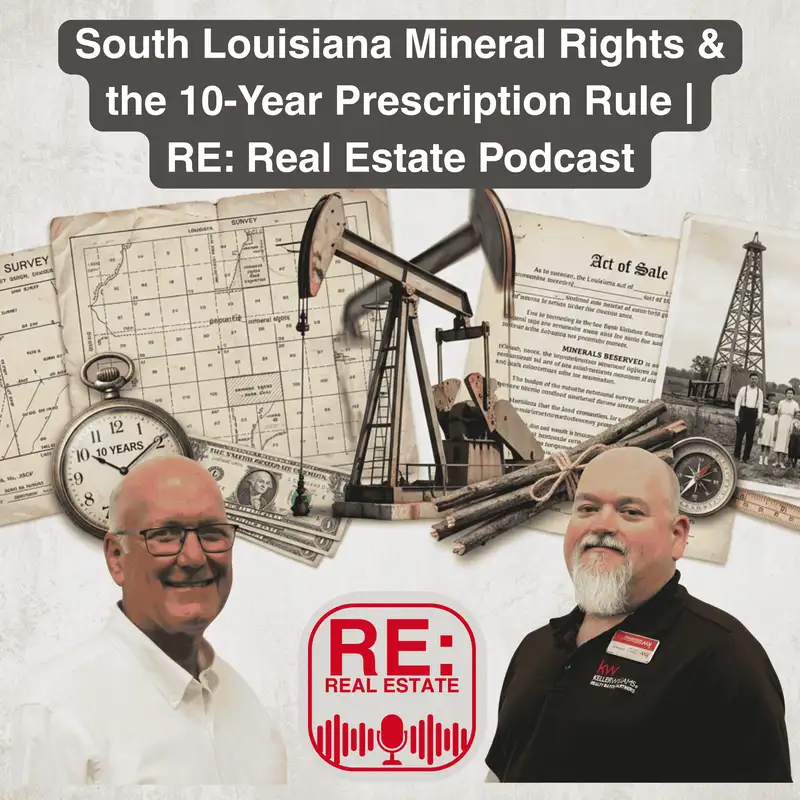
Mineral Rights in South Louisiana: Does the 10-Year Rule Apply to You? | RE: Real Estate Podcast
Clint C. Galliano (00:04.139)
Ahem.
Clint C. Galliano (00:24.872)
In oil and gas country, the family that kept the mineral rights built generational wealth. The family that didn't even know mineral rights existed got a one-time payment while royalties flowed somewhere else for the next 30 years. Today, we make sure you're in the first family. This is Built To Own.
Ben Harang (00:51.032)
Like
Clint C. Galliano (00:53.749)
All right.
Ben Harang (00:54.114)
That was that was probably all awkward and stuff to say built to own. But it sounded good.
Clint C. Galliano (00:59.23)
That wasn't bad. It wasn't bad.
Ben Harang (01:07.597)
All right.
We're ready to get rolling.
Clint C. Galliano (01:12.79)
Let's rock and roll.
Ben Harang (01:16.364)
All right, here we go.
Hello everybody and welcome back to another episode of the RE Real Estate Podcast. My name is Ben Harang, and with me today, as usual, is my co host, Clint Galliano. How you doing today, Clint?
Clint C. Galliano (01:36.214)
I'm doing wonderful, Ben. How are you doing?
Ben Harang (01:39.116)
Man, I'm doing terrific. we got a double header going on today. We did a did a we recorded another podcast this morning, so it's podcast re recording day, I guess. but
Clint C. Galliano (01:52.01)
Yeah, we touched on episode, actually, we're gonna pull some excerpts from what we recorded this morning and add them into what we're recording today. But that episode in its entirety, we're gonna release in a few weeks when we're done with our built-to-own series.
Ben Harang (02:03.413)
Mm-hmm.
Ben Harang (02:11.851)
Yeah. So we're four weeks into our built to own series. Last week we covered the five practical ways Louisiana civil law differs from common law, which is a a discussion all its own. This tea this week we're gonna take one specific stick from the bundle of sticks, the right to profit, and we go deep into mineral rights. Clint, you've been in oil & gas gas data and systems for nearly
Three decades. I'ma follow your lead today, man.
Clint C. Galliano (02:45.575)
Hey, happy to take it on. So first off, I'm going to start with a confession. When I first got into real estate, I assumed that mineral rights were a niche concern. Thinking that it was mainly something for ranch owners in Texas or oil families in Oklahoma or people over at the South Fork Ranch, I'd
did know that there were some inherited family properties that had royalty interests in it, things like that. But I didn't realize that it was on a day-to-day basis that that would be a topic that would come up on whether or not when you're buying or selling a piece of property that you would be concerned about the mineral rights.
So in South Louisiana, it's a common thing. And a lot of times property gets sold while the seller retains the mineral rights. So today we're gonna walk through what mineral rights actually are and how Louisiana handles them differently from everywhere else. And what the average listener needs to know before they ever buy or inherit land here.
Ben Harang (04:10.091)
All right. So mineral rights are part of the bundle of sticks we covered in episode two, specifically a subset of the right to profit. In most American property transactions, this stick stays with the surface. In Louisiana, especially an oil and gas country, it often does not.
Clint C. Galliano (04:31.135)
Today we're going to cover three things. The difference between the surface estate and the mineral estate. And by estate, we're talking about surface rights and mineral rights. We're also going to cover the 10-year rule under the Louisiana Mineral Code that quietly returns prescribed minerals to the surface owner and when that comes into effect. And then the three main types of mineral interests.
royalty, working interests, and overriding royalty.
Ben Harang (05:06.113)
Okay, so in this episode this episode is especially relevant in any property transaction involving land. Farm land, camps, large lots, family inheritances, and rural property of any kind. If you're buying or inheriting land in this region and you're not asking about minerals, you're potentially leaving generational wealth on the table.
Clint C. Galliano (05:31.829)
If you remember back on episode three, we covered prescription as one of Louisiana's five practical legal differences. The 10-year mineral rule is the most consequential application of liberative prescription in everyday Louisiana property life.
Ben Harang (05:51.348)
Okay, before we go any further, nothing in this episode is legal, tax, or financial advice. Mineral rights are highly fact specific, and the difference between two situations that look identical can be tens or hundreds of thousands of dollars in the actual outcome. Every example in this episode is illustrative only. Before you act on anything you hear today.
Consult the Louisiana attorney who handles oil and gas, real estate, or successions. Consult the licensed landman for mineral title work. Consult a CPA for tax implications. We're here to put the framework in front of you. The application is yours and your professionals.
Now that have the legal stuff out the out the way, Clint. let's get rolling on.
Clint C. Galliano (06:49.663)
So you may be wondering, we mentioned the two estates and I kind of give a brief example of what they were. So what really is the difference? So under Louisiana law, property is split into two distinct estates, the surface estate, so that's everything you can see, build on, walk on, grow crops on, and the mineral estate.
So that's everything that lies beneath the surface. Oil, gas, sulfur, salt, and other valuable substances.
Ben Harang (07:27.339)
These estates can be owned by different people. When you buy land in Louisiana, you may receive both estates or you may receive only the surface. Whether you get the minerals depends entirely on what the Act of Sale says and what the previous owners did with the mineral rights.
Clint C. Galliano (07:49.834)
most common way mineral rights get separated from the surface is a previous owner reserves the mineral rights when they sold the property. They sold the surface but kept the minerals. From that moment forward the surface owner and the mineral owner are different parties, potentially forever, potentially across generations.
Ben Harang (08:13.589)
Why would anyone reserve mineral rights? In the nineteen fifties, sixties and seventies, when oil and gas activity was booming in South Louisiana, families who sold farmland or family property frequently reserved the mineral rights as a hedge against future production. Many of those reservations are still active today.
Clint C. Galliano (08:39.273)
So what can a mineral owner do? They can develop or lease the mineral rights. They can contract with an oil and gas operator or operators. Those are the oil and gas companies. They can collect royalties from production. Practically, this means an operator can come on the surface and drill, subject to surface use rules, even if the surface owner doesn't want them there. The surface owner gets the surface impact
the mineral owner gets the royalty checks.
Ben Harang (09:12.863)
Okay. this is the uncomfortable truth for surface owners who didn't know they were buying property without the minerals. It's also the source of the most pres preventable wealth loss in this region. The fix is upstream upstream. Ask before you buy.
Clint C. Galliano (09:42.965)
All right, I'm trying to see if we need to discuss this further. I don't think so. The blue stuff we don't need to talk about. We'll go into the 10-year rule and the three interests.
Ben Harang (09:49.781)
No. Mm-hmm. So you you are you are
Clint C. Galliano (10:00.232)
All right, so next we're gonna cover the 10-year rule and the three interests.
So concept A, the 10-year rule, it's the mineral servitude prescription. When someone reserves the mineral rights separately from the surface in Louisiana, what they've created is technically a mineral servitude under the Louisiana Mineral Code, Title 31. A mineral servitude is subject to a 10-year prescription.
Ben Harang (10:35.103)
In plain English, if the mineral servitude is not used, meaning no production, no good faith drilling operations for ten consecutive years, the servitude generally prescribes the minerals revert back to the surface owner.
Clint C. Galliano (10:54.481)
If there's any production, then that starts the clock over. So if a well is drilled and it produces, the 10-year clock resets and runs again from the date production stops. As long as production continues, the servitude continues indefinitely.
Ben Harang (11:14.359)
So why does this matter for surface owners? If y if you bought land where the minerals were reserved decades ago, but no production has occurred in the last ten years, the minerals may have already reverted to you. You may already own them and not know it.
Clint C. Galliano (11:34.847)
why this matters for mineral owners. If you inherited mineral rights and you've let a decade pass without production, you may have lost them. The rules around what counts as production for prescription purposes are technical and worth a conversation with a land man.
Ben Harang (11:54.968)
So this is not a do-it-yourself analysis. The prescription clock can be complicated by partial production, suspended production, force majeure, and other factors. A landman or oil & Gas attorney is the right person to actually run this analysis on a specific property.
Clint C. Galliano (12:16.949)
All right, next we've got concept B, royalty interest. So in plain English, a royalty interest is the right to receive a share of the income from the oil and gas production without paying any of the costs of drilling or operating the well.
Ben Harang (12:39.423)
It's passive. The royalty owner doesn't make operational decisions, doesn't pay for the equipment, doesn't hire workers, doesn't handle the well. They just collect a percentage of the gross revenue when production happens.
Clint C. Galliano (12:57.013)
Royalties interests are what most Louisiana mineral owners hold. When you hear about a family that gets a check from the well, this is almost always what they have. Typical royalty interests range from 12.5 % to 25 % of production depending on the lease terms negotiated.
Ben Harang (13:19.031)
Concept C is a working interest. In plain English, a working interest is the right to actually develop the minerals, to drill, produce and operate. With it comes the obligation to bear a proportional share of all the costs.
Clint C. Galliano (13:37.439)
Working interests are what oil and gas operators themselves typically hold. A working interests owner makes operational decisions and is on the hook for development costs, but they get a larger share of the production after royalties are paid.
Ben Harang (13:54.21)
Working interests are not what most listeners will encounter. They're mentioned here for completeness, but the typical Louisiana family with mineral rights is dealing with royalty interests, not working interests.
Clint C. Galliano (14:08.947)
And then just, I guess you could say a popular note on working interests. If you've ever watched the TV show Landman, at the end of the second season, they're trading working interests on drilling the wells. And so that's what they're referring to. All right, concept D, overriding royalty interests. Plain English.
An overriding royalty interest is a royalty interest layered on top of an existing lease held by someone who isn't the original mineral owner.
Ben Harang (14:48.427)
As an example, a landman who put a deal together might be paid with a one percent overriding royalty. They didn't own the minerals, they don't pay the drilling costs. They get a small piece of the production for putting the lease together.
Clint C. Galliano (15:07.349)
Why listeners need to know this term? When you read a mineral document and see O-R-R-I or override, it's a layered royalty, not a mistake or a duplication. Now, in our conversation with the land man, this also may be, so not just the land man might get an overriding interest, but a geologist may get the interest or other people involved in planning.
Ben Harang (15:32.909)
Mm-hmm.
Clint C. Galliano (15:37.49)
and executing the well. Depending on from, I know, company I used to work for, they would do deals with oil and gas operators where they would get an overriding interest in some wells to develop fields for providing the services on the exploration and drilling of those jobs.
Ben Harang (16:07.561)
Okay, let's let's talk about an example just to kind of pull it all together. we're gonna take a hypothetical forty acre tract in the Bayou region, two families, same land, different stories.
Clint C. Galliano (16:25.693)
Alright, Family A bought the tract in 1985. In 1990, they sold the surface to Family B, but reserved the minerals, or mineral rights. Standard reservation recorded properly, mineral servitude created.
Ben Harang (16:45.109)
In nineteen ninety five, oil and gas production began on a tract. Family A receives royalty payments, modest at first, maybe a few hundred dollars a month, across thirty years of production, including a multi-year boom period. Those royalty payments add up to a meaningful piece of generational wealth. Conservative estimates in round numbers two hundred to four hundred thousand dollars, varying wildly.
by well productivity and gas prices over time.
Clint C. Galliano (17:19.753)
Family B owns the surface. Family B receives the surface impact compensation when the well is drilled. It's a one-time payment for road access, pad construction, surface damages, modest amount, maybe $5,000 to $15,000, depending on the specifics. Then Family B watches Family A collect royalties for the next three decades, if they ever even know about it.
Ben Harang (17:49.024)
And the the kicker is Family B didn't know about the reservation when they bought it in nineteen ninety. The act of sale referenced it, but the title work was done quickly and nobody walked Family B through what the reservation actually meant. They assumed they were buying the land outright. They weren't. They were buying the surface only.
Clint C. Galliano (18:13.109)
Now consider a variation. What if family A reserved the minerals in 1990, but no production ever occurred? Under the 10-year rule, the mineral servitude would generally prescribe in 2000. The minerals would revert to family B, who may still not know they own them today.
who may still not know they own them today, 25 years later, simply because nobody told them the servitude prescribed.
Ben Harang (18:47.725)
The same land, the same dollars on paper, completely different awareness, different generational outcome. This is why next week we keep zooming in on specific sticks. Water rights, then on ramps to ownership, then the five engines of wealth.
Ben Harang (19:21.857)
go to homework and then clothes.
Clint C. Galliano (19:23.677)
Yep, yep, that was just taking a little bit to get there.
Ben Harang (19:27.085)
Okay. Me too.
You got the homework.
Clint C. Galliano (19:32.821)
All right.
All right, like every episode we've done recently, we've got some homework for you. So the homework this week comes in two parts again, depending on your situation. First, if you're considering buying any property that includes land in Louisiana, whether it's farmland, a camp, a large lot, rural property, anything beyond a typical subdivision lot, before you sign anything,
Ask the seller in writing, what are the, ask the seller in writing, are the minerals included or reserved? Ask the title company to specifically trace mineral ownership in their work. Don't assume the standard title search will catch a 60 year old mineral reservation. Ask them directly to look for it. If the answer concerns you, that's a conversation with a land man.
or an oil and gas attorney before you close. Second, if you already own rural land in South Louisiana, or you likely to inherit some, pull the existing title work. Look for any reservations of minerals, any references to mineral servitudes, any language about oil and gas at all. If you find a reservation that's decades old, the next question is whether production has occurred on or near that tract in the last 10 years.
That's a land man conversation. There may be minerals that have been reverted to you and you don't know. In both cases, the answer is the same. The next step is a Louisiana land man or oil and gas attorney for a professional opinion on your specific facts. Not a national finance show, not a Google search, a licensed professional who handles Louisiana mineral title for a living.
Ben Harang (21:31.147)
All right. That was it got deep, Clint. That's that's episode four of Built to Own. Next week we'll look at water rights, the rules for owning property on a bayou, a navigable waterway, or any frontage that touches water. If you own waterfront property or want to, don't miss it.
Clint C. Galliano (21:35.124)
Yeah.
Clint C. Galliano (21:54.181)
And that's kind of the whole point of this Built to Own series is that we're doing, and I hate the term, but we're doing a deep dive on all of this stuff because it doesn't seem that there's a lot of discussion on this. So we want to bring it all to light. So if this episode puts something in front of you that you hadn't thought of before, share it with at least one person in your family.
Mineral rights are the kind of thing that gets handed down accidentally, not intentionally. And the easiest fix is for one person in the family to know to ask. Subscribe wherever you get your podcasts. Go to rerealestatepodcast.com. You can listen to episodes right there on the website. You can subscribe wherever you get your podcasts. I think I said that already and I'm saying it again. You could also...
whatever your favorite podcast platform is, we've got links for you to subscribe there. We also have our YouTube channel that you can get to from there. So go ahead and subscribe so that next week's episode will land for you automatically.
Ben Harang (23:06.893)
All right. Everything's available on RE Real Estate Podcast dot com, the audio and video versions of it. so I think that's it, Clint. We'll we'll see you next week.
Clint C. Galliano (23:20.181)
Another one in the can, Ben.
Ben Harang (23:21.931)
There it is. Talk to you later.
Clint C. Galliano (23:25.878)
All right, thanks.
Creators and Guests