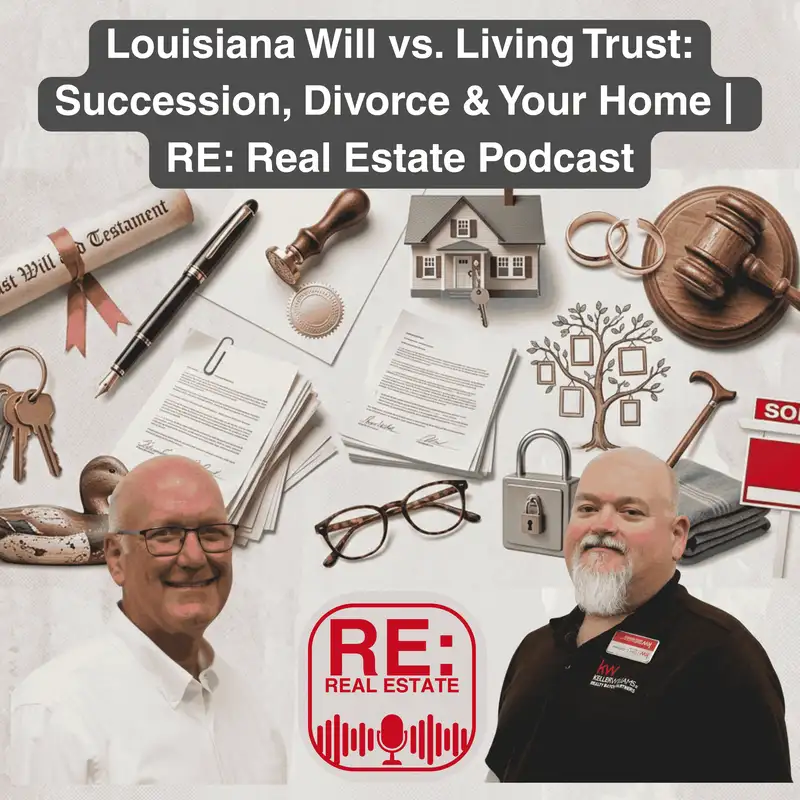
Louisiana Will vs. Living Trust: Succession, Divorce & Your Home | RE: Real Estate Podcast
Clint C. Galliano (00:07.363)
Mark If you own anything of value in Louisiana, you need a will. Not maybe, you need one. Today we're going over exactly why. Let's talk about it.
How was that?
Ben Harang (00:22.19)
Bingo.
Clint C. Galliano (00:25.155)
All right. Let's get into it.
Ben Harang (00:26.766)
All right, here we go.
Ben Harang (00:35.374)
Good afternoon, everybody, and welcome to another episode of the RE Real Estate Podcast. I'm Ben Harang, and with me today, as usual, is my co-host, Clint Galliano. And we also have a special guest with us, local attorney, Mr. Woody Falgoust Welcome, Woody. Welcome, Clint.
Woody (00:55.496)
Thank you. Good to be here.
Ben Harang (00:59.372)
Clint how you doing today, man?
Clint C. Galliano (00:59.501)
Yes, indeed. I'm doing wonderful, Ben. How about you?
Ben Harang (01:04.62)
Doing terrific. it's not raining. It's not blistering hot today. they they keep saying it's four degrees cooler and not quite as humid. I'm not completely sure I agree with that, but that's what they say. but I I'll t yeah, I'll take it. I'll take any little bit we can get.
Clint C. Galliano (01:19.309)
You need a wet bulb.
Ben Harang (01:27.33)
So what what are we gonna talk about today, Clint?
Clint C. Galliano (01:35.309)
Somebody say something, I didn't catch that.
Ben Harang (01:39.81)
Okay. Clint, what are we going talk about today?
Clint C. Galliano (01:44.815)
All right, well, as we mentioned, Woody Falgu's joining us today. He's an attorney and a licensed title insurance producer, and he sees exactly where estate planning and real estate collide. We're covering secessions, planning ahead, and divorce. Three things nobody wants to think about until they have to. All right, Ben, let's get Woody in here.
Ben Harang (02:07.881)
Okay, Woody. Let's start with the basics. when somebody dies in Louisiana without a will, what actually happens to their house?
Woody (02:17.63)
So if they die without a will, that means they died intestate without a testament. So what happens to the house is the house is owned by their estate. And so to sell that house, a succession needs to be opened, and either the heirs need to be placed in possession of the house in the rest of the estate, or it needs to be appointed an administrator, and hopefully the parties can agree, the heirs can agree.
and appoint an independent administrator because an independent administrator has authority to sell a home. If they disagree as to who that independent administrator is going to be, then the court needs to appoint an administrator and actually authorize the sale. So you're already leaving things up to chance a bit because you've died without a will. If you die and you leave a will or you leave a trust, it's much more straightforward, much more efficient.
And of course you, you the testator, can set the rules.
Ben Harang (03:19.511)
So so in a will I can appoint an independent administrator which gives them the authority to transact on the house or the real estate. Okay. Cool.
Woody (03:28.691)
That's correct.
Clint C. Galliano (03:31.324)
that's interesting.
All right. so we talked about a topic of the topic of forced heirship in a few episodes. Why don't you give us a little bit more detail on what forced heirship is in Louisiana, Woody?
Woody (03:51.625)
So forced heirship used to have very few exceptions back in the day. it started under Napoleonic Law, probably before Napoleonic Law. If you're going back to the European nations, definitely before Napoleonic Law, before Napoleon. But what does it mean today? Well, what it means today is a forced heir is a child under the age of twenty-four, so twenty-three or younger, or a child who has a
condition that renders them incapable of caring for their person or their estate. Now that second definition is not super precise, but basically if you have a child with a physical or mental disability that's so severe that they can't take care of him themselves, well then in that case they're they're forced airs.
Ben Harang (04:44.703)
Okay. let's break here for a second, Clint. I'm getting a little static. I don't know if you're hearing it. what do we find that if we have multiple windows open on a computer, the resources it uses can cause a problem. so if you can close whatever you're using that's not whatever you have open that's not ha doesn't have anything to do with the stream. But
Woody (05:02.408)
You want me to close some of these?
Clint C. Galliano (05:11.19)
It's not the recording window.
Woody (05:13.734)
That's great because man, I live with Windows open all over the place. And some of them I need to close anyway, right? Well let's see, and then I can go down. That was on my I've got a brief that's due Friday and I I just had stuff open all over the place, video players, Word documents, the web, Westlaw, PDFs, Internet, email.
Ben Harang (05:17.237)
Mm. Right.
Clint C. Galliano (05:17.902)
Yeah.
Clint C. Galliano (05:42.142)
Wow.
Ben Harang (05:42.732)
Yeah.
Woody (05:43.912)
So I'm I'm a lot cleaner now. I don't know if it's making a difference.
Ben Harang (05:47.542)
Okay. I think it is. I think it is. All right. So we're gonna pick up where we where we left off. All right, Woody, so set a succession never got filed and now we have the house for sale. What does it actually look like when it shows up as a title prop?
Woody (06:08.935)
So we find out that the record owner, the assessed owner, is actually a deceased person. So that means a succession has to be some form of succession has to be performed. And when I'm saying some form, we could just open the succession and like I said, if the heirs agree on an independent administrator, well that individual can act for the estate and sell the property. if they do not
Ben Harang (06:36.013)
Mm-hmm.
Woody (06:38.119)
Well, we need to go all the way to judgment and put the heirs in possession of this piece of real estate, or sometimes they won't even agree to do that. This is the minority of cases, but it happens. You have to go to court, have the court appoint an administrator and have the court approve the purchase or the sale of the property, rather, you know, what the what it's gonna sell for and all that other good stuff.
So what we're hoping to of course is not do that, is do take the simple route, but those are the three options.
Ben Harang (07:03.915)
I
Ben Harang (07:09.877)
Right, let's just this brings up something and this is where the wheels come off for me sometimes, when I don't follow the script. if let's say we go through the succession, they they have the judgment of possession and you have five heirs, and four of want to sell the property and one wants to keep mom and daddy's house because they sentimentally attached or emotionally attached.
A lot of people think with a majority rules that the one that wants to keep it is out of luck, they have to sell it. And that's not the case, is
Woody (07:48.37)
No, majority does not rule when it comes to co owners or when it comes to heirs if a succession is under an administration. So you really don't want it to go to judgment if you know that's gonna be the case. If you know that one of the heirs is gonna refuse to sell, then you want to try and force a sale while the succession is still under an administration. And we have done that before, and it's similar to when they're all in possession.
Ben Harang (08:00.621)
Mm.
Woody (08:18.129)
But it's a little bit different. It's just another method of forcing a sale. The law is gonna sell the property. The law says you're gonna sell the property. you don't you don't get to stay co-owners forever. That's not an option. If you have one co-owner, whether it's a succession heir or whether this is, you know, long after any succession was completed, or it's four people who brought bought property together. The law does not force.
Ben Harang (08:26.167)
Yeah.
Ben Harang (08:33.175)
Mm-hmm.
Ben Harang (08:44.631)
Mm-hmm.
Woody (08:46.885)
you to become a co owner with anyone.
Ben Harang (08:51.991)
Got it.
Clint C. Galliano (08:56.63)
All right. So a way to get around running into these problems is to prepare your affairs in advance. So just flip it around. If somebody wants to get ahead of it, what's their real options? You know, is it a will? Is it a trust? Is there something else to to help make sure that your wishes get followed when you pass away?
Woody (09:22.513)
Well, if you're going to be deceased, then there really are only two main options if you want to control it. One is a will and one is a living trust. Now, the will. The will allows you to make up the rules for how your estate's going to be distributed and who's going to be your independent executor and you know other provisions that you want to insert in your will. But to enforce a will when it comes to real estate, you're going to need a succession.
Right, you will need to open up a probate in court. You will need to actually file it into the probate records. A judge will be assigned to it, and a judge will have to sign off on whatever relief it is that you're requesting. That's if you have a will only and not a living trust. If you have a living trust, it's like we have a fourth person on this call right now. Right now we've got three.
Natural people, three, three human beings, right? We all have our own legal rights. If we created, let's say, the Joseph Doe Revocable Living Trust or Irrevocable Living Trust, we have a fourth juridical person, a fourth legal person, a juridical person, right? And so the idea is you're taking that piece of real estate, let's keep it simple. This is the family home at 111 Boudreaux Lane, right?
You're moving that family home into the living trust, and now the living trust owns it. You may be the trustee, you know, Mr. and Mrs. Mr. and Mrs. Blow may be the trustee, or Doe may be the trustee, right? But the trust is the actual owner. So when the trustees die, or one of the trustees dies, the other trustee can sell, or when both trustees die, the successive trustee can sell the property.
No succession, no court proceeding. You just sell it right from the trust.
Ben Harang (11:24.855)
Okay. Just a a follow up on that. When people started doing trusts early on, the they were losing their homestead exemption for property s taxes because the trust owned it and the individual did not own it. is that still the case or did have they recognized that the living trust can own it and still get the homestead exemption?
Woody (11:47.175)
Get him.
It it's not. And that was one reason I didn't I didn't always particularly care for a living trust. That's changed dramatically. Now it's a huge part of what we do. But for a while we were having the reverse people had placed their homes in living trusts and they were coming in our office. We hadn't done the trust, but they were coming in our office to reverse it so they could get the homestead exemption. Well the constitution changed. Now if you have a revocable trust and you are the trustees.
In other words, the the owner, the prior owner of the house, just let's say Mr. and Mrs. John Smith, they transfer, they transfer the house into their revocable living trust. They remain the trustees, they get the homestead exemption. If it's an irrevocable trust, it's a little different. In that case, you have to, if you transfer the property into an irrevocable trust, and typically that means you're not the trustee, your child is or someone else is.
You have to reserve a usufruct. And then if you reserve a usufruct for life, then you still get the homestead exemption. But that's the extra step you have to take if it's an irrevocable trust.
Ben Harang (13:01.005)
Okay. But either way you can still get the homestead exemption. Thank you.
Clint C. Galliano (13:02.382)
Okay.
Woody (13:04.87)
Yes.
Clint C. Galliano (13:06.604)
Okay, and that actually answers the question I had on what was the difference between a revocable and a irrevocable trust.
Woody (13:13.969)
Well, that's that's one of the differences. there are there are multiple differences. The number one difference being you can't revoke an irrevocable trust, thus the name, whereas you can revoke and kill a revocable trust if you want to, right? The other main difference is well, there are a few. An irrevocable trust has its own tax ID and is taxed at a different rate. Now you'd have to have quite a bit of investments in there for that to be significant, but
It is taxed at another rate, at a higher rate. An irrevocable trust is also used for nursing home Medicaid planning. So if I transfer my house into an irrevocable trust, if I transfer my accounts into an irrevocable trust, the idea is I'm transferring it to another entity that isn't me, right? Because I'm not the trustee. My daughter's the trustee, my brother's a trustee, whatever it is, right? So in that case,
If five years pass before I go into the nursing home, those assets that have made it in the trust are shielded and protected and they become non countable assets. So that's the other main difference. There are others, but those are the those are the biggest differences.
Ben Harang (14:28.541)
I do have a another question about that. So let's say it happens three years. What happens for the first two years, I guess? I don't I don't know how how how is it counted if you if you don't meet the whole five years? Is it an all or nothing kind of thing?
Woody (14:48.221)
If you don't meet the whole five years, you're stuck. It's still a countable asset. Everything inside that irrevocable trust is countable. And that's where it gets a little tricky because a house, if it's below, and I I Ben and Clint, I don't remember the threshold, but it's if it's below 700 something thousand in value, a house is not a countable asset if it's in your name. If it's in your name. So depending on the language of that trust, certainly in a in an in a revocable trust.
You could reverse it and put it back in your name. So the house is exempt as long as you're alive. Now when you die, it is subject to a state recovery. Medicaid can get the money back they paid the nursing home from from the house. they don't do it often. I've never even seen it happen to me and my clients. We got one weighed for Medicaid late wane waived lean weighed, excuse me, yesterday. but it could happen. And certainly if the house is valuable enough.
Ben Harang (15:28.726)
Mm-hmm.
Woody (15:46.553)
Medicaid stands to collect something. It's just doesn't happen that frequently.
Ben Harang (15:52.397)
Okay. Thank you.
All right. you up, Clint.
Clint C. Galliano (15:56.375)
Yeah.
Yep. All right, so
When you you know, obviously when you do a trust, you have a plan in place and everything, but say somebody did a a trust ten years ago or even a will ten years ago. What are the life events that somebody should consider revisiting and maybe updating that will or trust? You know, what what what are the situations that change how you may want to distribute stuff?
Woody (16:32.507)
That's a great question and because things do change. Sometimes nothing changes. I mean I probated a will before from the late seventies and there really wasn't an appreciable difference between then and what what the testator ended up I guess wanting to do at the end. but that's that's odd, right? So what could change? Well, someone could die.
So we do try to make contingencies, for instance, God forbid one of your children were to pass away before you, no one wants that. But we try to set up trust in the name of the of the minor children of that child, for instance, so we don't have to make a change if that child dies. But sometimes it does necessitate a change. What I see the most often is people, if it's a trust, want to change the trustee, the successive trustee, or if it's a will, they want to change the executive.
I see that if it's a minor's trust, they want to change the trustee. sometimes, let's face it, children become estranged from their parents, and we do get parents coming in in both directions. they decide they want to disinherit or diminish the inheritance of a child, or sometimes they reconcile and they want to add the child back in or make the child an equal heir again. I've had
Children who are perfectly normal get in a horrible accident and suddenly they're they're basically what I mentioned earlier are forced heir. They are incapable of taking care of themselves. So you you so they're suddenly they're on, let's say, Social Security benefits, Medicaid, Medicare, something like that prematurely, and we don't want an inheritance to diminish or take away those benefits. So we'll set up a special needs trust.
So many things can happen. Sometimes the children move away. They don't live locally on the buy right. So so the parents will say, I don't want them to have to deal with this. I want them to have to sell the property. I don't want them to make a decision. So can we can we make the sale and the will or the trust? Can we can we say they have to sell the house within a year or six months? I mean all Clint, you name it.
Woody (18:54.119)
Things come up, that's why I tell people at a minimum, revisit your needs every five years. That means you have to come into an attorney's office and make an appointment, but you want to go through the mental exercise of revisiting.
Ben Harang (19:05.709)
Mm.
Clint C. Galliano (19:07.214)
Right, yeah. Okay. Good deal. Hey Ben, how about we we get into divorce and and what that does with the assets that are either in a will or in a trust.
Ben Harang (19:09.237)
Okay. Well, let's
Ben Harang (19:21.805)
I'm gonna let would he take it from there?
Woody (19:24.605)
So there's a couple of different scenarios. There's the divorce scenario you you presented in the beginning of the cast, and there's what you just said. It used to be the law, and this was a harsh law back when I was in law school, the law was if husband and wife are still married, but but pending divorce, I mean, in other words, there's been a divorce that's been filed or or they're already divorced, right? There's been a judgment of divorce.
If if the husband didn't change his will, he died unexpectedly, and the wife was in the will, she still inherited. There is a special provision now in the civil code that says, nope, that's void. That provision is void unless it was something the husband insisted. I've had men come in here or women come in here for that matter. one one case I'm thinking of in particular, he said, Look, I want to leave something to my ex-wife.
My my new wife might not like that, but my ex-wife, you know, heck she raised my kids and I still love her. So that's that's a provision where the man intended, you know, with both eyes open to do that. But if you get caught and you get divorced and then the wife's still in the will, well the new law says it it doesn't count. Now, you also asked about earlier what happens when there's a piece of real estate being sold and the couple is going through a divorce.
Ben Harang (20:24.077)
Mm.
Woody (20:48.515)
I mean, is that something y'all want to talk about now?
Ben Harang (20:50.881)
Yes.
Woody (20:52.263)
So if this is co-owned real estate or community property real estate, and we don't have a community property settlement. If we have a community property settlement, it's pretty easy. Whoever gets it in the community property sells it. But in this case, there's been a divorce filed, but no one has it yet. Well, both husband and wife have to sign any sale, and then they have to agree, at least in my office, on a disbursement, or I'm putting both names on the check. Because what'll happen sometimes is they'll have some split going on.
Ben Harang (21:02.807)
Mm-hmm.
Ben Harang (21:18.262)
Mm-hmm.
Woody (21:22.449)
Right? But they haven't, they haven't the, you know, it's not it's not really, well, it's not been judicial yet. So I'll do that. I'll write them separate checks as long as they sign something. And I want to say me, the closing attorney, whoever the closing attorney is, right? if they have attorneys, obviously we want to talk to their attorneys and make sure everything's okay. I've seen some nasty situations there where there was a judgment of community property.
Clint C. Galliano (21:40.526)
All right.
Ben Harang (21:49.965)
Mm-hmm.
Woody (21:52.318)
a settlement in place or there was a final divorce settlement and s one spouse holds out. They both have to sign still, but they'll hold out because I'm not signing that because he didn't give me this. So he didn't give me that. In one case it was the guy was owed a bunch of duck decoys and he wouldn't sign, right? Even though even though he was supposed to sign 'cause his wife got the property. you know, you get
Ben Harang (22:15.797)
Mm-hmm.
Woody (22:22.919)
I mean, I I had I had one woman one time who this is years ago, I mean, her husband was desperate to sell this property because he needed to buy another house in another city. but he hadn't done quite everything she wanted him to do. And she basically told me the day before the day off, she says, and and you know, I'm not gonna say exactly what she told me, it's not fit.
It's not fit for the air even though podcasts podcasts they they they drop F bombs and say all kind of things now, right? Th these comedians, they say whatever they want. Well in this case, basically she said to use a cliche, I have him over a barrel. That's not what she said. And so he had to he he needed he needed the money. So he did whatever it was she wanted, even though he didn't have to, and that was that. Now the more the more difficult question for people is
Ben Harang (22:51.551)
Ha ha
Clint C. Galliano (22:58.52)
Yeah.
Ben Harang (23:06.185)
huh.
Woody (23:20.827)
Okay, I'm going through a divorce and I've filed. We filed a divorce, but we don't have community property settled. We don't have the community property terminated and I want to buy a house. What happens? So first thing that I tell people, because we don't do divorce work anymore, Cassie, my law partner used to do a ton of it. I did some of it. we don't do it anymore, but of course we we remember.
So, what you want to do if that's your situation is you want to terminate the community as soon as possible. And you got to ask the court for that relief. Why? Because the divorce could drag on. You don't know how long this thing's going to drag on, you know? So go ahead and get the community property terminated as soon as possible so you can buy something and not have it be presumed community. You can buy something in your name like a house and have it be your house. But if you don't have that done,
If you don't have a final divorce or you don't have community property terminated, then what we're gonna insist on for your protection, meaning the buyer, is that your soon-to-be ex-spouse signs an acknowledgement that this house you're buying is your separate property. Now, I've had mortgage companies and banks tell me, well, they don't need to do that, because that civil code article protects our interests. It does. It protects the mortgagee's interest in a loan.
But what it doesn't do is protect the buyer's interest. So the last thing you want is to be fighting with your spouse over a house that she's claiming is hers and and really isn't, right? So anyway, that's how that works.
Ben Harang (24:50.177)
Yeah.
Ben Harang (25:01.085)
Mm-hmm. Okay. one one more question and then we're gonna wrap it up. power of attorney. When does a a seller actually need one and and what makes it valid in Louisiana for a closing?
Woody (25:15.879)
Ben, that last part is a great is a great question because the title insurance underwriters out there believe that a power of attorney has to be in Louisiana form, which means it has to be an authentic act. So if if let's say the seller lives now in the state of Vermont and they're giving power of attorney to their realtor Ben Orang or Clint Galliano to sell the house, and they
They take that document that the Louisiana closing attorney prepares and they have it notarized, but not witnessed by two neutral witnesses in addition to the notary. It's an improper form because it's not an authentic act. So we need to send it back, and this happens a lot. We need to send it, even though we'll we'll spell out in the email exactly what it needs, and we'll call them. In other words, sometimes the notary was act also as a witness. So we'll have to say.
Ben Harang (26:06.477)
Mm.
Ben Harang (26:12.93)
Yeah.
Woody (26:13.841)
The notary cannot be a witness. I've seen the party act as a witness. You know, the seller acted as his own witness. The seller cannot be a witness. This is all spelled out, and they still do it wrong. So it has to be in valid Louisiana farm, and it has to authorize the agent, the mandatory, if you want to call it, or the power of attorney, that individual has to be able to authorized to sell or buy real estate, but particularly sell real estate. That's normally when it comes into play.
Ben Harang (26:18.039)
Ha ha.
Ben Harang (26:23.661)
Uh-huh.
Ben Harang (26:44.781)
Okay. All right. I think we took up enough of your time today, Woody. We appreciate it. Clint's about to give me some homework that I refuse to do.
Clint C. Galliano (26:55.572)
Yeah.
Woody (26:56.251)
Glad he's not giving me homework.
Clint C. Galliano (27:00.77)
Yeah, that's all right. Well it it it may drive homework you away.
Woody (27:04.941)
now that hey, we we do like homework, that kind of homework. That's right.
Ben Harang (27:05.268)
Yeah, it may. It may.
Clint C. Galliano (27:09.174)
Yep. All right. Well, as has been said, it's homework time.
Ben Harang (27:14.643)
I'm not doing it, Clint. Nope, nope. You can you can't make me.
Clint C. Galliano (27:20.27)
All right, if you don't have a will or you haven't looked at it since before a marriage or a move, make that call this week. and to plug Woody here, you can reach out to Woody's office for the estate side. And anything touching a house you can reach out to me or Ben, we'd be more than happy to help you.
And we're gonna have all of our contact info, including Woody's, in the show notes. So you can go there, find it, and reach out to us.
Ben Harang (27:57.387)
All right. So that's about it. if you like the video, if you got some value out of it, like, share. show it to your mama and them, show it to anybody. Share it with whoever may be interested in in buying and selling real estate. if it's real estate related, Clint or I can help you if you need an attorney, Woody can certainly help. you can you can subscribe wherever you get this podcast, wherever you get your podcast from.
You can find the audio and the video of the podcast, if you if you don't mind looking at two guys with faces for radio on rerealestate podcast dot com. That's rerealestatepodcast.com. You can find the history, the playlist, you can find everything we've done over the last hundred and one episodes. So we've been doing this a while and we actually can still make mistakes doing it.
So all right. Woody, thanks. we appreciate your time. and we'll we'll see you at a closing.
Woody (29:03.985)
Thank you, Ben and Clint. I enjoyed it. Good luck to you.
Ben Harang (29:08.001)
Have a good one. Thanks.
Clint C. Galliano (29:09.326)
Thank you, man. Appreciate it.
Ben Harang (29:12.14)
Hi, Clint.
Creators and Guests