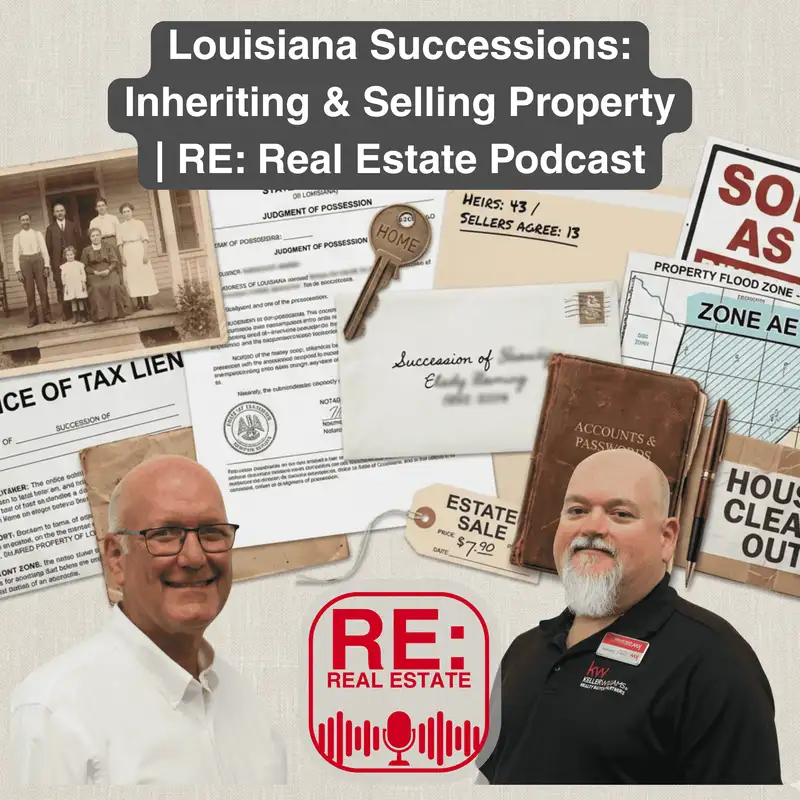
Louisiana Successions: Inheriting & Selling Property | RE: Real Estate Podcast
Clint C. Galliano, REALTOR® (00:00)
Somebody you love passes away and they leave you the house. Maybe it's the house you grew up in. Maybe it's a camp on the bayou that's been in the family for generations. It sounds like a gift, and it is. But it can turn into one of the most complicated real estate transactions you'll ever be involved in. Today we're talking about what actually happens when you inherit property and want to sell it in Louisiana. Let's talk about
Ben Harang (00:39)
Hello everybody and welcome to another episode of the RE Real Estate Podcast. My name is Ben Harang and with me is my cohost, Clint Galliano. Clint, how are doing today?
Clint C. Galliano, REALTOR® (00:52)
I'm doing wonderful, Ben. How you doing?
Ben Harang (00:54)
And I'm doing terrific. I had a little cold snap the last couple of days. Got a little pep in my step. It's good. It's
Clint C. Galliano, REALTOR® (00:58)
It was so nice.
Ben Harang (01:01)
What are we talking about today, Clint?
Clint C. Galliano, REALTOR® (01:04)
All right, so today we're talking about inheriting property and what's involved if you want to sell it in Louisiana. So this episode isn't just for people dealing with an inheritance right now. It's for anyone who may inherit property someday or whose parents or grandparents own a home, so almost everyone. It's also valuable for buyers.
Ben Harang (01:16)
Mm-hmm.
Clint C. Galliano, REALTOR® (01:30)
Inherited properties show up on the market regularly and there are unique quirks that buyers should understand if they're going to be purchasing something like that. And just to reassure you, it's not a law lecture because we're not attorneys, but we've both sat through enough of these at the closing table to know what people wish they'd known sooner.
Ben Harang (01:42)
No.
Right. And the idea of, if there's four of them and somebody, one of them wants to sell it, they don't understand why they can't. So we're to kind of talk about things like that. So we're going to get into it. Louisiana is a little different than everybody else. We do what we call a succession rather than probate, which is what they do in other states. It still goes through the courts, but it...
It's handled differently.
Clint C. Galliano, REALTOR® (02:13)
All right.
So in Louisiana, when someone dies, their heirs may automatically become co-owners of the property. But that doesn't mean that they can just sell it without going through proper legal steps. And depending on if there's a surviving spouse or something, there's all kind of other property divisions, unless something else is set up.
Ben Harang (02:36)
there's really two different types of successions. One is relatively simple. If the values are, I think if the values are below $125,000, you can do it basically administratively. If it's above that or a...
or a typical succession or a judicial succession, it needs to go through the court system and have a judge sign off on it. So, just depends on the value.
Clint C. Galliano, REALTOR® (03:03)
Yeah, and I believe that
with small successions or simple succession, that can be done by a notary. ⁓ But if there's, like you said, if there's anything that's more complicated, then that needs to be handled by an attorney, a family law attorney.
Ben Harang (03:12)
Mm-hmm.
Yeah. And, ⁓
just, said something about a notary being, being a non-attorney notary for the last 43 years. I don't do a whole lot of real estate stuff. I'll notarize a signature and a sale, but that's it. some notaries will do small successions and do some cash sales. and those in, invariably when an attorney gets ahold of them, they'll find a problem.
with them. that's just some advice about make sure whoever you go to to handle the succession is competent to do what you want them to do.
Yeah, it's not a do it. It's not a do it yourself kind of thing. Clint, make, make sure you get, get some help and get it done. Right. It'll pay off in spades down the road.
Because if you don't get all the heirs if there's four heirs and three of them in a succession, nothing's going to happen until that fourth one gets included.
Clint C. Galliano, REALTOR® (04:25)
Yep. All right. Well, a notarial act of possession or a judgment of possession, obviously coming from a judge, is typically required before property can be transferred or sold. This document formally recognizes the heirs and may or may not say who gets what. Typically, if it's an intestate secession, which means there's no will,
Ben Harang (04:26)
So.
Clint C. Galliano, REALTOR® (04:50)
then that document will likely just split everything evenly amongst the heirs. If there is a will, then it will likely follow the will.
Ben Harang (04:50)
Mm-hmm.
Right. Right. And people will talk about a will. Well, I don't want to sit down and do a will right now. I'm not going to die anytime soon. I have time. Well, if you don't have a will and you do die, you have a will. It's just that the state decides what is going to happen to your possessions and you don't have a say so in it anymore. So advice is to do a will so it can at least for the most part, go where you want it to go.
whatever, whatever pennies you may have. and get a, get an attorney. talked briefly about notaries and I'm not poking at non-no non-attorney notaries. but we didn't go to law school. We took a test and we essentially notarize, signatures while notaries in Louisiana have, can do 98 % of what attorneys can do.
it's best not to stretch the limits, just get, get a succession attorney to do a succession when a loved one passes away.
Clint C. Galliano, REALTOR® (06:01)
and don't wait years and years and years and we'll likely touch on that shortly. kicking off with talking points, Ben, why don't you on the multi-heir problem.
Ben Harang (06:06)
Yeah, yeah.
Okay. So our next segment is going to be what we're calling the multi-heir problem. In Louisiana, it's not uncommon for multiple people to inherit property when someone passes away. It's referred to as an undivided interest. And if you own an undivided interest, you have the right to use that property for whatever you want to use it for.
You have no right to sell that property if you decide to sell it. The only way it can be sold is if a hundred percent of the heirs agree to sell it. I'm, I just finished working on one that had in excess of 42 or 43 heirs, in different forms of ownership, actually at 13 sellers. And that was interesting just to get 13 sellers on the same page to agree to something.
Clint C. Galliano, REALTOR® (07:06)
I am.
Ben Harang (07:07)
so it does happen and this is property that's been on a family for generations and, the family, some of the, some of the family members have never met each other, but they owned the property together. So it's yeah. Yeah. So, just cause you inherit a piece of a property doesn't mean you can sell it. If you're the only heir, you can do what you want with it after you get a judgment of possession.
Clint C. Galliano, REALTOR® (07:22)
I can see that.
another issue you run into in multi-heir properties is if one or more of the heirs have liens against them. If any heir has outstanding judgments, tax liens, child support liens, or other debts, those liens can attach to their fractional interests in the property. It will have to be satisfied at or before closing. A title search will surface these, but the earlier you know, the better.
So I'm going to inject a little story here. And this was before I knew about all of this. sellers and the buyers. So I was acting as a dual agent on a transaction where there were heirs that had all types of liens against them.
the closing attorney paid out the liens prior or basically redid the closing disclosure to pay out the liens or pay off the liens prior to splitting the proceeds. And they did it by hand at the closing table. And then that actually became an issue later.
Ben Harang (08:38)
no.
Clint C. Galliano, REALTOR® (08:47)
while the family was attempting to complete the secession. But it was discovered that that was the incorrect way to do it, that the only part that was being allowed to repay the liens was the interest of the person with the liens. So that means that the amount that they were supposed to get, that's the maximum that can be paid out towards or onto those liens.
Ben Harang (08:56)
Mm-hmm.
Mm-hmm.
Right.
Clint C. Galliano, REALTOR® (09:13)
and
that it does not diminish each of the other person's proceeds or share of the proceeds.
Ben Harang (09:20)
Right. Now, if the proceeds are not enough, if there's four of them and 25 % of the proceeds is not enough to satisfy the liens and the lien holder does not sign the release, then the property cannot sell. So you need to figure all that out before you get to the closing table. As you found out.
Clint C. Galliano, REALTOR® (09:38)
And
that may have been the deciding thing because that apparently was something that I guess the title company found it at the last minute. And that might have been the case that their share of the proceeds was not enough to close out the lien. And so that's why the rest of it was paid out from the other heir's share. ⁓
Ben Harang (09:50)
Mm-hmm.
Mm-hmm.
Well, I have seen a succession held open for in excess of 20 years because one heir had had judgments and it had done the judgment of possessions the property would have never sold and We ended up selling it the the the estate got the money and then whatever they did with it after that it was up to them
So there's all kinds of things to be aware of with inherited property. And once you get the judgment of possession, you own it just like you bought it. Whatever percentage of your undivided interest is.
Clint C. Galliano, REALTOR® (10:36)
And family dynamics are the hardest part. And like you mentioned earlier, if one sibling wants to sell or one wants to keep it or third one is out of state and not responding, then everybody gets caught in the middle. So the more time passes with unresolved secessions, it gets more complicated. That's how you wind up with 13 sellers and what, 43 heirs?
Ben Harang (10:51)
Mm-hmm.
No, no doubt, no doubt. And then while all this is going on, two of the sellers were in ⁓ nursing homes and one of them passed away. We opened this, the succession open and about a month before we were supposed to close, they finished the succession and his widow got possession of the property and it had to start the...
the abstract again to include her in it when she was not in it initially. So it just, it's a never ending cycle if you don't take care of it soon. People get older and die. And sometimes I think people die just to poke fun at you when they choose the time to die. I have a good friend of mine that died on my birthday and I think she picked that day just to make sure I never forget her.
Clint C. Galliano, REALTOR® (11:55)
There you go. Well, and so we talked about these complications on some previous episodes. Not only does it add to the list of errors when you don't do a succession and the previous.
undivided interest owner doesn't do a secession. And so you've got a string of secessions. They all need to be completed in order to settle the estates. And that's estates with an S. But then sometimes there are situations where errors pop up because of not following procedure and filing paperwork. Like I talked about a listing I had where
Ben Harang (12:20)
Mm-hmm.
Mm-hmm.
Clint C. Galliano, REALTOR® (12:39)
The husband and wife owned the property. The husband quit-claimed his interest in the property to the ex-wife, except he did it out of state using their procedures, which is not the same procedure as in Louisiana. And so the wife, not knowing any better, took that quit-claim deed and filed it with the parish. And so...
Ben Harang (12:57)
Mm-hmm.
Clint C. Galliano, REALTOR® (13:07)
At the time, she was married to husband number two.
Ben Harang (13:11)
and
Clint C. Galliano, REALTOR® (13:12)
And
so that made him a co-owner because community property, it was received while they were married, then he winds up passing away. And so...
Ben Harang (13:19)
as community property.
Mm-hmm.
Clint C. Galliano, REALTOR® (13:32)
Basically, it put a cloud on the title and to clear it up, they would have to do a secession on the deceased husband. And his heirs refused any contact with the seller and wouldn't sign off on anything and did not agree to give up their interests in the property, even though they were, I'm not gonna say they were improperly acquired, but due to mistakes.
Ben Harang (13:38)
Mm-hmm.
Mm-hmm.
Clint C. Galliano, REALTOR® (13:58)
they became heirs to the property. so ultimately we were not able to close on that property.
Ben Harang (14:06)
Yeah, because, because of the way it was done, the stepchildren ended up owning property from the stepmother before she was married to their father. there's, yeah, it gets convoluted. There's no doubt about it. whenever, whenever you have inherited property, if you have a judgment of possession for all the heirs, then you, you have a chance. If the successions are not done, you just can't get, you really can't get started.
if it's not opened.
Well, if the succession's open, in Louisiana, can have an independent administrator or administratrix to sell the property on behalf of the estate. Depending on how the will is written, you can decide this before you pass away. Depending on how it's written, if you want to name an independent administrator, or if you're going to just have an executor of your estate.
then you need to get court approval assigned. But if you name an independent administrator, they can act on behalf of the succession without court approval.
So inherited property is often sold as is. They may be dated, deferred, maintenance, or full of belongings that need to be cleaned out before it's listed. So it's always a challenge, especially if you have multiple heirs, to get them in and clean the place out. Because somebody didn't want to give up their weekend unless everybody else gives up their weekend sometimes.
Joe didn't want to take his out because Susie hadn't taken her stuff out yet. So don't know why I need to take mine out until Susie takes her stuff out. So it's just a challenge when you're dealing with multiple owners to get something in sellable condition.
Clint C. Galliano, REALTOR® (15:50)
And then after that, if the heirs can decide on getting that taken care of, then they need to decide on if they're going to invest money to update and get top dollar or price it in as is condition to sell it fast. Neither is wrong. It just depends on the heirs situation and the property's condition.
Ben Harang (16:04)
Mm-hmm.
Right. and estate sales are often a good option to deal with those personal items and nobody wants to move out. It, it doesn't mean enough to them to take it. but they don't want to put it in, in the garbage dumpster either. So having an estate sale kind of cleans everything out and you have, you have a third party that kind of drives that train, which is a good thing to get the house cleared out.
of things that either need to get thrown away or the heirs need to it with them.
Clint C. Galliano, REALTOR® (16:41)
Now, the next thing to watch out for is insurance. That can be tricky. Insurers don't like to insure vacant homes, especially inherited homes. Standard policies often have vacancy clauses. The heirs need to notify the insurer and possibly get a vacant home policy, which is for shorter periods and also more expensive.
Ben Harang (16:49)
Mm-hmm.
You're typically gonna pay for 90 days. You're gonna pay what you would normally pay an annual premium for it's just about four times as much And then if all of those things get taken care of we have the ever present Flood zones that the house is located in
Clint C. Galliano, REALTOR® (17:26)
think we're going to need to do a separate
episode on flood zones and flood insurance.
Ben Harang (17:31)
Yeah, well, I'm going just hit the highlight on this one. If it's in a flood zone that requires flood insurance as a condition of the mortgage, it becomes more complicated and difficult to sell that property. So that's all I'm going say about that, but that's another consideration while you're trying to get the house ready to sell.
Clint C. Galliano, REALTOR® (17:50)
Now, other things you should look at are tax considerations. When you inherit property, there's a step up in basis. so what that, I guess the layman's way to explain it, the person you're inheriting the property from, they bought it at a specific value. And over time, the property appreciates. So your parents may have
bought or built a house for $75,000. Right now, that house could potentially, depending on where it's at and as long as it was kept up, could be worth $250,000. And if they were to sell it before they passed away, they would pay capital gains taxes on the gains. Well, not likely, but I guess it's as you get more expensive properties.
Ben Harang (18:27)
Mm-hmm.
Right.
Clint C. Galliano, REALTOR® (18:40)
and
they go above the limits, then they would pay capital gains on those, the gains from what it cost them to originally acquire it versus the amount that they disposed it at or the price they sold it for. As heirs, you get a stepped up cost basis. So whatever the property was worth on the day that the original owner passed away, then that is the value of the property.
Ben Harang (18:48)
Mm-hmm.
Right.
Mm-hmm.
Clint C. Galliano, REALTOR® (19:08)
for the heirs that are going to sell it. So if it was worth $250,000, then they sell it and sell it for $250,000 or even sell it for $300,000. Then they only pay taxes on above whatever it was valued, whatever price they sell it for above the amount it was valued at.
Ben Harang (19:25)
Mm-hmm.
Clint C. Galliano, REALTOR® (19:37)
when the person that they inherited it from died.
Ben Harang (19:43)
Right. So that's the capital gains and the longer you hold it, inherited property, the more it appreciates that the value you use when you inherited it doesn't change, but the value that it's worth may change. So the longer you hold it, the more likely you'll have some capital gains. Tax exposure. ⁓
Clint C. Galliano, REALTOR® (20:07)
And another
thing to be thankful for is that in Louisiana, we don't have a state estate tax. That sounds funny saying it, but it's worth noting that for out-of-state heirs who may be worried about it because other states do have an inheritance tax, which is basically what that is, Louisiana does not. Or at least not under, yeah, it's like what, under a million dollars?
Ben Harang (20:14)
Mm-hmm. Mm-hmm.
Yeah, that's the last swipe.
It changes, I think it's five million now. So most people don't need to concern themselves with it. 99 % of the people have no estate tax in Louisiana. But before you close, get a CPA and an attorney involved. Just make sure.
Clint C. Galliano, REALTOR® (20:34)
Okay.
Ben Harang (20:51)
that you're going to handle the proceeds the proper way so you don't do something foolish and end up having to pay taxes on something twice. So just be prudent about it. Don't go out there and try to act like you know it all and then it comes back to bite you because you did something not necessarily wrong, but it may have been a better way to do it and could have saved you some money.
Clint C. Galliano, REALTOR® (21:15)
All right, to recap, we talked about how Louisiana is different, that we use succession and not probate. We discussed multi-heir problems, so if there's more than one person inheriting the property. We also covered getting the property ready to sell and the tax considerations that heirs should know about. So now that I've recapped, I'm going to give you a little bit of homework. I'm going to try and give you some homework.
for every episode. So for people who will at some point inherit property, have the conversation. If your parents or grandparents own property in Louisiana and don't have a current properly drafted will, or if you don't know where their important documents are, sit down with them this week and find out.
Ben Harang (22:03)
Mm-hmm.
Clint C. Galliano, REALTOR® (22:06)
Ask where the deed is. An adult conversation, not a give me money conversation, because that's just pathetic. anyways, ask where the deed is. Ask whether there's a will and who the attorney is. You don't have to solve everything this week. Just know that you need the baseline information. Doing this now while everybody's healthy and things are calm will save your family an enormous amount of stress and money later.
Ben Harang (22:06)
Have an adult conversation with them.
Right, right.
Mm-hmm.
Clint C. Galliano, REALTOR® (22:32)
And if you've already inherited a property and the secession hasn't been open, call a secession attorney this week. Every month you wait makes it more complicated. Now, back to the first part of this homework. Something else that you may want to consider if your parents are still living is to create what my father-in-law called a doomsday book. And basically, it was a little journal that had
all of his account numbers, all of his passwords, all of his, how he wanted things to be done. So that if they've got retirement accounts or savings accounts or treasuries or anything like that, have all of that information documented so that if say something does happen suddenly and you're not just sitting there trying to figure out how to
how to get into this account or that account or get access to this or that. And especially when you're going to be doing a secession, it's a lot easier to have that on hand and available than to have to pay for the attorney to get access to everything. Because it's more billable hours that they're going to need to get access to these accounts and various things.
Ben Harang (23:33)
Mm-hmm.
And it's a stressful time if everything goes right. And when you kind of at a loss, cause you don't know where anything is or what anything means, it just compounds the stress. So you'd better off having an adult conversation with your loved ones now, then putting your head in the sand and not doing anything about it.
All right. Well.
Clint C. Galliano, REALTOR® (24:18)
All right. That's a wrap
on inherited property in Louisiana secession. It's not the most cheerful topic, but it's one that absolutely will matter to somebody in your family at some point. And now you'll be the one that actually knows what to do. Do your family a favor and share this episode with them. Seriously, tag your mom. You can find out all of our episodes at rerealestatepodcast.com.
Ben Harang (24:30)
Mm-hmm.
Mm-hmm.
Clint C. Galliano, REALTOR® (24:45)
Subscribe to the podcast and platforms everywhere & YouTube. And if you got a question about this topic or anything real estate, hit the ask a question button on the website and we might just make it an episode.
Ben Harang (24:58)
Uh, we probably would, we probably would. All right, Clint enjoyed it, man. Another one's in the can.
Clint C. Galliano, REALTOR® (25:05)
Yes, indeed. Thank you, Ben.
Ben Harang (25:08)
Have a good one.
Creators and Guests