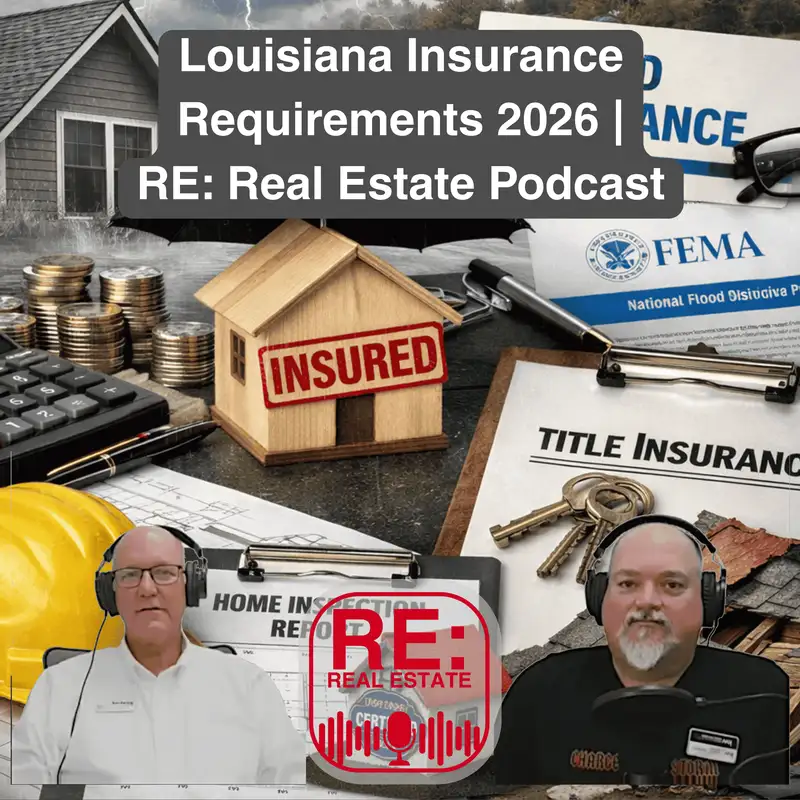
Louisiana Insurance Requirements 2026 | RE: Real Estate Podcast
Clint C. Galliano, REALTOR® (00:00)
Buying a home is one of the biggest investments you'll ever make, and protecting that investment is just as important as finding the right property. Today, we're going to clear up some of the confusion around insurance.
Ben Harang (00:27)
Hello everybody. Welcome to another episode of the RE Real Estate Podcast. My name is Ben Harang and with me is Clint Galliano. Clint and I have been co-hosting this podcast for a little over a year now. And we're on our 66 or so episode, Clint. So it's moving right along and there I am with my arms again. I'm trying, I'm trying.
How you doing today, Clint?
Clint C. Galliano, REALTOR® (00:57)
I'm doing wonderful, Ben. How you doing?
Ben Harang (01:00)
I'm doing terrific. The weather's nice and cool. Life is good. Everybody's healthy. I'll take, I don't know what I do to deserve the life I have, but I'll take it.
What were we about today?
Clint C. Galliano, REALTOR® (01:15)
Alright, today we will be talking about some different types of insurance that are involved when you purchase a
So currently we've had some stabilization in our market compared to the crisis years of 21 through 24 and the big dip of 23 and 24 really. And while we've got a lot of availability in our market, our prices have stabilized. So that's pretty cool.
Ben Harang (01:34)
Hmm.
the increases have abated.
Clint C. Galliano, REALTOR® (01:55)
Yeah, or the price increases.
our inventory has increased, so that's a good thing.
Ben Harang (02:05)
We're in a little more of a balanced market these days, I think. So things should be competitive out there.
Clint C. Galliano, REALTOR® (02:12)
Yeah. that's the state of the market. I want to touch a little bit. You know, there's this mindset out there that homeowners insurance is a requirement. That's not a legal requirement. It's not like auto insurance where they passed a law saying that you have to have that insurance.
So in Louisiana, there is no law saying you have to have homeowners insurance. But if you're financing your home, your lender definitely requires it because they want some kind of protection that you pay for to ensure that they're not at risk. So later in this episode, we're going to talk about a new law that changes how much your lender can force you to carry. All right, Ben, why don't we start out talking about
Ben Harang (03:03)
Okay.
Clint C. Galliano, REALTOR® (03:06)
some recurring coverage.
Ben Harang (03:08)
Alright, a couple of things that you're going to have to buy every year when you have a mortgage on your house is a homeowners policy. And that covers fire, theft, liability, sometimes wind and hail. Sometimes wind and hail coverage is excluded and you need to have a separate wind and hail policy. You might have a
standard homeowners policy with a private carrier and then need to go to LA citizens to buy just the wind and hail coverage. So that's that's an option sometimes. Wind and hail deductible can be a percentage of the value of the in value of the amount of insurance you have. If you have a 2 % deductible and you have a $300,000 house, you deductible on wind and hail.
could be $6,000. Sometimes it's a name storm deductible, sometimes it's just a flat wind and hail deductible. So make sure you understand what deductible you're buying when you buy it. then flood insurance, as Clint said, homeowners is not a legal requirement. It's a requirement of the lender. The flood insurance is a requirement of the federal government. If you have any,
a government backed loan and you're in a designated special flood hazard area, you're required to buy flood insurance. So be, be aware of what flood zone the house that you're to buy is in and make sure you price flood insurance on it. Whether or not it's in a, whether or not the flood insurance is required, just so you know what the cost is. ⁓ risk rating.
2.0. We operate in both Lafourche and Terrebonne parishes generally. Terrebonne Parish has adopted new flood maps. Lafourche is still negotiating the flood maps, but both Lafourche and Terrebonne are operating under risk rating 2.0,
The premiums for what they tell us and they won't tell us everything. The closer you are to a body of water, the higher the premium is going to be. So closer you are to the Gulf, the higher the premium is going to be. And the benefit of being above the base flood elevation becomes much more critical. So just be aware of the elevation and the flood zone that you're in and the property that you plan to buy.
Clint C. Galliano, REALTOR® (05:39)
it used to be that if you were elevated to above one foot above base flood elevation, then you were good. The way they're calculating risk rating 2.0, it's kind of a black box calculation. They hired a contractor to come up with it and
I think the specific term is a flood source that they use. so, you know, it's kind of, I guess, nebulous what a flood source is. Is it the ditch in the back of the neighborhood? Is it a navigable body of water? ⁓ It depends, but they won't let anyone see what the calculation is. But what the result is, is that everybody across the country
Ben Harang (06:20)
Mm-hmm.
Clint C. Galliano, REALTOR® (06:31)
is operating under this risk rating 2.0 reality. And if they're paying for flood insurance, they're paying a heck of a lot more than what they used to.
Ben Harang (06:42)
And also what's come out of this, because flood premiums have gotten out of hand, before risk rating 2.0, there was virtually no private flood insurance market. Today, there are private insurers that will issue flood insurance policies because of the costs that NFIP or FEMA are charging for the current flood policies.
So there may be some opportunities to save some money with private flood insurance, private flood insurers when you buy a house. So talk to your insurance agent, Clint and I are real estate agents. We're not insurance agents. We're just trying to make people aware of the ramifications. So talk to your insurance agent and see what you can do about lowering your premium to make the house you want more affordable.
Clint C. Galliano, REALTOR® (07:37)
We didn't even stay in a holiday express last night.
Ben Harang (07:41)
Yes, and if you want to hear something funny listen to the tagline at the end of the At the end of these episodes. I still chuckle when I hear it We're real estate agents, but we're not your agent unless we have something in writing to the
All right. The 2026 game changer is the stated value policy. Um, the legislature, Louisiana legislature in 2025, um, passed a law that
homeowners can now opt for a stated value policy rather than replacement cost. used to be the insurance company made you carry a replacement cost coverage on the house. The lender wanted you to carry enough insurance to cover their loan. Those were not always in agreement with each other. So now if the lender is satisfied with the stated value policy that
Might be equal to what you're borrowing on the, on the property. The, the insurer or the insurance company should be able to issue a policy for that amount of money and not penalize you in a partial loss. So that's all I'm going get into about the insurance. Talk to your insurance agent, but there's some options that should lower the premium on the homeowner side to make the house a little more affordable.
Clint C. Galliano, REALTOR® (09:05)
and if you don't have a favorite insurance agent or you're looking to possibly change insurance agents, contact either one of us. We've got a list of insurance agents that we can recommend. We're not going to recommend a specific insurance agent, but we'll give you a list that you can choose from or choose all of them, talk to all of them, and see who can give you what you need.
Ben Harang (09:26)
Mm-hmm.
Yeah. Yeah.
Clint C. Galliano, REALTOR® (09:32)
All right, so now moving on to a different type of insurance. So those types of insurance are for the, I guess to repair and maintenance and keeping up your home in the event of some type of catastrophe. ⁓ This next type of insurance, these are one-time purchase types of insurance.
Ben Harang (09:50)
You
Clint C. Galliano, REALTOR® (09:58)
related to the title of your property. These are purchased mainly at closing through the title company. And so that's probably the biggest difference from the ones we just talked about, other than this is a one-time premium. So you pay for it at closing and you don't have to,
pay it again in a year or pay a bill next month or anything like that. So the first one is the lender's policy. So the way a lender's policy works is that you buy this policy and it covers the title so if somebody comes in and has a valid claim for your property that you purchased and they go to court and fight it and lose.
then it covers the lender for the amount of your loan so that they're not out their money. Pretty much every lender requires this because it protects their interest in the property by way of them making the loan to purchase the property. The other type of policy is the owner's title policy and it's optional.
Ben Harang (11:00)
Mm-hmm.
Clint C. Galliano, REALTOR® (11:11)
A lot of people say, well, that's just a scam by the title companies so that they can make money. Well, obviously they make a little money on it. I mean, anybody who does anything tries to make a little money on something. The benefit of it is, so if something does happen and somebody brings a valid claim against the title of a property that you purchase, the lender gets paid off and you don't have an owner's title policy.
Ben Harang (11:15)
Mm-hmm. Mm-hmm.
Clint C. Galliano, REALTOR® (11:40)
then you're kind of SOL. So whatever money you've put into it is gone. ⁓ You don't have any kind of recourse unless you've got an owner's title policy. And that will have the, if you've got an owner's title policy, then that title insurance will A, fight the policy and B, reimburse you for what you've spent to purchase the policy. So that it protects you and
Ben Harang (11:46)
Mm-hmm.
Clint C. Galliano, REALTOR® (12:07)
The reason that I always think it's a good idea is that the history of land purchases in South Louisiana is very murky. I could tell you about one story of somebody bought some property down near Mandalay area and they bought it as a hunting lease, bought the property and they
investigated the title, did a title search, pulled an abstract, and went back 40 years and everything looked good. A couple of years later somebody shows up and they had a, I guess, a more valid chain of title that prior to somebody 30, 40 years ago that purchased that property, this other claimant
had a more valid chain of title saying that they actually owned it and that the other one was false. So somebody did a shady deal or something like that, or maybe it was a relative. And so the person that had originally purchased it, they wound up losing out. And I don't remember if they had owner's title policy or not, but that's part of the reason why.
Ben Harang (13:07)
huh.
Clint C. Galliano, REALTOR® (13:23)
you know, especially because the way things happen in South Louisiana is that they might wait four or five generations before a secession is done on a piece of property. They'll just say, okay, you get this piece of property, you get that piece of property, and until somebody decides to sell outside the family, they know there's no secession's done. So it lasts as long as you own your home.
Ben Harang (13:34)
Yeah.
Mm-hmm.
Clint C. Galliano, REALTOR® (13:48)
Again, it's one-time pay at closing. And ultimately, if you buy both policies together, which lenders policies mandatory if you're buying with a loan, and you get the owner's title policy, it winds up being cheaper than if you come back later and buy the owner's title policy separately.
Ben Harang (14:07)
Right, right. And my opinion of owner's title policies has changed over the years. It used to be you get an RD loan, it's 100 % financing. You don't need the title policy because you don't have any skin in the game. If there's a problem with the title, they fix it and you move on down the road. Well, there's two ways to fix the title.
Either actually fix the title to straighten it out to where you own it and the bank has a mortgage on it or pay the lender off because the title is so messed up it can't be fixed and now you own a piece of property with a title on it that's so bad you can't sell it. So without the owner's title policy in that situation you would be left owning a house that you couldn't sell.
I now strongly suggest that you buy owners title insurance, whether or not you have a mortgage on the property. Um, just it's a one-time deal, roll it into closing costs, call it what you want, but you can, you can sleep better at night that long lost relative is not going to show up for five generations or four or five years from now claiming ownership in the property. So one time costs.
My suggestion is get it done.
All right.
Clint C. Galliano, REALTOR® (15:35)
right, so our listeners may ask what can they do about controlling all of the insurance costs today.
Ben Harang (15:42)
Well, I'm glad you asked Clint. There's something called a fortified roof. Hurricane Ida, did a lot of damage around here and a lot of the damage came from the roof failing and water damage through the failed roof. If a house, if that is the roof on a house held, there was virtually no damage to the house.
If it failed, the house could have been totalled So with a fortified roof, they have a layer of protection under the roof. there's some different straps, I think, but generally is a stronger roof, especially when it comes to water to keep water out. in the event of a hurricane. If, if you, if you're going to change your roof, there is a,
a grant program for fortified roofs that will help with the cost of the increased cost of of changing the roof they'll pay for the the cost of the fortified portion of it
Clint C. Galliano, REALTOR® (16:42)
Well, they'll give you some money towards that, towards getting that done. It's not necessarily cover all the costs.
Ben Harang (16:50)
would not not the cost of the roof but i think it's based on the increased cost of the roof versus a non fortified roof is what they based the payment on and then another another item that's always a problem they have what they call storm chasers or what i call storm chasers roofers that show up
Clint C. Galliano, REALTOR® (17:12)
Carpet Baggers.
Ben Harang (17:13)
the day after the storm hits and people are trying to figure out what just happened. And this guy rolls up in a big dually pickup truck and said, I can change that roof tomorrow for $28,000 sign right here. if, if the, the cost of the roof is over $7,500, you have to hire a licensed contractor or licensed roofer to change the roof.
somebody just can't can't just roll in and say I'm a roofer today and I'm gonna go find a crew of people to change the roofs and I'm gonna just sell the new roofs. It needs to be a licensed roofer for anything over $7,500. So they're trying to get rid of some of the people that came in, especially after Ida, they came in and had assignments where they had contracts where they had people assigned the insurance proceeds to the roofer. And that became a huge problem.
on how much it was going to cost to change that roof. ⁓
Clint C. Galliano, REALTOR® (18:17)
Yeah,
and I've run across a few roofs where they left all of the vent jacks and all of the original drip edge and just changed the shingles and didn't do a good job of changing the shingles. So they didn't replace anything. you know, with a new roof, you should get all new vents, all new vent jacks and all of that stuff.
Ben Harang (18:30)
Mm-hmm.
Clint C. Galliano, REALTOR® (18:42)
and they left all the original stuff and just put shingles on.
Ben Harang (18:45)
right, right, they got in and got out in a hurry. And unfortunately, there were some bad roofs put on after Hurricane Ida and the roofers took advantage of the victims of the hurricane. So that requirement to hire licensed roofers is an attempt to rectify that.
Clint C. Galliano, REALTOR® (19:02)
actually just right before Christmas had a client close on a house that their roof got changed right around Ida. Might have been right before right after. But when we got the inspection done there was a roughly 18 inch by 18 inch section of the roof decking that had just rotted out and this was like
Ben Harang (19:13)
Mm-hmm.
Clint C. Galliano, REALTOR® (19:28)
downslope from the chimney. So was water leak getting in and it must have pooled at that section of decking and rotted it out. And you could see the shingles through this hole. Luckily, it wasn't a carpet bagger. It was a roofing company they could get in touch with and they were able to contact them and they came in and put in a, I guess a patch on the decking to
Ben Harang (19:33)
Mm-hmm.
Wow.
Mm-hmm.
Clint C. Galliano, REALTOR® (19:56)
to fill in that hole so that the buyer wouldn't have any issues with that later, which was surprising.
Ben Harang (20:01)
huh. that's good.
Yes. Yes. That's a good thing. that's why the out of town people make me nervous after a storm. The storm chases. I'm not a fan of. one other thing you can do is do a wind mitigation survey of your house. They are home inspectors that are certified wind mitigation specialists. I think they call them and they'll come in and have a checklist and based on the quality of construction of your house.
that submitted to the insurance company and there could be some credits on your premium for the wind mitigation survey that you do. It's about a three hundred dollar survey probably. If you get a discount it lasts for the life of the policy. So it's worth it if you can get any discount at all. So that's just a wind mitigation survey by a home inspection, home inspector.
So that's just something else you can do to try to control the cost of home ownership. And Louisiana citizens, you have to love them. Without them, the residential real estate market would have been shut down for about three years. It's come to the point to where if you have Louisiana citizens for your homeowners, you really need to try to replace it. The rates are higher than the...
the private market so if you can get out you will absolutely save money used to be the rates were the same so there was no incentive to get out they've they've changed that I think I don't know 10 percent higher than the private market so if you can get out of Louisiana citizens get out and then you can also raise your deductible on the the fire and theft
you'll probably have a percentage deductible on the wind and hail coverage, but you could raise your deductible from a thousand to five thousand or whatever you're comfortable with and save a few dollars on the premium that you're going to be paying every year. So that's just some ideas on what you can do to reduce the cost of home ownership.
Clint C. Galliano, REALTOR® (22:09)
All right. Yep. All right. So kind of wrapping things up a little bit, one of the common questions that we get is, can I assume the seller's flood policy? A lot of times, sellers, if they've been in the home for a while, they were grandfathered in under an original premium amount.
Ben Harang (22:09)
Alright Clint, you want to take the next one?
Clint C. Galliano, REALTOR® (22:36)
prior to risk rating 2.0 being put into effect. And by law, the NFIP can't increase their premiums more than 18 % per year. So what the result is, is that those premiums are cheaper than if the buyers would go out and just buy a new policy. Eventually it may get up to
Ben Harang (23:02)
Mm-hmm.
Clint C. Galliano, REALTOR® (23:05)
the $3,000 a year, what have you, but if they can get it for $1,800 or $2,000 a year, $2,300 a year right now, that's still cheaper than the $3,000 a year that it'll eventually end up at. 99 % of the carriers that...
do flood insurance allow the policies to be transferred to a buyer? There's at least one carrier that does not do transfers. I'm not going to say across the board that they don't do transfers, but I've heard tell of and actually experienced, one where they wouldn't transfer the flood policy. They said they didn't do that. So it's not 100%.
Ben Harang (23:42)
Mm-hmm.
Clint C. Galliano, REALTOR® (23:54)
but it's the majority of the policies are able to be transferred. Most of them are written through the National Flood Insurance Program. it's a universal thing. The carrier is just the pass through for it. And so it's easy enough to transfer. All right. Well, if you liked what you're hearing, if you found this
Ben Harang (23:59)
Hmm.
Clint C. Galliano, REALTOR® (24:17)
Useful, educational. Would appreciate it if you like, share, comment, and subscribe. Share with your friends. Tell your mom and them. Go check us out at rerealestatepodcast.com. You can listen to the episodes on the website. You can get a link to your favorite podcast app or service and listen to the audio versions. You can get the link to our YouTube channel.
and watch us if you want to see two guys with faces for radio like Ben's fond of saying... You can also find Ben and I's agent sites. know, if you want to go and look for homes or connect with Ben and I, you can do that there also. What else, Ben?
Ben Harang (24:57)
All right. Did you say the website is rerealestatepodcast.com? Did I hear you say that?
Clint C. Galliano, REALTOR® (25:04)
I said that it's rerealestatepodcast.com.
Ben Harang (25:06)
Okay.
I thought that's what she said. Okay.
Clint C. Galliano, REALTOR® (25:09)
Yeah,
so you hear us say that we say that three times. We're trying to make sure that you hear that we're saying re real estate podcast.com.
Ben Harang (25:17)
Yes, that was four. was four. All right. We'll get another one in the can Clint.
Clint C. Galliano, REALTOR® (25:20)
He
All right, Ben.
Ben Harang (25:24)
All right, y'all have a good one. Thanks for joining us.
Creators and Guests