Is Homeownership in South Louisiana Out of Reach? | RE: Real Estate Podcast
Clint C. Galliano (00:00)
More Americans believe they can't afford to own a home than at any other point in modern history. On average, they're wrong by tens of thousands of dollars in several years. the cost of being wrong is the wealth their family will never build. Today we take down that belief. This is built to own.
Ben Harang (00:35)
Hello everybody and welcome to another episode of the RE Real Estate Podcast. I'm Ben Harang and with me as usual is my co host, Clint Galliano. How you doing today, Clint?
Clint C. Galliano (00:48)
I'm doing wonderful, Ben. How you doing?
Ben Harang (00:51)
I'm doing terrific. I was driving into my my office to to get ready for today and the rain and the wind and it was breaking loose outside. I thought we'd have rain beating down on the the metal building, but it looks like it might be passing us. It just got put off for a minute. But if you hear anything in the background Yeah.
Clint C. Galliano (01:08)
Yeah, it showed up over here right I was fixing to
say the same thing. It showed up over here right before we started recording and so I've got the same thing.
Ben Harang (01:18)
Yeah. So I'm apologize in advance. We we might have some background noise, but we're gonna deal with it. Okay. So what are we talking about today, Clint?
Clint C. Galliano (01:25)
That's right.
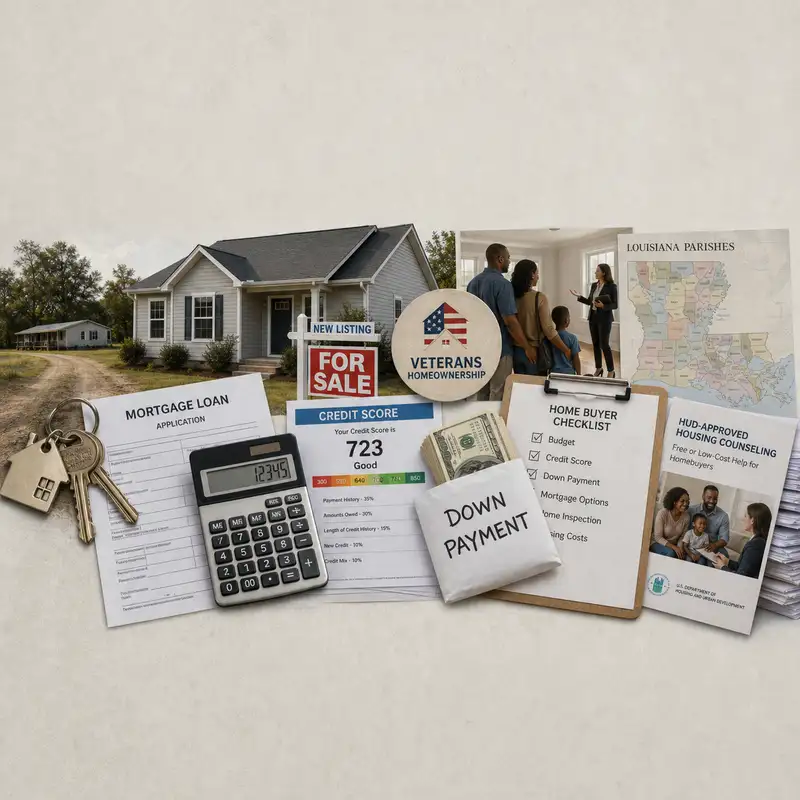
this is the first episode of Act Two. And actually it's the only episode. In Act One of Built to Own, we answered the what do I own when I own property? question. And Act Two is today. And it answers how do I get in? So we're going to cover three things three big affordability myths down payment.
Ben Harang (01:32)
Mm.
Clint C. Galliano (01:52)
credit and reserves, the four legitimate loan on ramps, and that's FHA, VA, USDA or rural development, and conventional loans. And then the three composite buyers we're going to review to show what the numbers actually look like. The single most important thing today for this episode is
For a lot of listeners, the path to ownership is closer than they think. Not by a little, by years and tens of thousands of dollars. And I want to reiterate, nothing that we go over today is a sales pitch. The action items route to third parties like lenders and HUD approved housing counselors, not us. I'm gonna go over this disclaimer real quick.
Ben Harang (02:37)
Mm.
Clint C. Galliano (02:43)
Before we go any further, nothing in this episode is financial, tax, or lending advice. Loan programs change. Eligibility depends on your specific situation. Every example in this episode is illustrative only. And before you act on anything you hear today, consult a licensed mortgage lender who's licensed in Louisiana who can pull your actual credit and income. And if you want independent guidance at no cost to you,
A HUD approved housing counselor can help you out. Both are third parties to this show, and we're just here to put the framework in front of you. All right, Ben, why don't you take it away?
Ben Harang (03:23)
All right. So we're gonna go down the myths. So myth number one, you need a twenty percent down payment. Where it comes from the pre-1930s American mortgage market really did require large down payments, and the number lived on culturally long enough for after the mark mortgage market changed.
Clint C. Galliano (03:49)
So where it hits the hardest is national personal finance shows still recommend 20% as an ideal. and ideal gets heard as required. Family advice compounds it. Parents who bought homes in the 80s often put 20% down and remember it as the standard.
Ben Harang (04:10)
So FHA loans allow as little as a 3.5% down payment. VA loans allow zero down payment for eligible veterans. USDA rural development allows zero down in eligible rural areas, which covers most of our region. And conventional loans allow three to five percent down through several programs, including the Home Ready and Home Possible programs.
Clint C. Galliano (04:39)
Now the trade-off when you go with the lower down payments that generally require mortgage insurance, MI or PMI for private mortgage insurance on conventional, MIP mortgage insurance premium for FHA, and a funding fee for the VA and USDA. It's a real cost. It's also real math, not a reason to keep on renting.
Ben Harang (05:02)
Right. So the the perfect credit, you need perfect credit. Everybody's gonna have bumps and bruises along the way. where the idea of the perfect credit comes from is the assumption that mortgages require credit, like personal loans require credit. They don't work the same way.
Clint C. Galliano (05:23)
Reality is that an FHA loan will generally require a credit score around 580, sometimes lower with compensating factors. VA loan has no VA set minimum, though lenders typically want a five eighty to a six twenty, and then USDA loans typically want six forty or better. Conventional loans will typically want a six twenty to a six forty minimum.
Ben Harang (05:52)
So what this means is the perfect credit means seven fifty plus and get you the best rate. But you don't need perfect credit to get in. You need adequate credit to qualify. And those numbers are different.
Clint C. Galliano (06:11)
All right, moving on to myth number three. You need six months of reserves. Where it comes from? Financial guru advice about maintaining an emergency fund plus a specific reserve requirements for I'm gonna start that over.
Where does it come from? Financial guru advice about maintaining an emergency fund, plus the specific reserve requirements for conventional loans on investment properties or high balance loans.
Ben Harang (06:44)
So the reality is reserve requirements depend heavily on the loan program and the property. Owner-occupied FHA and VA loans often have no reserve requirement. Conventional loans on a primary residence often want two months of reserves, sometimes zero for lower risk loans. Six months of reserve is what people bring when they're buying investment properties or high value homes, not what a first-time buyer.
needs to qualify for a starter home.
Clint C. Galliano (07:19)
All right, so here's a distinction worth make worth making. Having reserves is smart. Being required to have six months of reserves before you qualify is a myth.
Ben Harang (07:30)
Okay, so here's the first on ramp. FHA Federal Housing Administration. Who's it for? First time home buyers? Buyers with lower credit scores? Buyers without large down payments? FHA is the workhorse loan for working families in America.
Clint C. Galliano (07:52)
And have like we said earlier, down payment can be as as low as three and a half percent. So that's that's the minimum that you have to put down for an FHA, and that's not taking into account any kind of down payment assistance or anything. And the minimum credit score of five eighty. if you get ten percent minimum down payment, you can get that.
with scores between five hundred and five seventy nine. So I didn't even realize that was an option, but if you've got the money to put down, you can get an FHA loan.
Ben Harang (08:28)
Well, and and a lot of times people it's it's down payment driven. So if the if it requires a three and a half percent down, they don't think about putting ten or fifteen or twenty percent down if they have it. to get it at a lower credit score point. And that's off track. They told us don't do that. So we got coming back down. Going back going back on our on our points. Okay, here's some key features.
Clint C. Galliano (08:51)
Getting
Ben Harang (08:55)
They allow gift funds for the down payment. They're more flexible on credit than conventional loans. They have an upfront mortgage insurance premium plus an ongoing monthly mortgage insurance premium that lasts the life of the loan on most loans originated today. That's the trade-off.
Clint C. Galliano (09:17)
The only exception is getting back to that ten percent down payment number, is that if you put ten percent or more as a down payment on an FHA loan, once it hits twenty percent equity, you can get that mortgage insurance premium removed.
All right. the other common misconception, FHA is not just for low income buyers. Anybody can get an FHA loan up to the loan limit for their county or parish, all the way up to like hundreds of thousands of dollars.
Ben Harang (09:49)
Right.
All right, the on-ramp number two, which is the VA Department of Veterans Affairs loan product. and who's it who's it for? It's for eligible veterans, active duty service members, National Guard and Reserve members meeting service requirements, and certain surviving spouses.
Clint C. Galliano (10:12)
Down payment requirement, zero percent for eligible borrowers. This is one of the most powerful mortgage benefits in the country for those who have served.
Ben Harang (10:23)
So some of the key features are no monthly mortgage insurance, a one-time funding fee waived for many disabled veterans, the the competitive interest rates, the entitlement can be reused across a lifetime with proper restoration.
Clint C. Galliano (10:43)
So a common misconception is that many veterans who could use the VA never do because they don't realize that they're eligible. They think once they use it, or they used it once decades ago and forgot they can use it again and again. It's
It's basically a a a a rinse and repeat type alone is for up to your eligibility amount.
Ben Harang (11:04)
Yeah.
Right, right. And if if you you just can't have two of in place. You pay one off and get another one. so enough about VA.
on ramp number three is the USDA rural development. Who's it for? Buyers in USDA designated rural areas subject to income limits.
Clint C. Galliano (11:31)
Where it applies locally, all of Lafourche, Terrebonne, Saint Mary and Assumption parishes qualify. The only areas nearby that are blocked out, to my knowledge, are Baton Rouge and New Orleans metro areas.
Ben Harang (11:47)
Mm-hmm.
the rural development loan has a zero percent down payment for eligible borrowers.
Clint C. Galliano (11:56)
Some of the key features is that there's no monthly mortgage insurance in the traditional sense, but there's an upfront guarantee fee and an annual fee. Income limits do apply. Typically the household income cannot exceed a hundred and fifteen percent of the area median.
Ben Harang (12:16)
some common misconceptions. The USDA loans are only for farmers. They're not. They're for residential buyers in USDA eligible areas, which is a much larger footprint than most people assume.
Clint C. Galliano (12:31)
on ramp number four, conventional loans. These are Fannie Mae and Freddie Mac loans. Who's it for? Buyers with reasonable credit that don't fit FHA, VA, or USDA programs. Also buyers who want to avoid FHA's life of loan mortgage insurance.
Ben Harang (12:51)
A down payment is three percent minimum for first-time home buyer programs like Home Ready, which is a Fannie Mae product, and Home Possible. Freddie Mac, a five percent standard conventional down payment, and a twenty percent down payment will avoid PMI entirely.
Clint C. Galliano (13:12)
key features. PMI drops off when the equity reaches 20%, broader property type eligibility, faster underwriting in many cases, and a much more lenient appraisal overlay.
Ben Harang (13:28)
Yes. some misconceptions. The conventional loan requires twenty percent down. That's not true. That's the amount down to avoid the PMI. it is not the minimum to qualify for a conventional loan.
Clint C. Galliano (13:43)
some Louisiana specific assistance for you. one resource is Louisiana Housing Corporation. They offer down payment and closing cost assistance programs for eligible buyers, including the mortgage revenue bond assisted program and the mortgage credit certificate program.
Ben Harang (14:03)
There are also parish level programs that exist as well. The availability changes year to year. The HUD approved housing counselors covered in section five today. Stay current on what's available.
Clint C. Galliano (14:18)
Assistance can be stacked with FHA, VA, USDA, or conventional in many cases, subject to program specific rules.
Ben Harang (14:29)
So now we're going to get into some examples. the first one is buyer A, the $45,000 renter. this is a single adult, $45,000 gross annual income, currently paying eleven hundred dollars a month rent, credit score of $640, has about $4,000 saved.
Clint C. Galliano (14:49)
Program fit? FHA likely with LHC down payment assistance.
Ben Harang (14:56)
So just some rough math. On a $175,000 home, 3.5% down is $6,125. With LHC assistance, they may cover $3,000 to $5,000 of that. Monthly, principal interest taxes, and insurance comes out to around $1,350 to $1,450 a month, depending on rates and insurance. Higher than current rent by about
Two hundred and fifty to three hundred and fifty dollars.
Clint C. Galliano (15:28)
Buyer isn't saving $6,125 in down payment. They're building equity with a portion of every monthly payment. Over five years, that's $15,000 to $20,000 in principal pay down. Wealth they wouldn't have as a renter.
Ben Harang (15:46)
that's the the FHA buyer. This is a sixty thousand dollar veteran. So it's a married veteran, sixty thousand dollars gross annual income, spouse working part-time, currently paying thirteen hundred dollars a month rent, credit score is six ninety, and they are VA eligible.
Clint C. Galliano (16:07)
Program fit. This one's a no-brainer. VA loan. Zero down payment, no monthly PMI.
Ben Harang (16:14)
So the rough math on a two hundred ten thousand dollar home, zeroed down, principal interest taxes and insurance around fifteen hundred to sixteen hundred dollars a month, slightly higher than their current rent, but with equity building from day one.
Clint C. Galliano (16:31)
VA is a benefit the veteran earned. Not using it is leaving that benefit on the table. Many veterans who use VA once for a smaller home decades ago don't realize they can restore entitlement and use it again.
Ben Harang (16:45)
Absolutely. the next buyer is a fifty-two thousand dollar teacher. A single adult, fifty-two thousand dollars in gross income, currently paying one thousand fifty dollars a month in rent, credit score seven hundred twenty, and has about eight thousand dollars saved.
Clint C. Galliano (17:05)
program fit on that. It's conventional loan with home ready or home possible. Three percent down. They might also qualify for FHA. The comparison at closing is worth having that conversation with your lender to decide on which better meets your goals.
Ben Harang (17:24)
So rough math on this one. On a hundred and ninety thousand dollar house, three percent down payment is five thousand seven hundred dollars. Principal interest taxes and insurance about fourteen to fifteen hundred dollars a month, depending on the rate, insurance and program, about three fifty to four fifty more per month than the current rent.
Clint C. Galliano (17:45)
with a 720 credit and stable income, this buyer likely qualifies for the best conventional rates available. The difference between a conventional loan they qualify for and an FHA loan they assume they need is real money over 30 years.
it's homework time.
Ben Harang (18:01)
No, no, no, no, I'm not doing it.
Clint C. Galliano (18:04)
So here's your homework for the week. It may take you 30 minutes total. Pull your credit score. Just pull it. Use annualcreditreport.com, credit karma, your bank's app. if you've got a car loan, typically they'll give you access to your updated credit score. And whatever gets you the number fastest. Look at it. That single act.
removes one of the biggest reasons people don't start. Then, if you're serious, book an initial appointment with a HUD approved housing counselor, not a lender, a HUD approved counselor. The counseling itself is available at no cost to you and it's federally funded. The directory is on HUD.gov. Search for HUD approved housing counseling agencies in Louisiana. Filter for your parish and pick one. Call them this week.
Two actions. Under an hour combined, that's what you got for this week.
Ben Harang (19:01)
I I think even I could do that homework, Clint.
Clint C. Galliano (19:04)
Easy enough.
Ben Harang (19:05)
It is. It is. that is episode number six of Built to Own. And that's Act Two. And it's underway. Next week we get into the five engines of property wealth. Once you're in, which is what this episode was about. And the next question is how ownership actually compounds into wealth. That's next week.
Clint C. Galliano (19:29)
if this episode changed the size of what feels possible for you, or for someone you know, share it. Send it to the friend who's been running for eight years and telling themselves that ownership isn't for them. The point of this series is that the framework has always been available. It just hasn't been in front of enough people. Remember to subscribe to RE Real Estate Podcast dot com wherever you get your podcasts, and you can also watch us on YouTube.
If you like seeing a couple of guys with faces for radio. And if you subscribe either on YouTube or wherever you get your podcasts, then next week's episode's going to land automatically.
Ben Harang (20:12)
All right, that's RE Real Estate Podcast dot com. Audio or video of the podcast. You can get from right there on that site. share it with your mama and them. like it, comment, whatever you want to do. It helps it grow. all right, Clint, I think we got another one in the can.
Clint C. Galliano (20:30)
Yes indeed. All right. Thank you, Ben. Enjoyed it.
Ben Harang (20:33)
same here. Y'all have good day. Thanks.
Creators and Guests