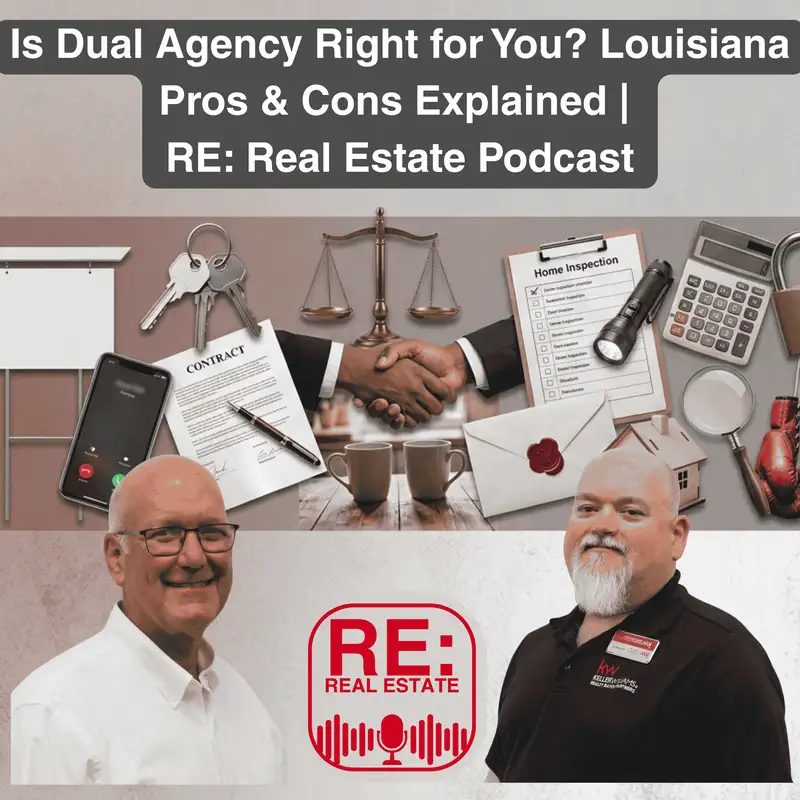
Is Dual Agency Right for You? Louisiana Pros & Cons Explained | RE: Real Estate Podcast
Clint C. Galliano (00:03)
Mark, one agent, both sides of the same deal. In Louisiana, it's legal, but it has to be disclosed. And it happens more than you think. The real question is whether it's right for you. Let's talk about it. I'm gonna do one more take of it.
I'm saying more often than you think, because that's what wants to come out.
Mark two One agent both sides of the same deal. In Louisiana, it's legal, but it has to be disclosed. And it happens more often than you think. The real question is, is it right for you? Let's talk about it.
Ben Harang (00:58)
For me.
All right.
Mark. Hello everybody and welcome to another episode of the RE: Real Estate Podcast. My name is Ben Harang, and with me today, as usual, Clint Galliano, my co host. Good afternoon, Clint. How you doing today?
Clint C. Galliano (01:27)
I'm doing wonderful, Ben. How you doing?
Ben Harang (01:30)
I'm doing terrific. It's falls almost in the air. It's not ninety eight degrees, it's ninety five degrees. ⁓ not a whole lot of raining going into the weekend, so it should be the the change is coming.
Clint C. Galliano (01:48)
Looking forward to it.
Ben Harang (01:50)
Yeah, I think we all are. So what are we talking about today, Clint?
Clint C. Galliano (01:55)
All right, today we're talking dual agency, what it means under Louisiana law, what your agent can and can't do on both sides of the transaction, and the honest pros and cons. Why don't you set the scene, Dan?
Ben Harang (02:11)
All right. So you call the the number on a yard sign and the listing agent picks up. Imagine a listing agent answering their phone. You love the house in Louisiana if that one agent works with both you and the seller, that's dual agency, and it requires written consent from both the buyer and the seller. It's something that that I've evolved with over time. ⁓ and Clint doesn't like it at all.
Clint C. Galliano (02:44)
Yeah. So here's what surprises people. Louisiana's default is designated agency. So what that means is that your agent is your agent individually. So if Ben lists a house and I bring a buyer, even though we're both working for Keller Williams Realty Bayou partners, it's not dual agency. Because the agency is tied to the designated agent.
Ben Harang (03:12)
Timing matters to consent gets signed with the listing agreement or at least before the agent starts working with both sides. It's not something that's done at the closing table just to clean up the paperwork.
Clint C. Galliano (03:31)
Yeah.
Ben Harang (03:31)
So clear.
Clint C. Galliano (03:34)
Go ahead.
Ben Harang (03:36)
So Clint, once both sides sign a form, what does the agent actually still do for both of them?
Clint C. Galliano (03:45)
So the Louisiana Real Estate Commission's dual agency form lists what a dual agent does for both clients. Honesty, defects, comps, inspections, closing costs. But notice what's missing. Nothing about fighting for the lowest price or pushing for top dollar. To me, that's a handicap because you're not serving both sides equally.
Ben Harang (04:08)
Mm.
And and here's where a dual agent can here's what a dual agent cannot tell either side. You can't tell the buyer the seller's bottom line, or you can't tell the seller the buyer's top dollar that they're willing to pay. ⁓ or any other confidential information without written permission. And and one of those things sometimes is why the
seller selling or why the buyer likes this particular house versus the other ten or fifteen in the same neighborhood. ⁓ either one of those could handicap the buyer or seller's position in the negotiations.
Clint C. Galliano (05:04)
So picture the seller asking a dual agent, what do you think they'll really pay? The only honest answer is I can't tell you that.
Ben Harang (05:12)
So what am I paying you for? Is would be my response. so
Clint C. Galliano (05:15)
Exactly.
So let's ⁓ let's talk a little bit further out of this. We're g we're gonna kinda do a little sidebar here. And Ben, tell me your your thinking on dual agency and and how you practice.
Ben Harang (05:32)
So doing this since dirt, it was much more common than it is now. And and we just did it without thinking about it. Because when I started, the buyers did not have any representation and the buyer's agent was actually a sub agent of the listing agent that worked for the seller, which is about as convoluted as you can get. But that was the that was the law in nineteen ninety four.
That changed in about nineteen ninety six, but the industry didn't change with it. once we got into the buyer representation agreement and ⁓ lawsuit settlement and all that stuff, it became very clear that it's it's extremely difficult to to practice dual agency representing both buyer and seller.
unless both the buyer and a seller are sophisticated and have done multiple deals, you might be able to do it for ⁓ but I'm I'm doing it less and less. And today the only way I'll do it is if both sides really understand it. They want me to do the transaction for them because we've done multiple deals together. if I have a a repeat client on one side and a new client on the other side.
I will now typically refer the new client out to another agent and let that agent be the advocate for that buyer. I'll be the advocate for the seller and hopefully we'll make a deal.
Clint C. Galliano (07:13)
Yeah, my thoughts are are very similar. ⁓ at least two years prior to the ⁓
the landmark change within the real estate industry. I was exclusively using buyer representation agreements when working with buyers and chose not to work with a buyer if they wouldn't sign it. ⁓ because I I felt that it helped spell out how we work together. ⁓ but as far as dual agency goes, I made the decision
Guess it's probably going on three years ago now, that I wasn't going to do dual agency. ⁓ and just like you, if I get a lead on any of my listings, ⁓ or even if I'm working with a buyer and they want to make an offer on my listing, I'll refer them to another agent for the transaction. ⁓ because I don't want anybody walking away and saying,
Ben Harang (08:15)
Mm.
Clint C. Galliano (08:21)
Did my agent represent me to the best of their ability? Because if you're doing both sides of the deal, you're kind of handicapped because you can't push for the higher dollar amount from one side or the lower dollar amount from the other side or the more concessions or less concessions without alienating one side or one of your clients that you're representing. So I just choose not to do it. And I'm okay with that.
Ben Harang (08:50)
Right, you become more more of a you become more of a transactional agent than an advocate.
Clint C. Galliano (08:57)
Right, exactly. You're you're you're not an advocate and you're not necessarily a fiduciary, if you're trying to work both sides of that deal. And maybe it's because I'm comfortable comfortable financially. I don't feel that I need to chase that higher compensation for that. ⁓ other states handle things a little differently, like in Florida.
Ben Harang (09:08)
Right.
Yeah.
Clint C. Galliano (09:23)
The only way an agent can do both sides is if they're not representing either side and just doing the the paperwork transactionally, which is it's kind of a weird concept, but it works to keep people out of trouble.
Ben Harang (09:30)
Mm-hmm. Mm-hmm.
It is.
Uh-huh. So so the biggest upside of doing a dual agent agency is the communication between the parties. It's one person, one set of facts, and no game or telephone. Nothing gets lost in the translation. Translation if the buyer sell tells the agent something, the agent tells the seller or vice versa. You're not going through two agents to get to the buyer and the seller. ⁓
Which can be problematic, which is why a lot of people still do dual agency. ⁓ but the the public is starting to push back on the dual agency also, and I can't say I blame
Clint C. Galliano (10:19)
No, ⁓ listing agent usually knows the house better than anybody, flood zone, elevate elevation certificate, roof with the seller's already fixed.
Ben Harang (10:31)
But the the buyer's agent can get that information pretty quickly. ⁓ right. The downside and when I'm when I'm going through life, I'm always looking at okay, what's the downside of doing this or doing that or not doing this or not doing that? The biggest downside i is you give up the advocate. ⁓ if you want somebody in your corner telling telling you what to offer and why a dual agent cannot
Clint C. Galliano (10:37)
Yeah, it's easy enough to get.
Ben Harang (11:01)
do that in the same way as a a buyer's rep can. So if you want somebody on your side, get a employ your own agent and don't go the dual agency route.
Clint C. Galliano (11:18)
Yeah, especially because if something goes wrong, rough inspection or low appraisal, both clients need guidance at the same moment from the same person if you're using dual agency. And that's a recipe for disaster.
Ben Harang (11:33)
It is. So so when does it make sense? If like I said before, if the parties are experienced, the I've I've worked deals where the buyer and the seller were talking and couldn't quite couldn't quite make the deal, but the price has already been set and they just have a couple of terms to be worked out. ⁓
And if everybody if you value the speed that it can get done, you might consider dual agency in that case. When should you pass? A first-time home buyer? Absolutely not. A complicated deal might be complicated to me, might not be complicated to Clint, but get your own agent if you feel like the deal's complicated. Or if you just want somebody in your own corner. And I'm gonna tell you that.
⁓ is big to me because when I'm doing a deal for myself, whether I'm buying or selling, I always want to have somebody to lean on just to make sure I'm doing I'm headed in the right direction. I'm not missing something. ⁓ so it's good to have somebody to bounce things off of.
Clint C. Galliano (12:47)
Yes indeed. All right. Now we're gonna go into Ben's favorite segment. Homework time.
Ben Harang (12:58)
Not gonna do it. No no, nope, that's homework for you, not for me. I don't do this. I have a PTSD from school.
Clint C. Galliano (13:03)
Yeah.
⁓ can I relate? All right, here's the homework. Before you sign a dual agency form, whether you're on the listing side or the buying side, ask three questions. Who else in the brokerage, the agent you're working with, could represent you? And if you can't get a good answer on that, maybe you look somewhere else.
Ben Harang (13:10)
Ha ha ha
Clint C. Galliano (13:38)
And then the next question is, what will you share with the other side? Because by default, a lot of the information is confidential to you unless you give permission to share it. If you want to talk it through, feel free to call our text Ben or me. Our contact info is in the show notes. We'll be more than happy to walk you through it. And it doesn't matter if you choose to use us on a deal or not.
Ben Harang (13:51)
Mm-hmm.
Clint C. Galliano (14:06)
We're here to answer your questions.
Ben Harang (14:09)
Yeah, and you know, I'ma just divorce is a big part of what we do. And sometimes it's public knowledge people are going through a divorce, sometimes it's not. And that one piece of information may be vital to a buyer trying to make a deal on a house, whether they're they're motivated or not. And in a dual agent situation, that agent can't even
address it because he knows it's private information. But as a buyer's agent, when you show the house, I mean there's there's giveaways in the house, but you can check the public record, you can you can dig to find out what's going on and why they're actually selling it. The dual agent cannot do that. So that's just a little lagniappe All right. If
Clint C. Galliano (15:05)
Yeah. Huh.
Ben Harang (15:08)
I'll cut you off, Clint. Go ahead.
Clint C. Galliano (15:10)
That's all right. No, that's it's I I thought you had already done this next section.
Ben Harang (15:14)
All right. if the episode helped you, like it, share it with somebody who's buying or selling, and subscribe wherever you get your podcasts. You can also do it at rerealestate podcast dot com and get the audio and video version.
Clint C. Galliano (15:35)
Wanna thank y'all for listening and remember to like, comment, and share at RE Realestate Podcast.com. You can even ask a question or get to our YouTube channel directly from that website. We'll see y'all next time on the RE Real Estate Podcast. See y'all!
Ben Harang (15:53)
⁓ Clinton, until next time.
Clint C. Galliano (15:58)
Have a good one, Ben.
Ben Harang (16:04)
All right.
Creators and Guests