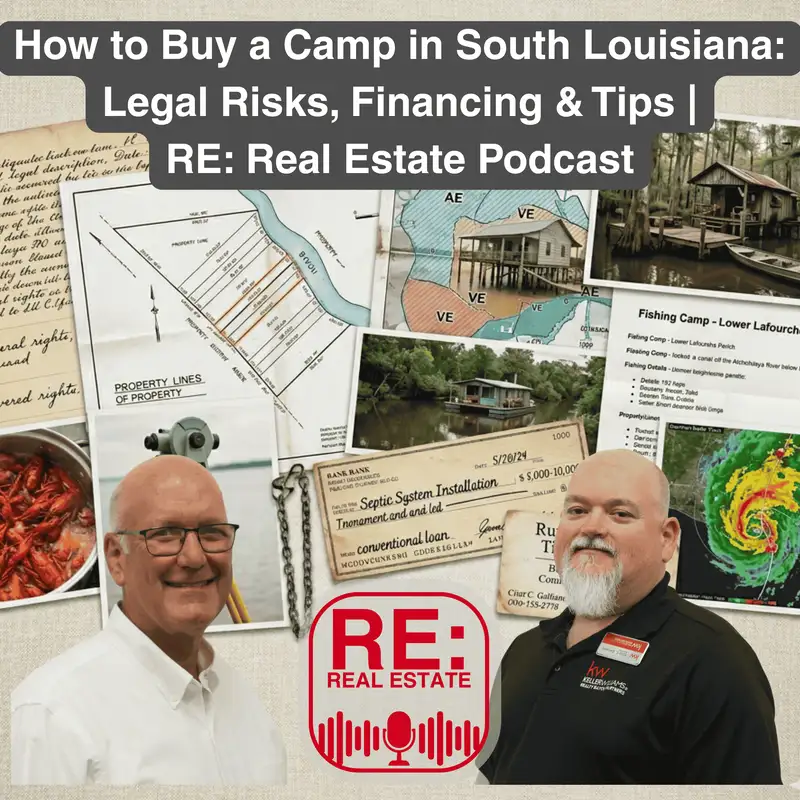
How to Buy a Camp in South Louisiana: Legal Risks, Financing & Tips | RE: Real Estate Podcast
Clint C. Galliano, REALTOR® (00:00)
There's nothing like watching the sunset over the marsh from your own back porch, until you realize that your back porch is technically in a flood zone, and your mineral rights belong to a guy who passed away in 1924. Buying a camp on the Bayou is a high stakes game of risk and reward where the rules are as unique as your mamere's gumbo.
Ben Harang (00:35)
everybody. And welcome to another episode of the RE Real Estate Podcast. My name is Ben Harang with me today as usual as my cohost, Clint Galliano. Good afternoon, Clint. How are doing today?
Clint C. Galliano, REALTOR® (00:50)
I'm doing wonderful, Ben. How you doing?
Ben Harang (00:53)
I'm doing terrific. weather's nice. No rain in sight. Nice weekend coming up. life is lovely. So tell us what we, tell us what we're talking about today.
Clint C. Galliano, REALTOR® (01:02)
Yes, indeed.
All right, so today we're talking about buying land or a camp in South Louisiana. We know that camp property is near and dear to a lot of people's hearts and it's one of the, I would say, most interesting purchases people can make in South Louisiana.
Ben Harang (01:27)
Mm-hmm.
Clint C. Galliano, REALTOR® (01:28)
It's
about the fishing and the crawfish boils and the family memories, not just the size of the camp. And the goal of this episode isn't to scare people off, it's just to make sure that if you're thinking about buying a camp in South Louisiana, that you go in with eyes wide open so your dream doesn't turn into a nightmare. Things we're going to cover, we're going to cover why things are different.
Ben Harang (01:47)
Thanks
Clint C. Galliano, REALTOR® (01:53)
in Louisiana, what makes it legally unique, the risks most buyers don't ask about, how financing actually works, and why people keep buying anyway. All right, with that said, we're gonna start off on what makes South Louisiana land different.
Ben Harang (02:16)
All right. So if you're from South Louisiana, you know about, about batch or a bet or land, which is the land between Batur as Dos Gris and Thibodaux That's the difference. inside joke there, mature live oak trees. the batture land sits between the natural levee and actual water's edge.
Clint C. Galliano, REALTOR® (02:24)
batture
That's almost like Mature.
Ben Harang (02:44)
and in Louisiana, the ownership of that strip can be complicated. in many cases, the state of the landowner hold rights to, to it, depending on the water bayou and how it was formed by sometimes purchase what they think is waterfront property only to find out later that the yard between their camp and the river technically is not theirs. ⁓
Clint C. Galliano, REALTOR® (03:08)
or bayou
Ben Harang (03:10)
A bayou, right. Always identify exactly what's being conveyed in a legal description. On the bayou in the listing remarks is not a legal description. So a lot of the property around here, the batture is between the highway and the bayou. And it's actually a separate lot of record.
So if you think you're buying waterfront, just make sure you're buying waterfront. And it's not because you walk out there and say the bayou is right there in my front yard or in my backyard. That's not necessarily waterfront property. So just know what you're buying.
Clint C. Galliano, REALTOR® (03:49)
Yep. All right. Next thing is mineral rights. So Louisiana's got a history of severed mineral rights, meaning the person who owns the surface may not own what's underneath it. For camp buyers, this usually isn't about oil wells showing up in the backyard, but can affect things like who has right to access the property for exploration.
pipeline easements that cross the track, or even long-term land values. The key question buyers should ask is, are the mineral rights intact or severed? And if they're severed, what does the mineral servitude proscribe? A title attorney can run this down, but many buyers never think to ask. And there's all types of rules and statutes regarding mineral rights.
But generally it's always a good idea to get that clear prior to closing.
Ben Harang (04:42)
And if you typically, if you're on a 100 by 100 foot lot, it's less important than if you're buying 50 or 100 acres. So just be aware of what you're buying. And with the waterfront property comes certain water rights and access. Known elsewhere as riparian rights.
So owning land at fronts on a navigable waterway in Louisiana comes with specific rights and specific limitations. Navigable waterways are generally considered public, meaning anyone can travel on them, but your right to the bank and dock area is tied to your ownership of the adjacent land. For camp buyers on bayous or lakes, this affects everything from where you can legally build the boat dock.
to whether neighboring property owners can walk along your banks. These aren't hypothetical disputes. They come up regularly in communities along Bayou Lafourche, Lake Buff, and the Atchafalaya.
Clint C. Galliano, REALTOR® (05:44)
Property categories that buyers tend to confuse, there's the Chafalaya Basin Camps, there's Coastal Marsh Property and Cypress Swamp Lots. So basin camps typically sit on state-owned water bottoms under a lease, meaning they may own the structure but not the ground under it, and the lease can expire or change. There's...
A lot of people that have floating camps that they park off of canals off of the Atchafalaya River below Highway 90 and some of them above. And they just lease property from the state. So they've got access to the land on it. They can dock their floating camp there, but they don't own any of that. Coastal marsh property. So Terrebonne and Lafourche Parishes.
along with St. Charles and Jefferson qualify for agricultural wildlife use designations that affect taxes and use rights. So those are things to consider and take into account. Typically you can find out about all of that as you're your due diligence and inspection on your property. Cypress swamp lots in residential camp communities usually come with a more traditional deed structure.
Ben Harang (06:53)
Mm-hmm.
Clint C. Galliano, REALTOR® (07:00)
but may have HOA style camp road associations. Understanding which category you're dealing with changes everything about your due diligence, which makes sense because it's what you have to follow to be there.
Ben Harang (07:12)
Mm-hmm.
Sometimes it's like a residential subdivision, a hundred miles inland on some of the waterfront subdivisions. So just again, just know what you're buying. All right. Another item to be aware of and ⁓ we have, I think we have hit this topic ad nauseam as far as I'm concerned is FEMA flood zones and flood insurance.
In your due diligence, make sure you know what flood zone the property's in before you buy it. Especially if you're paying cash, the lender will tell you what zone it's in if you're financing it. You may pay cash for something that's in a flood zone and it's not a big deal to you. And then you go to sell it and the people that want to buy it are.
can't, can't get a loan because it's in a flood zone. The premiums are too high. So just, just make sure you, you are aware, what the, the flood zones, flood zone is and the real cost of the flood insurance. and I think that's enough about that this time, Clint.
Clint C. Galliano, REALTOR® (08:20)
So you kind of covered the flood zones and flood insurance. The only thing I will add to that is that basically reiterate what you're saying is pay attention to it. Most people think that the insurance requirements are related to the elevation of the property.
Ben Harang (08:33)
you
Clint C. Galliano, REALTOR® (08:44)
under risk rating 2.0 that is, it doesn't apply. The main thing is how close you are to a flooding bayou of water.
Ben Harang (08:57)
And if you're on
a bayou of water, somebody up North is going to say, you're going to flood.
Clint C. Galliano, REALTOR® (09:03)
somebody that doesn't understand how our bodies of water work, because they're used to tributaries as opposed to what we have is distributaries.
Ben Harang (09:05)
Right. That's right.
Mm-hmm.
Mm-hmm. Yeah.
Clint C. Galliano, REALTOR® (09:14)
So the long and short
is that the closest to the bayou of water, or running bayou of water, is typically going to be your highest land and less chance of it flooding. All right, next. Camp road access and private roads. So a lot of the properties that we deal with camp-wise are going to be off of state or parish roads.
But if you're looking at, maybe in the swamp, there may be a private road to access it. You may have to cross somebody's property to get to it. So you need to investigate that you've got access to the road, figure out who maintains the roads, and if there's a formal road maintenance agreement, and who the other landowners are with access rights. Because you don't want
Ben Harang (10:00)
Mm-hmm.
Clint C. Galliano, REALTOR® (10:08)
You want to make sure you know who's going to be passing on your property. There is one local area that's fairly inland, but it's isolated. And for people in the Raceland area, they know it as the prairie. And there are houses that are easily accessible by paved road. But then you can go off of that paved road through cow pastures and cane farms.
Ben Harang (10:22)
Mm-hmm.
Clint C. Galliano, REALTOR® (10:33)
And then there's a literally a tiny community that has no electricity access and no water. They get water trucked in or they build their own cisterns. So it's kind of like finding a hidden community that you didn't know exists. And that property gets bought and sold. And it's in the middle of the prairie.
Ben Harang (10:49)
Mm-hmm.
Clint C. Galliano, REALTOR® (10:59)
southwest of Raceland. So it's interesting and enlightening checking all of that out. And so if you've got property that you don't have legal recorded access easement to, it's an island. You may own it and might not be able to get to it without trespassing on somebody else's property. So verify that you've got able to get legal egress and ingress before closing.
Ben Harang (11:00)
Mm-hmm.
It is.
Right.
And don't buy somebody else's problem. Solve the problem before you buy it. So how about financing a camp or a land purchase for recreation? So lenders draw a hard line between raw land and a lot that has an improvement on it, like a camp. The raw land sales are typically more.
high risk for the lenders. They'll require a larger down payment and a shorter term, whereas the camp on a lot, whether it's on a water or not, is more bankable or financeable for the lender to go ahead and do it. Clint and I were talking before, there are a lot of camps that are accessible by boat only, and those camps are uninsurable.
those camps, you're not going to be able to buy or sell with financing on a structure. You'll have to mortgage your house or finance something else or pay cash or do something creative other than use that property as collateral for a loan. So if there's a will, whether there's a will, there's a way. there are lenders outside of banks and secondary mortgage, the secondary mortgage market.
that do specialize in recreational land. So if you want to buy recreational land, there people to get it financed for you.
Clint C. Galliano, REALTOR® (12:47)
And typically, if there is an improvement like a camp, you're not going to be able to get an FHA or USDA mortgage on it. Typically, it's going to wind up being a conventional loan. Now, that being said, there are options that you can use instead of conventional mortgages. So.
As Ben said, Fannie Mae and Freddie Mac don't do land loans. So 30-year financing isn't available for most camp or rural land purchases. Other options might be local community bank or credit union. So there are a number of local banks that do those types of loans. And they hold it as a portfolio loan. So that's a loan that they're making. They're not selling it off.
They own the loan, they hold the loan, they service the loan. So that's one avenue to investigate. The other option might be seller financing. So unless the seller just has to get the lump sum net proceeds upfront,
then seller financing may be an option. It can cut down on the seller's taxes because they're not getting that lump sum, which may or may not be a capital gain, depending on the price it's sold at. But unless they're living in the camp, they can't claim the capital gains exemption for that. ⁓ So that would be the main thing.
Ben Harang (14:11)
Mm-hmm.
Clint C. Galliano, REALTOR® (14:17)
Other than that, get pre-qualified specifically for land through a lender that does handle land loans or land lending before you start shopping, not after you find the property. It'll shorten your closure time and make things run a lot smoother because they should let you know ahead of time the things you need to have in place to close.
Ben Harang (14:27)
Mm-hmm.
Mm-hmm. You know, I wasn't being rude checking my text messages while Clint was talking. was looking up some friends of mine and I forgot the name of the entity they worked for that finances recreational land and its First South Farm Credit. They're all across Louisiana and they do specialize in financing.
recreational land. if you, if you want to buy a tract of land rather than just a camp on a lot, that's, that's somebody that could possibly help. So the neck, the next stop. Yeah, we need, we need to get them on a, on a podcast. so that, that leads us to cash buyers and a lot of people that buy camps, buy them for cash, but still do your same due diligence.
Clint C. Galliano, REALTOR® (15:14)
Yeah, we'll send them an invoice.
Ben Harang (15:28)
that you would do if you were financing it. Find out about the flood zone, even though the lender's not gonna make you find out about the flood zone or tell you what it's in. Make sure you have access to the water, which is why you wanna buy the camp anyway, if it's for fishing or hunting. Make sure you have access to it. Whether the road is public or private. If it's private, make sure there's something in writing about who maintains the road.
Cause what's going to happen is whoever uses it the most or whoever uses it will end up having to pay for it rather than splitting them, splitting it among all property owners. so surveys, just make, make sure you know what you're buying, is the, the one takeaway you ought to get from this entire.
episode. You want to flush out everything before the closing rather than find out you bought somebody's problem after the closing. know, you don't, in the title insurance, I've evolved in my opinion about title insurance over the last 32 years in that when I first started, nobody was buying title insurance or nobody locally was even selling it.
largest closing attorney used to say in a closing that, people would ask him and said, if you want to, if you want to answer, I've been doing this a long time. And two people said they wanted to buy it. He never pushed it. He never, he didn't sell much of it. And today I wouldn't buy property without buying title insurance on it. there's, there's too much, there's too much out there. we, we went through the, we went through the eighties and the nineties, went through the bust of the eighties. went through the.
Financial meltdown or the housing crisis of 08, 09 with a lot of foreclosed properties and Bad legal descriptions is it gets flushed out when that much more that much property hits the market at the at one time So I'm just trying to emphasize do your homework make sure you know what you're buying and don't just take somebody's word Yeah, my my my papa said that's our property to the water. You can use that. That's not good enough
Make sure you have the legal right to access the water, which provides other rights for you if you own the property adjacent to the water.
Clint C. Galliano, REALTOR® (17:54)
so some things to watch out for post-closing, just to make sure you're not caught off guard. Purchase price is rarely the end of the story with camp property, and this is assuming that it's either going to be raw land or you're buying a dilapidated camp that you're redoing. Some common post-closing surprises include septic system installation.
Ben Harang (18:06)
Mm-hmm.
Clint C. Galliano, REALTOR® (18:18)
That could be eight to $10,000, depending on where it's at and what type of system you're installing for sewage treatment. Louisiana's got saturated soils, so a traditional septic system or waste pit is not acceptable.
Electrical service extension from the nearest electricity providers line, which can run tens of thousand dollars in remote areas. There's the local electric service provider co-op that prior to Hurricane Ida provided service out to camps off of Lake Decade and Terrebonne Parish.
Hurricane Ida destroyed that service line and the, I don't know how many camps are out there, but it's not a lot, but it would be a significant cost to rebuild that service line. And they will likely not do it because the majority of their co-op clients do not want to foot the cost for providing electricity to two or three people or however many camps are out there. ⁓
Ben Harang (18:58)
Mm-hmm.
right.
Clint C. Galliano, REALTOR® (19:26)
Another
thing to look out for is waterline tie-in and parish permitting for improvements. You want to make sure that you've got access to a waterline or you're going to be hiring that company that services those camps behind the prairie.
Ben Harang (19:43)
Yeah. And think about the camps that are on Lake Decade. When those people bought them, they had electricity out there and now they own a camp without electricity. That has adversely affected the value of those camps. So that's not something you can foresee, it's buying a fishing or a hunting camp. There's things that can change, like the hurricane.
You know, the whole camp can get washed away. The whole thing can flood. The power can get knocked out, to return. So it's, while the lifestyle value of a camp people enjoy, you know, the fishing rodeos, the Memorial Day crawfish boils.
that turned into four day events, the place where your kids learn to learn to fish and where, where your dad taught you how to fish, that intangible value is real. and it's a primary driver for the purchase. as part of the fabric of life down here, and acknowledging it openly is what separates agents who understand their market from those that don't.
And the goal of this episode, isn't to talk people out of buying camp property, is to help them buy it smartly. So again, keep your eyes open. It will cost money. It's a luxury, even though it might not be a luxury camp, but it's generally going to cost money to have the camp and people are willing to do it.
Clint C. Galliano, REALTOR® (21:17)
land is scarce. Other than just east of the Mississippi River and in the Atchafalaya Delta, we're not making any more. In fact, we're losing more than, well, I think we're making slightly more, but it's not necessarily usable as it is for the other areas.
So waterfront and bayou access tracts they're generally scarce and becoming more so. Quality fishing camps along Bayou Black, Lake Palourde Bayou Buff, and coastal marshes of Lower Terrebonne and Lafourche have appreciated meaningfully over the past decade. Unlike a suburban subdivision, you can't build more bayou frontage. Buyers who do their due diligence and buy the right property in the right area are acquiring something that has real long-term value.
not just sentimental value.
Ben Harang (22:08)
That's true. That's
Clint C. Galliano, REALTOR® (22:10)
And there's added benefit for rental and lease income potential. Fish and camp on productive waterways can be rented through platforms like Airbnb or VRBO, particularly during peak seasons. But it doesn't turn the camp into a cash flowing investment in the traditional sense. But it can mainly offset your carrying costs like flood insurance, maintenance, utilities, and
Stuff like that, if you're a bayou that's open to that, that can be a boon. Things you got to take into account is that the upside is that when you're not using the camp, you can rent it out to people wanting to go fishing or needing a place to stay or like our current situation.
Ben Harang (22:39)
Mm-hmm.
Clint C. Galliano, REALTOR® (22:54)
oil spill cleanup workers needing a place to stay that's close to where the problem is. So that's the upside. The downside is that you've still got to pay your insurance, you've still got to pay your utilities, you've got to pay for maintenance and things like that. So this is more of a lifestyle asset with appreciation potential and controllable costs if you buy it right.
Ben Harang (22:56)
Mm-hmm.
Clint C. Galliano, REALTOR® (23:21)
Buyers who regret camp purchases the most always skip due diligence. The ones who look back 15 years later and say it was one of the best decisions they made ever, they almost always did their homework up front and that pattern holds across all of real estate but is especially true for camps and land.
Ben Harang (23:40)
Mm-hmm. Okay. So how about we wrap this up, Clint? Just kind of hit some highlights. ⁓
Clint C. Galliano, REALTOR® (23:48)
Yeah, so
in summary, we covered what makes Louisiana land legally unique, the risks most buyers don't ask about, how financing works, and why people keep buying anyway. So that's what we talked about. Let's do some tips.
Ben Harang (24:09)
All right. First tip is get the survey. Know exactly what you're buying. Don't rely on anybody's, anybody's word that it's been in their family for a hundred years and they always had access to the bayou So they're selling access to the bayou Get a, get a current survey by a licensed surveyor to establish the legal boundaries, identify any encroachments, confirm access to the water.
and it's the foundation for your title insurance policy. The costs typically run 800 to $2,500, depending on what actually needs to be surveyed. Uh, it's a rounding error on $150,000 camp purchase. Uh, at one time costs can, um, if you skip it, it can cause problems down the road. So get that survey or use the survey. they have a recent survey.
if they're selling it, but don't buy a hundred year old legal description. Go ahead and get it surveyed today.
Clint C. Galliano, REALTOR® (25:13)
Tip number two, use a title attorney who knows rural Louisiana land. Not all closings are equal. Some national title companies and residential closing attorneys may not be equipped to spot title defects that are common in rural South Louisiana. It could be unresolved successions, severed mineral interest, prescriptive servitudes, or heirship issues.
Find a real estate attorney in Terrebonne and Lafourche who regularly handles rural land closings. They know what to look for and who to call when something needs to be fixed before closing. This is not the place to save money by using whoever is cheapest or most convenient because in all likelihood, they are probably not experienced with what the issue is.
Ben Harang (26:01)
All right. How about tip number three? Hire an agent who knows the specific area. Camp and land real estate is hyper local in a way that residential real estate simply isn't. An agent who sells houses in Houma doesn't automatically know the nuances of a marsh camp in lower Lafourche Parish. A camp lot on Lake Buff or a hunting tract in St. Mary Parish.
The right agent knows the flood panel and flood map panels, understands which roads are publicly maintained versus private, knows the local lenders who do land loans and his relationships with the title attorneys that Clint talked about and surveyors who handle the deals. During a survey in South Lafourche or South Terrebonne,
in the water is a whole lot different than doing a survey in a residential neighborhood that's 15 feet above sea level on dry land. And some surveyors are not interested in getting in boats or marsh buggies or something to go do a survey. They'd much rather do that 100 by 120 foot lot in a local subdivision and don't get their shoes dirty.
Those are just some things to keep in mind. We went over a lot and Clint and I talked about it before we started recording about if you stop and think about it, it seems like nobody would buy a camp because they are a challenge, but it seems like as fast as the camps come on the market, people are buying them if they're priced right.
There's obviously a demand for them. Just go in with your eyes wide open. Don't go in with your eyes closed is the best advice I can give you. And I think I said that a time or two.
Clint C. Galliano, REALTOR® (27:51)
Yep. All right. We don't really have any homework on today's episode, but I just wanted to remind everybody to like, share, subscribe, comment, and share it with your friends. Let your mom and them know about our podcast. You can find it at rerealestatepodcast.com. You can find out how to subscribe on your favorite podcast platform. You can watch us on YouTube.
Ben Harang (27:53)
So.
Clint C. Galliano, REALTOR® (28:19)
You can even ask a question or access Ben and I's websites, individual websites. So got any questions, stories, or topics for future episodes? Reach out to us and drop us a line. All right, Ben.
Ben Harang (28:33)
Did you say it's all
did you say it's all available on re real estate podcast.com?
Clint C. Galliano, REALTOR® (28:40)
That is correct. It's rerealestatepodcast.com.
Ben Harang (28:45)
All right, another one in the can, Clint. Have a good one.
Clint C. Galliano, REALTOR® (28:48)
Alright, you too, Ben.
Creators and Guests