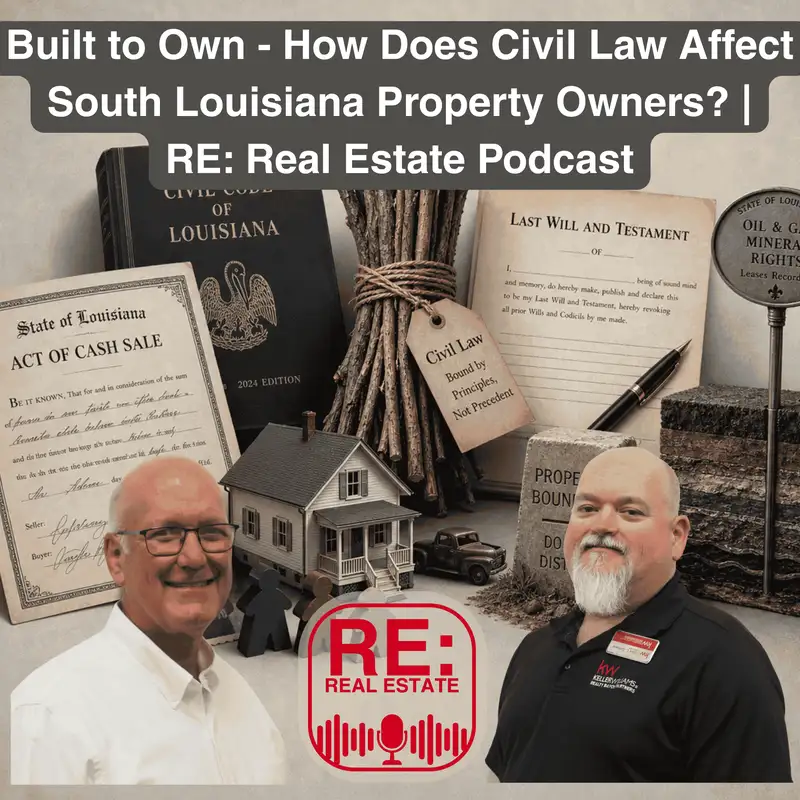
How Does Civil Law Affect South Louisiana Property Owners? | RE: Real Estate Podcast
Clint C. Galliano (00:00)
Every state in America runs on legal traditions inherited from England. Every state except one. Louisiana runs on civil law inherited from France, and that one difference is worth real money to anyone who owns property here, or will ever inherit any. Today we show you why. This is built to own.
Ben Harang (00:42)
Hi, everybody, and welcome to another episode of the RE Real Estate Podcast. I'm Ben Harang here with my co-host, Clint Galliano. We're three weeks into our built-to-own series. Last week we installed the most important framework of the series, the bundle of sticks. If you haven't heard that one yet, you may want to go back and listen to episode number two first. Today we take that framework.
And show you how Louisiana law handles those sticks differently from other states in America. Clint, how you doing today?
Clint C. Galliano (01:21)
Doing wonderful, Ben. we got a little thunder and lightning soundtrack in the background. How you doing?
Ben Harang (01:28)
I'm doing terrific. I'm I I guess we might stay dry inside, but I'm not a hundred percent sure with the way the weather's been going on. Hopefully we stay dry inside.
Clint C. Galliano (01:39)
Yep, yes sir
Ben Harang (01:42)
What we're talking about today, Clint?
Clint C. Galliano (01:45)
All right. Well, this episode's where the rubber meets the road. Up to this point, we've been laying foundations. We've talked about mindset. We've talked about framework. Today we get into something that actually changes what happens to your house, your savings, your kids' inheritance, and your spouse's position, if anything goes sideways. And here's the thing: if you've ever taken financial advice from somebody in another state or watched a personal finance show on national TV.
You've probably been told things that are flat wrong in Louisiana. We're gonna fix that today.
Ben Harang (02:21)
Yes, we will. Louisiana is the only state in America that runs on civil law rather than common law. That's not a technicality. It's a two hundred year old structural difference that touches almost every property transaction here.
Clint C. Galliano (02:39)
And today we're going to cover five practical ways civil law diverges from common law in ways that affect real Louisiana families community property, forced heirship, usufruct, predial servitudes, and prescription.
Ben Harang (02:58)
That's some big words, Fent. Most of what people learn about money and property on national television, national podcasts, and national personal finance books is written for the other 49 states. A lot of it is misleading and actively wrong if you apply it here.
Clint C. Galliano (03:19)
This is one of the episodes where you don't want to take what we say and act on it directly. We're educators, not attorneys. Damn it, Jim. The disclaimer at the end of this section is real and it's heavy. So why don't you lay it on us, Ben?
Ben Harang (03:39)
Before we go any further, nothing in this episode is legal, tax, or financial advice. Louisiana civil law is highly fact specific, and the difference between two situations that look identical from the outside can be tens of thousands of dollars in actual outcome. Every example in this episode is ill illustrative only. Before you act on anything you hear today,
Talk to a Louisiana attorney who handles successions, real estate, or family law. Talk to a CPA. Talk to a licensed real estate professional. We're here to put the framework in front of you. The application is yours and your professionals.
Clint C. Galliano (04:24)
All right, so you may be wondering why Louisiana is different.
So start off with Louisiana was a French colony, then briefly Spanish, and then back to French, then American. By the time the Louisiana Purchase happened in 1803, the territory had over a hundred years of legal tradition rooted in civil law,
a system that traces all the way back to Roman law.
Ben Harang (04:58)
When Louisiana became a state, it kept its civil law tradition. Every other state, every single one, inherited English common law. We're the outlier in American legal history.
Clint C. Galliano (05:13)
Two systems aren't just different vocabulary for the same concepts, they're structurally different. Common law evolves from court decisions and precedent. Civil law starts from a written code, in our case, the Louisiana Civil Code, which is updated by the legislature.
Ben Harang (05:34)
Why this matters in twenty twenty six. When you read a national personal finance book that says set up a living trust to avoid probate, that's common law advice. Trusts work in Louisiana, but they work differently here. When someone says leave everything to your spouse, that's common law advice. In Louisiana, you may not be able to. Forced heirship may apply.
Clint C. Galliano (06:04)
You may want to connect to Episode 2's bundle of sticks. Civil law doesn't reject the bundle of sticks framework, it just handles certain sticks differently. The right to devise, passing property at death, is a stick most affected. The right to transfer during marriage is the next most affected, and the right to encumber and exclude have their own Louisiana wrinkles.
Ben Harang (06:33)
And none of this is bad. Civil law has been working for over two hundred years here. The problem isn't the law, it's that most Louisiana property owners don't know the law is different until something happens.
Clint C. Galliano (06:47)
So you might hear Dave Ramsey or Suze Ormond or any national finance personality talk about Will's trust and inheritance. They're speaking common law English. They're not wrong nationally, but they're wrong here, and sometimes by a lot.
Ben Harang (07:06)
Okay, so the difference number one of the five practical differences. Married couples own differently community property. The plain English version, when you get married in Louisiana, unless you sign a contract saying otherwise, everything you and your spouse earn or buy during the marriage is jointly owned. Half is yours, half is theirs. Period.
doesn't matter whose paycheck it came from, it doesn't matter whose name is on the deed.
Clint C. Galliano (07:40)
So what changes? Each spouse needs the other's consent to sell community property, real estate. If you bought the house during the marriage and only your name is on the deed, your spouse still has community interests. They have to sign at the closing table even if they're not on the title.
Ben Harang (08:01)
There's an exception. Matrimonial agreements, sometimes called prenups or postnups, can establish a separate property regime. These are valid in Louisiana, but require specific formalities.
Clint C. Galliano (08:18)
And you may be wondering, why does it matter? About 80% of married Louisiana property owners are in community property without ever having thought about it. They don't realize what their spouse owns until something's happens, whether it's a divorce, a death, or a sale where the spouse won't sign.
Ben Harang (08:38)
Okay, difference number two, you can't disinherit your children completely. This is forced heirship. Plain English version in Louisiana, certain children, generally those under twenty-four or those of any age who can't care for themselves, are forced heirs. You can't write them out of your will entirely. They're entitled to a portion of your estate called the legitime
No matter what your will says.
Clint C. Galliano (09:12)
This is one of the most distinctly Louisiana features in all of American property law. In Texas and Mississippi and Alabama, you can leave your kids out of the will entirely. Not here, not for forced heirs
Ben Harang (09:28)
The size of the legitime depends on how many forced heirs you have. With one forced air, they get one fourth of your estate. With two or more, they collectively get half. The rest of your estate can go wherever you direct.
Clint C. Galliano (09:46)
Why this matters? Because people move to Louisiana from other states and assume the rules that they grew up with apply here. They don't. A will drafted in another state that disinherits a child may be partially invalid here, and the family doesn't find out until the parent has died.
that would be a rude awakening in in some cases.
Ben Harang (10:08)
⁓ it
it is. It often is and we see it a lot. the and a lot of times the the surviving spouse just believes they own everything and they can do whatever they want to do and they get their feelings hurt when they find out otherwise. so on to the third difference. Your spouse has rights that you didn't grant called usufruct.
Plain English version, usufruct is the right to use and enjoy property that someone else owns, including collecting income from it. In Louisiana, one spouse dies, leaving community property to children. The surviving spouse automatically receives a usufruct over that community property unless the will says otherwise.
Clint C. Galliano (10:58)
So in practical terms, the surviving spouse can stay in that house. They can collect rent if it's a rental. They can use it. But they don't own it outright. The children own it as naked owners. And it doesn't mean that they don't have clothes on. That's just a legal term.
Ben Harang (11:18)
So this is critical for blended families. If you remarry and have children from a prior marriage, your new spouse may end up with usufruct over property your children would otherwise inherit immediately. That arrangement can run for the rest of the surviving spouse's life.
Clint C. Galliano (11:39)
Yeah, I've I've seen that happen and you know it it's it's cause for hurt feelings and stuff and generally they eventually have to accept it. but it it's a fact of life in Louisiana.
So again, why does this matter? This is the issue that destroys more Louisiana families than any other. The new spouse and the children from the first marriage have inherited competing interests over the same property. Without a clear plan, it can produce decade long legal fights.
Ben Harang (12:15)
And unfortunately it does. The fourth difference, easements work differently here. predial servitudes. Plain English version, in common law states, the right of one property owner to use another property owner's land for a specific purpose is called an easement. In Louisiana, it's called a predial servitude. And the rules are different.
Clint C. Galliano (12:42)
So here's some examples. A neighbor having a right to cross your land to reach a public road. A power company having the right to run lines across your property. A drainage servitude that lets water flow across your backyard.
Ben Harang (12:58)
The biggest practical difference is how servitudes are created, recorded, and terminated. predial servitudes can be created by title, by destination of the owner, or by prescription, and some of them aren't in the public record where most buyers think to look.
Clint C. Galliano (13:20)
Why does this matter? When you buy property in Louisiana, the title search needs to be done by someone who knows Louisiana civil law specifically. National title companies sometimes miss predial servitudes because they're looking for easements in common law sense. One thing that does help when purchasing property in Louisiana is that by law
Regardless of who the seller is and who the overseeing title company is, the closing has to be handled by a Louisiana title company. They have to have an office in Louisiana. So and this comes up in the case of foreclosures. you know, if somebody is trying to purchase a foreclosure, kind of getting off topic here, but
Ben Harang (14:12)
Mm.
Clint C. Galliano (14:12)
They will contract out with a local title company to do the title work and do the closing.
Ben Harang (14:21)
Okay. Difference number five. Time can create or destroy rights. Prescription. Prescription is the civil law cousin of what common law states call adverse possession or statute of limitations. In Louisiana, time can either give you a right to the property you don't own or take away the right.
you do own depending on the situation and how much time passes.
Clint C. Galliano (14:53)
So acquisitive prescription is if somebody openly possesses a piece of property like an owner for long enough, typically ten or thirty years, depending on the circumstances, they can acquire ownership even from an actual owner.
Ben Harang (15:12)
A liberative prescription is a if a right is not exercised within the legal time limit, it can be extinguished. The most important example for property owners is mineral servitudes. If minerals are reserved by a previous owner and no production occurs in ten years, the mineral rights generally revert to the current owner.
That's the entire subject of next week's episode.
Clint C. Galliano (15:44)
Why does this matter? Prescription is the silent stick mover in Louisiana property. Most owners never think about time as a force that changes who owns what. And it does all the time.
Ben Harang (16:00)
All right, here's an example we're gonna run through. Texas versus Louisiana. We're gonna take a hypothetical family, a married couple, two adult children, four hundred thousand dollars in combined assets, a paid-off home worth two hundred and fifty thousand dollars, and a hundred and fifty thousand dollars in retirement and savings. One spouse dies without a will.
Clint C. Galliano (16:27)
In the Texas version, common law, no community property by default, the surviving spouse and the children get a share of the deceased's estate under in intestate succession rules. Each party gets a defined fraction, clean, predictable.
Ben Harang (16:48)
Here's Louisiana version. Half the assets are already owned by the surviving spouse under community property. They were never the deceased spouses to give away. The other half passes through succession. If the deceased had a will leaving everything to the spouse, but there are forced heirs, children under 24, the forced heirs are entitled to the legitime
If there's no will, the spouse gets a usufruct over the community property half going to the children, but the children own it as naked owners. Gets a little convoluted there, Clint.
Clint C. Galliano (17:27)
Yep. So end result, same four hundred thousand dollars, same family configuration, materially different outcomes. The Louisiana surviving spouse may have less outright ownership, but more lifetime use. The Louisiana children may be richer on paper, but unable to access the asset until the surviving spouse dies.
Ben Harang (17:52)
Now imagine the family moves from Texas to Louisiana three years before the death of one of the spouses. The estate plan they drafted in Texas may not work the same way here. The will that disinherited a stepchild in Texas may be partially invalid here.
Clint C. Galliano (18:12)
Same family, same dollars, different state, different outcome. That's why next week we start spending entire episodes on specific Louisiana sticks, mineral rights, water rights, because the differences are big enough to be their own conversations.
Ben Harang (18:30)
All right. I think that does it for today, Clint.
Clint C. Galliano (18:35)
I think so. if you got something good it it got a little bit deep.
Ben Harang (18:36)
this this one g this one got heavy.
Yeah. so at at the end of the day we we talked about a lot of stuff. talk to your attorney, talk to your CPA, find a real estate professional that is experienced and that you you're comfortable with, and work through the specifics of your situation. 'Cause no two s situations are the same.
Clint C. Galliano (18:59)
Yes indeed. And if if some of this was interesting to you and you feel you need to know more, first off, if you haven't already, go back and watch episodes one and two of this series. but reach out to your attorney, to your CPA, and if you don't have one
Reach out to us at rerealestatepodcast@gmail.com and we can recommend some to you. you know, this this is about protecting you and your family and building your net worth. This is about avoiding risk. This is about ensuring that your family is able to grow and move forward.
Regardless of what happens.
Ben Harang (19:54)
Okay. So that's episode three of Built to Own. Next week we get into mineral rights specifically. The one stick from our bundle that families in the oil and gas country lose more often than any other. If you own land in South Louisiana or might inherit land in South Louisiana, do not miss it.
Clint C. Galliano (20:15)
All right, so homework this week comes in two parts depending on your situation. First, if you're married and you own property in Louisiana, find out your matrimonial regime. Now that's a funny word. it sounds fancy.
Ben Harang (20:27)
Hmm. Regime.
Yeah.
Clint C. Galliano (20:33)
The default is community property, but some couples sign matrimonial agreements that change that. Most don't know what which they're in. Look through your closing documents and any marriage paperwork. If you can't tell, that's a 30 minute conversation with a Louisiana family law or succession attorney. It's worth the cost. Second, if a parent owns Louisiana property, ask them whether they have a will and specifically whether the will addresses usufruct.
If a parent has remarried, this question gets even more important. The answer might be no, we haven't talked about that. And that itself is the win. Knowing what hasn't been addressed yet is the first step towards addressing it. In both cases, the answer is the same. If anything you find concerns you, the next step is Louisiana succession or estate planning attorney. Not a national template service, not a national finance podcast.
A licensed Louisiana attorney. And I'll say that again. A licensed Louisiana attorney.
Ben Harang (21:40)
No doubt. No doubt. All right. I think we took care of this this topic, Clint. I think it was a good one. We hit on some some heavy stuff. and and a lot of people don't like talk to talk about what happens after somebody dies. and I tell people, either you can decide what happens after you die, or the state's gonna decide what happens after you die.
But somebody's gonna make that decision and I think it rather it it you would rather want it to be you rather than the state of Louisiana. All right. I quit. We're gonna wrap it up,
Clint C. Galliano (22:13)
⁓ there's there's this
there's this one phrase that I like to say, you know, whether you have a will or you don't, you have a will. It's your wishes or the state's wishes.
Ben Harang (22:22)
Absolutely.
Whether you like it or not you is a different story, but you have a will. So all right.
Clint C. Galliano (22:29)
That's right. All right. So if today
helps something click into focus, share it with one person, especially anyone in your family who might inherit Louisiana property. This is the kind of information it gets expensive to learn the hard way. Subscribe wherever you get your podcast so next week's episode lands automatically.
And every episode is at RE Real Estate Podcast dot com and on YouTube at at RE Real Estate Podcast. We'll see you next week.
Ben Harang (22:57)
All right, have a good one, Clint.
Clint C. Galliano (22:58)
You too, Ben.
Creators and Guests