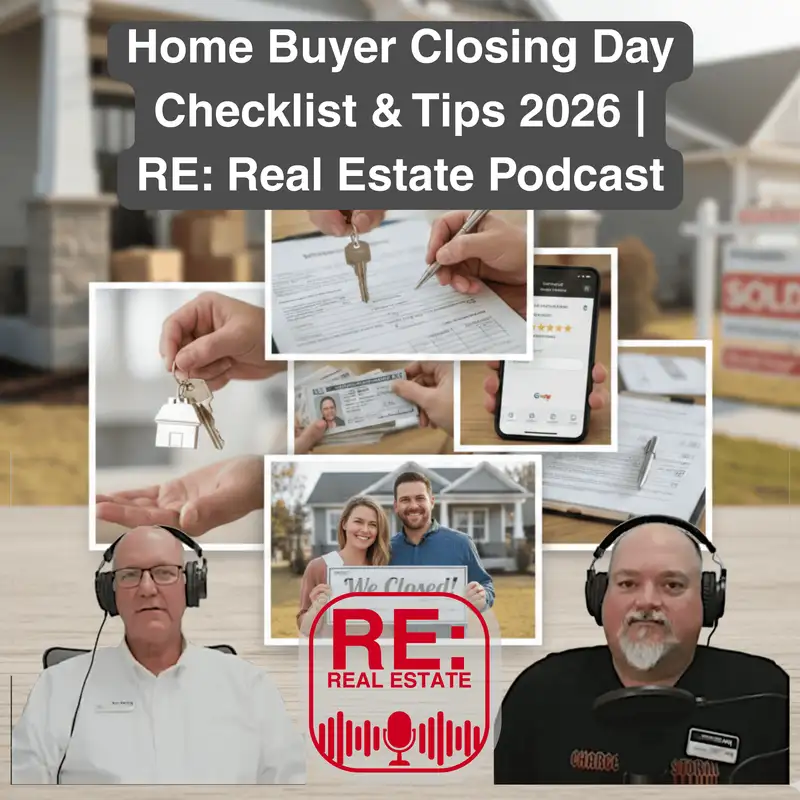
Home Buyer Closing Day Checklist and Tips - 2026 | RE: Real Estate Podcast
Clint C. Galliano, REALTOR® (00:14)
You've signed the offer, survived the inspection, and packed the boxes. Now you're ready for the closing table.
Today, we're breaking down the final hurdles and post-closing must-dos so you can grab the keys without any stress.
Let's get you home.
Ben Harang (00:34)
Hello everybody.
Welcome to another episode of the RE Real Estate Podcast. My name is Ben Harang With me today is my co-host Clint Galliano. Clint, good afternoon. How you doing today, man?
Clint C. Galliano, REALTOR® (00:49)
I'm doing wonderful, Ben. How you doing?
Ben Harang (00:53)
I'm doing terrific. Life is good, the sun's shining outside, weather's going to change, but that's okay. It's winter time.
Clint C. Galliano, REALTOR® (01:01)
I wore
a jacket today and I didn't even need it.
Ben Harang (01:04)
I had to take mine off. I did wear it today and I needed it. But before we started this foolishness, I took it off. what are we talking about today Clint?
Clint C. Galliano, REALTOR® (01:14)
Alright, so today we're talking about the closing. And as a buyer, this is the most exciting part of your home buying journey. Or at least it should be. we're going to go over the steps. And we're going to provide a roadmap.
steps that you need to go to and what you can expect on closing day and we're gonna go over basically all the things that should happen. So I want you to start out by telling us what do buyers need to bring to the closing.
Ben Harang (01:52)
There's a couple of couple of absolutes that you need and without them we can't close So the first thing you want to do is bring a government issued ID Drivers license or passport or or the two that are generally brought? If you don't have a driver's license a state I a state issued ID I'm not sure if there's anything else that meets that standard, but it's got to be issued by the state. It's not a
not a school ID, not a, not an employment ID, but it's got to be issued by the state. And if you're bringing cash to the close to the closing, which you probably are, it needs to be either wired to the title company before we close or come with a cashier's a certified check.
the attorneys, it gets a little awkward when somebody just says, I'm going to just write a check. And it's not that the attorney doesn't trust anybody or doesn't want to take your check, but they're prohibited from taking a check for anything over $2,500. They can take a check for less than $2,500 to right a wrong maybe or to fix a problem. But if you come in with $15,000 to the closing, they cannot legally accept the check for $15,000. So your lender,
will tell you what you need to bring. You need to have some time to get to the bank before the closing to get that bank check, certified check, cashier's check, whatever your bank calls it. those are really the two things you need to bring. it's a cash deal, need to, the title company will tell you what it's going to actually cost to close, including the sales price plus their fees. So either way,
You'll need to either wire the money or bring a cashier's or certified check to the closing.
Clint C. Galliano, REALTOR® (03:40)
Now,
my personal preference is certified funds or cashier's check just because it's pretty easy to go to your bank and request one. They'll take care of that for you fairly quickly. The downside is, is that if the bank that you deal with is not nearby, then it may be a better approach to wire the funds. The key thing to remember when you're wiring funds,
Confirm any requests and any account numbers and everything over the phone and make sure that you know who you're talking to on the other end That that's the point of the whole cyber fraud clause in our buyer rep agreements And our listing documents to make sure that nobody is getting scammed out of their money
Ben Harang (04:26)
And I have been involved in closings where we did get a bogus emails and I don't know how they do it, but they'll clone an email and make it look like it's coming from the title company and said, we've had a change in wiring instructions. Here are our new wiring instructions. If you get anything like that, full stop. Don't send any money. Don't call a number that's on that.
that email, call the number that you know and say, hey, did y'all change your wiring instructions? And they'll probably say, no, we didn't. So just be careful when you're wiring. Like Clint said, you are better off bringing a check so you don't get caught up in something like that. Because that's extremely difficult to undo if you send the money.
Clint C. Galliano, REALTOR® (05:13)
Yeah, and you may be required to bring other documents. On the buy side, the, so actually I've got a closing tomorrow. I'm selling one of our rentals and I have to bring an original for my certificate of authorization that basically says that I'm authorized to sign on behalf of the company. ⁓ So I have to bring the original. They were able to...
Ben Harang (05:35)
Mm-hmm.
Clint C. Galliano, REALTOR® (05:39)
go through everything and process everything with a copy, but they need the original document to attach to the sale. yes, yeah, yeah, if you remember a couple episodes back, we talked about in the beginning of January how we were waiting since basically the end of November for our power of eternity to show up from Kenya. So
Ben Harang (05:46)
And then the same thing would go for a Power of Attorney, they need the original.
Mm-hmm. Mm-hmm.
Clint C. Galliano, REALTOR® (06:03)
They do need the original on that also.
Alright, the main event. What happens at the closing table? Alright, so at the closing table, depending on who the title attorney is or the notary, depending on who you're closing with, they typically will try to get all of the seller's paperwork done first.
Ben Harang (06:10)
fun stuff.
Mm-hmm.
Clint C. Galliano, REALTOR® (06:31)
Because sellers mainly doesn't have a whole lot to do. If a WDIR is involved, they have to sign that. They have to sign the closing disclosure. And if you're using a loan, they have to sign it. If not, then they just get a copy of a closing disclosure, and that's all that's needed. The other thing they have to sign is the act of sale. That is the...
only requirements for the seller to sign. So typically they'll knock those documents out first. And when that's done, they'll let the sellers be on their merry way. As a buyer, you have to sign those documents also, but you also have to sign your mortgage paperwork. And that varies from lender to lender. I find that the lenders that
don't do a significant amount of mortgages, tend to have a lot taller stack of paperwork. Whereas the lenders that are kind of more like factory lending, they get a lot of their stuff signed online and only have the essentials that need to be signed in person and notarized. The main which would be the mortgage instrument that will be filed with the parish that says, hey, he's buying this property, we're providing the money and...
Ben Harang (07:42)
Hmm
Clint C. Galliano, REALTOR® (07:48)
he owes us this and needs to pay us this and or she. And so those are the main things. And depending on what it looks like, know, so maybe 20 minutes for the seller, but it could be up to and onwards of an hour for you as the buyer, depending on what that stack of paperwork looks like. I closed one where
the buyer was doing a down payment assistance mortgage also. So basically it was two whole sets of mortgage documents that he had to go through and sign. So that was kind of fun. So go ahead.
Ben Harang (08:23)
Yeah, and
one of the things that sometimes it seems like there's some downtime, everything's signed. Okay, all right, I'm sorry, go ahead. I'll back up. I'll get back in my lane, Clint.
Clint C. Galliano, REALTOR® (08:34)
that's what I was getting ready to cover.
So once everybody signs the the act of sale and everything and again this depends on the lender if they'll take the act of sale and process the the funding of the loan They'll send that over to be reviewed a lot of times. They'll wait until they finish the
mortgage paperwork and everything and then fax it over either fax or scan an email over to the lender and the lender verifies that everything was signed correctly and all the I's are dotted and T's were crossed and then once they verify all of that they will go ahead and quote unquote "fund the loan" and basically what that means is that they'll wire money to the title company to cover the the amount of the loan.
some lenders will actually wire the money ahead of time depending on what documents were taken care of. it depends on what lenders being used, but during that time while they're processing the payments, transferring the money, and verifying that all the paperwork was filled out correctly, you get to sit in the conference room and if the sellers are still there, because if they're waiting on their check.
to get paid, then they may be waiting with you. And so you can sit there and chit chat, ask questions about the house, find out details. If you're wondering what the light switch over the fireplace that was behind the TV, what that does, things like that. Also transfer the keys. Once the act of sale is signed, you can get the keys from them. So that's the reward. But that's what the...
Probably besides the signing, that's the other part that takes a little while is while they're doing that. Once everything is done, you may be asked by your realtor and or your title company to take pictures with the new keys or holding a closing folder to document it and use for marketing purposes. If you're not comfortable with that,
you can let them know ahead of time that you don't want to take pictures. But generally, it's always a good idea because they like to celebrate you and that you've done a wonderful thing.
Ben Harang (10:55)
Mm-hmm.
It's amazing that that's a generational thing. The younger generation will turn up and smile for that camera in a nanosecond. And older generation will say, I think we'll pass on that. So it does. It does. So don't be ashamed to pass on it or don't be ashamed to do it. Whatever you're comfortable with, that's what you ought to do.
Clint C. Galliano, REALTOR® (11:12)
That happens a lot.
Yep. Just be aware that you may be asked. So don't be surprised. And if you're closing with me, we're going make sure that you hold that title company sign upside down.
Ben Harang (11:25)
Yes.
Alright.
Absolutely. That's Clint's stick.
All right. The final steps. Utility management. Hopefully you've taken care of the utilities before the closing and given them the closing date as the time to read the meter and the utilities will not be disconnected. You don't want to do that.
Clint C. Galliano, REALTOR® (11:50)
It's a pain in the butt to get them reconnect.
Ben Harang (11:52)
You don't want to have to go through that, especially if you think you're moving in on the Friday and they're going to come connected on a Friday, you're probably out of luck. Address updates. Change your address with everybody. And that's also a pain in the neck. But start the process. You'll have to do it multiple times, but just start the process. the more data you have of who needs your new address, the better off you'll be in the long run.
Homestead exemption what I like to do with that is When we leave the closing table, we either walk or drive to the assessor's office Where we file the claim for the homestead exemption in Louisiana? You do not pay property taxes on the first seventy five thousand dollars of assessed value of the property Which around here is about eight hundred dollars a year eight hundred eight hundred fifty dollars on at first seventy five thousand dollars
So that's every year. So you want to make sure you do that. And the best way not to forget is to do it right after the closing. Sometimes we can't, sometimes closing it ends too late and we can't get to the assessor's office, but please do it soon after because the longer you wait, the more likely you'll forget and it's going to cost you. The taxes that are escrowed in a loan,
on mortgage on a a finance sale is calculated with the homestead exemption in place. So if you go a year without filing the homestead exemption and that bill comes out and you're not homestead exempt, your taxes, your escrow will be short about $850. So then they're going go up on your escrow payments.
Clint C. Galliano, REALTOR® (13:32)
that must boost it up to make sure that the escrow account has enough to cover taxes and the amount of that additional $850 or whatever that value would be.
Ben Harang (13:44)
Right, so if you don't get the Homestead Exemption that first year, the escrow is going to go up and they're not going to change it back until the following year when they get the new tax bill, regardless of what you tell them. So just make sure you do the Homestead Exemption soon after closing so you don't forget it doesn't mess up the planned escrow account payments that you're making.
Clint C. Galliano, REALTOR® (14:07)
So a couple of things on Homestead Exemption. It is only for owner occupants. So if it's an investment property that you're buying, you can't claim a Homestead Exemption on it. You have to be living in the property. Another thing, if you're a disabled veteran with a disability rating from 50 to 90%, you'll get some range of additional exemption on top of the standard Homestead Exemption. And if you're 100 %...
Ben Harang (14:25)
Mm-hmm.
Clint C. Galliano, REALTOR® (14:37)
then at that point, they freeze your taxes, or actually, you don't pay taxes on your home from that point on.
Ben Harang (14:44)
Right, right. So thank you for your service. If you are a veteran and if you are disabled, you absolutely deserve that credit. So make sure you get it. And another group that freezes the taxes are people 65 and over that have an adjusted gross income of a certain amount.
will freeze the taxes from that day forward. So if you're over 65 and whether you buy a new house or not, see if you're eligible to freeze your property taxes. What freezes is the assessed value. What does not freeze is the taxes that are applied to that assessed value. So you're not going to get away with out of all the increases, but you'll get out of most of the increases.
Clint C. Galliano, REALTOR® (15:29)
Just to give you an idea of how that works, a lot of the automated home valuation services take the assessed value of the property and use that as a basis for how to come up with a value of the property. was looking at, using one, had a client put in their home address and their home came back
about $100,000 less value than all of the neighbors. And this is rough estimate, but I did some investigations trying to figure out why. And what it was was that there was a 65 and over freeze, and so their property hadn't been assessed in over 10 years.
Ben Harang (16:00)
Mm-hmm.
Clint C. Galliano, REALTOR® (16:17)
And so that was roughly the amount of growth, it might even been 15, but that was roughly the amount of growth for the neighborhood that because they didn't assess the property any further after that point, the automated calculations came up with $100,000 less of estimated value. Now if they wanted to sell it, they would still be at the same value as the rest of the neighborhood and everything. But it just kind of gives you an idea of
Ben Harang (16:25)
Mm-hmm.
you
Clint C. Galliano, REALTOR® (16:47)
how that works. They're paying taxes on $100,000 less of property value.
Ben Harang (16:51)
Mm-hmm.
Right. It is. is. So if you're eligible for an exemption, go ahead and file for it. But everybody, all of the owner occupied properties is eligible for the $75,000 homestead exemption. So make sure you at least get that.
Clint C. Galliano, REALTOR® (16:55)
How cool is that?
All right, in conclusion, so we talked about what you need to show up for the closing. We covered what you're going to do at the closing table and then what to do after you finish at the closing table. So a couple of things, this is after you walk away from the closing. I want to talk a little bit about the power of referrals. So if you found your agent's service valuable, greatest compliment you can pay.
your realtor is a referral to friends and family or colleagues that are looking to buy or sell. ⁓ You know, it's easy thing to do. So, you know, help share the story of, what a wonderful job they did for you. Another thing is leave a detailed review on your realtors Google business page.
Ben Harang (17:46)
Mm-hmm.
Clint C. Galliano, REALTOR® (18:04)
And I'm not going to say if you want to be extra, but it'll actually help them out if you can upload a picture or a video to kind of talk about your experience. The visual reviews are very helpful. They help other buyers searching for a trusted professional. And they actually help the realtor to score heavier or higher.
Ben Harang (18:16)
Mm-hmm.
Clint C. Galliano, REALTOR® (18:29)
because they've got those types of reviews. And finally, congratulations on your new home.
Ben Harang (18:38)
It wasn't that bad, was it, Clint? The buying process. And we said this when we started, the buying process starts when you contact a realtor that you're comfortable with, that you can work with, and you ride it together and follow the advice, and you typically will get to the closing table.
Clint C. Galliano, REALTOR® (18:41)
It was not.
Ben Harang (19:01)
I guess that's we got another one in the can clint. That's what you say.
Clint C. Galliano, REALTOR® (19:05)
Before we say that I'm gonna say if you found this useful would appreciate it if you go to rerealestatepodcast.com and if you're into the audio podcast you can watch them there on the website, share it, subscribe, tell your mom and them or you can subscribe with your favorite podcast app and we've got links for just about everything there.
Our podcast is podcast 2.0 compliant, so it'll work with all of the new podcast apps. And we also have a link to our video podcast on YouTube. So if you prefer watching a video, you know, I mean, who wouldn't want to look at us, right? So good. Yep. So, you know, you can go to our YouTube channel and
Ben Harang (19:49)
Who wouldn't want look at those two faces for radio? Made for radio.
Clint C. Galliano, REALTOR® (19:58)
watch all of our episodes there. So like, share, subscribe, whatever way you can find us. Share it with your friends, tell your mom and them, that's at rerealestatepodcast.com.
Ben Harang (20:09)
Did you say Clint re real estate podcast.com.
Clint C. Galliano, REALTOR® (20:14)
That's it.
Ben Harang (20:15)
All right.
Clint C. Galliano, REALTOR® (20:18)
All right, now it's another one in the can.
Ben Harang (20:21)
another one in the can. Alright, I hope everybody has a great day. See you Clint.
Clint C. Galliano, REALTOR® (20:27)
See you man, thanks.
Creators and Guests