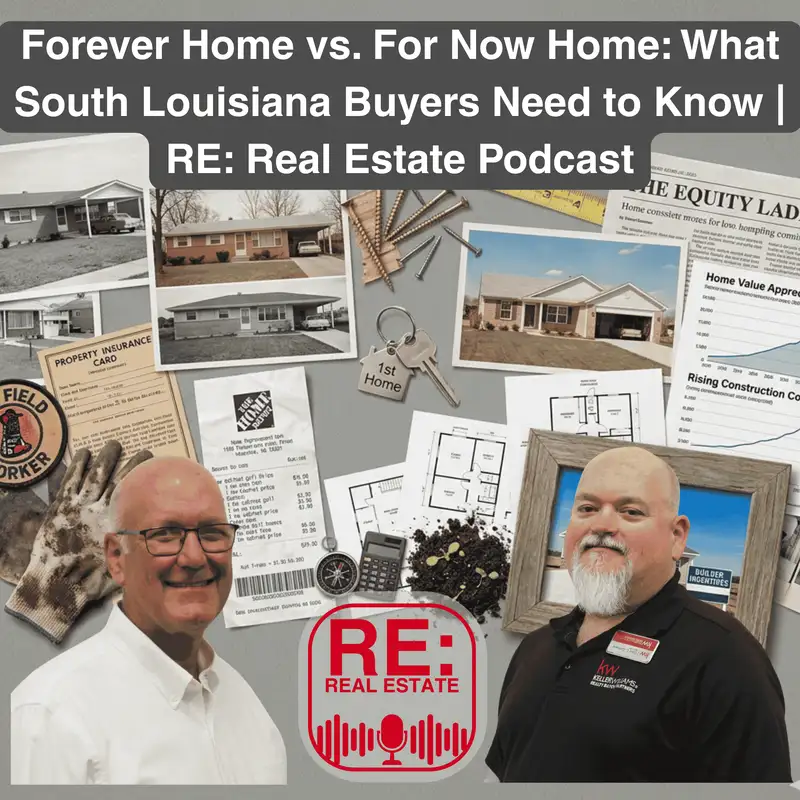
Forever Home vs. For Now Home: What South Louisiana Buyers Need to Know | RE: Real Estate Podcast
Clint C. Galliano, REALTOR® (00:00)
most people spend years dreaming about their forever home, the perfect neighborhood, the right square footage, the backyard they've always wanted. But what if chasing that dream is actually costing you money? Today we're discussing forever homes, for now homes, and how to think about one of the biggest financial decisions of your life. Let's talk about it.
Ben Harang (00:38)
Hello everybody. Welcome to another episode of the RE Real Estate Podcast. My name is Ben Harang. With me today as usual is my cohost, Clint Galliano. Good afternoon, Clint. How you doing today, man?
Clint C. Galliano, REALTOR® (00:54)
I'm doing wonderful, Ben. How you doing?
Ben Harang (00:57)
I'm doing terrific. ⁓ We got a little rain shower today that we hadn't had in, seems like, weeks or months. And it felt good for a change. So ⁓ tell us what we're talking about today, Clint.
Clint C. Galliano, REALTOR® (01:10)
good thing.
All right, so today we're talking about something I think that a lot of buyers need to hear. It's the difference between the home that you want right now and the home that actually makes the most financial sense for where you are in life. We're calling it the forever home versus the for now home. And I think that's gonna, this one's gonna hit close to home for a lot of people listening.
Ben Harang (01:40)
Mm-hmm.
Clint C. Galliano, REALTOR® (01:40)
So
buying a home is one of the largest financial decisions most people ever make. And yet a lot of buyers, they approach it emotionally rather than strategically. ⁓ The concept of a starter home, it's been around for generations. ⁓ know both of us started out with starter homes and our parents definitely had them. But somewhere along the way, the mindset shifted.
Ben Harang (01:53)
Mm-hmm.
Clint C. Galliano, REALTOR® (02:09)
and today's straight to the finish line. This episode isn't about telling people what to do, it's about helping them to make the smartest financial decision that they can live with.
Ben Harang (02:14)
Mm-hmm.
Yeah. Well, let's talk about how we got here, Clint. You know, it goes back to World War II. And post World War II, through the 60s, the GI Bill opened homeownership to an entire generation that never had access to it before. Homes were modest by today's standards. Small, functional, built for a family that was just getting started.
Clint C. Galliano, REALTOR® (02:28)
And that sounds like a good idea.
Ben Harang (02:51)
Nobody expected their first home to be their last home. The latter was the point.
Clint C. Galliano, REALTOR® (02:59)
in the 70s and 80s, a lot of people, their parents bought their first home. The starter home was a cultural norm. You bought what you could afford, you built equity, and when the kids came or the income grew, you moved up. The upgrade was expected, not exceptional.
Ben Harang (03:21)
Right. So in our market, moving up didn't always mean moving out. A lot of families expanded in place. Converting a carport or garage in the living space was a cheaper alternative than buying a bigger home.
It was practical, it was resourceful, and frankly, it's all over our market today. You can spot those conversions the minute you walk through the door. You walk in and say, yep, that was the garage, or that was a carport, or that was the front porch. The renovation expansion are simply cheaper than uprooting the whole family and buying up.
Clint C. Galliano, REALTOR® (03:59)
Yeah, it's like a lord knows how many showings I've gone on and pull into the driveway and it just sticks out. It's like, okay, that's definitely a converted garage.
Ben Harang (04:05)
Mm-hmm.
You have a brick house and then you have vinyl siding where the garage door used to be.
Clint C. Galliano, REALTOR® (04:16)
it. All right,
the next one is the equity escalator. The latter worked because home values generally appreciate over time. You bought small, built equity, then used that equity as a down payment on the next step up. Each move was financially strategic, not just lifestyle driven.
Ben Harang (04:41)
so what changed? ⁓ Things like rising construction costs, tighter inventory, and a cultural shift driven in large part by social media and home improvement television created a new expectation. Why climb the ladder when you can just start at the top? ⁓ And I tell people, social media, there's nothing on social media that is real.
It's all a facade. if you're down in the dumps because of what you see somebody else doing on social media, you're better off than they are, I promise you. That's my gig for the day.
Clint C. Galliano, REALTOR® (05:25)
Don't compare your inside to somebody else's outside.
Ben Harang (05:30)
There you go. There you go.
Clint C. Galliano, REALTOR® (05:33)
So Ben, I mean, you've been doing this for a while. So ⁓ you've kind of watched this shift happen in real time. When did you start noticing that buyer's expectations changed?
Ben Harang (05:45)
You know, when we were prepping Clint, ⁓ we talked about this briefly. I have a history in the property insurance business and Hurricane Andrew hit in 1992. ⁓ Devastated Homestead, Florida then came up and the eye went in in Morgan City and did a whole lot of damage around here. ⁓ It feels like after that storm, things blossomed. ⁓
There was a lot of pent-up demand for ⁓ housing that wasn't being met because of the high interest rates in the 80s. ⁓ And it feels like the interest rates were moderating in the early 90s. Subdivisions started being built. There was more land available to build houses, and the style of houses changed. They were no longer building those ranch-style houses, the wide...
the wide houses that were three rooms deep, but these had the high pitched roofs, the big columns in the front, the high ceilings, eight foot ceilings, nobody wanted anymore. I tell people I never hit my head on an eight foot ceiling before, but that's the era when I feel like the time changed, when things changed with the housing market and people started buying.
more expensive higher-end housing.
Clint C. Galliano, REALTOR® (07:13)
Now, something else that correlated with that approximate time frame was that the oil industry started to quote unquote come back from the crash of the 80s. I started my oil field career kind of towards the end of the 1992, end of 1993, right in that range.
Ben Harang (07:26)
Mm-hmm.
Mm-hmm.
Clint C. Galliano, REALTOR® (07:41)
I initially started out as a mud engineer and I was in the second class to go to what they call mud school. So that was what they called the training. And so I was the second class after they had shut it down for a number of years. So that was like when they were just starting to ramp back up. So it's a correlation, not a causation, but still that was pretty interesting.
Ben Harang (08:05)
Right, right.
Things changed about that time in a local economy in South Louisiana. All right, Clint, did you and Melanie follow the traditional ladder? Did you skip a rung and buy your last house first?
Clint C. Galliano, REALTOR® (08:23)
⁓ So we pretty much ⁓ rented, stayed with family and rented. ⁓ bought my house, my first house right before I met Melanie. And then we got married and lived in a rent house while we built our.
current house that we lived in. So as of right now, it's our last house. I'm not going to say it's going to be the last house we ever live in, but for right now, it's our last house. But that being said, we bought the lot and we built the house on it for $145,000.
Ben Harang (08:54)
Mm-hmm.
Yeah, and you can't find a house today for $145,000 that doesn't need to be redone. And you got a new house.
Clint C. Galliano, REALTOR® (09:13)
Exactly.
Ben Harang (09:15)
So, okay. All right, so what drives the need for buying your forever house first? We kind of hit on it, HGTV and the social media effect. Buyers today have been conditioned by years of renovation television and Instagram perfection.
with interiors to expect move in ready perfection from day one. The idea of buying something modest and building into it has lost its appeal for a lot of people. And again, Clint said it, don't judge your inside by other people's outsides. And that's where a lot of the influence comes from.
Clint C. Galliano, REALTOR® (10:02)
Yeah, because that's just the comparison trap. When your feed is full of other people's dream homes, your own for now home can start to feel like a consolation prize, even if it's a perfectly solid financial move. Ultimately, you got to ignore that. You know, it's the same thing like, you know, if you watch the news every day in the morning and at noon and at night, you're going to be a really anxious person.
Ben Harang (10:14)
Mm-hmm.
Yeah.
Yes, yes. So here's something that a lot of people never thought about. Student debt and delayed timelines. Student debt is a relatively new phenomenon. ⁓ Many first time home buyers are entering the market older than previous generations, which creates a psychological pressure to catch up by buying the forever home that feels like making up for lost time.
And that's an interesting twist that a lot of people never thought of.
Clint C. Galliano, REALTOR® (11:06)
It's true, because I want to say what? The most recent numbers, the average first time homebuyers age is like 40 or 41 years old.
Ben Harang (11:19)
as opposed to 25.
Clint C. Galliano, REALTOR® (11:21)
Right, yeah, it's like I was 25 when I bought my first home.
Ben Harang (11:25)
Mm-hmm.
Clint C. Galliano, REALTOR® (11:26)
⁓ The affordability paradox is another one. Ironically, the desire to buy a forever home right away can push buyers into price ranges that stretch them financially. And then that leaves little room for life that's supposed to happen inside that dream home. All of their money is going towards paying the note and they're struggling just to keep up.
Ben Harang (11:44)
Mm-hmm.
That's true. And what we're seeing in the home of Thibodaux market is that buyers are passing on solid, affordable homes because they don't check every box. Then watching those homes sell to investors or cash buyers while they're still waiting for the perfect house. There's a difference between wants and needs, the needs you need to fill, the wants.
You can fill them until you can't fill anymore. But don't let the house that that fits your needs and most of you wants get away from you because it didn't fit all of your wants.
Clint C. Galliano, REALTOR® (12:35)
It doesn't have the cabinet pulls I want, Let's look at another house.
Ben Harang (12:40)
change the cabinet pulls. mean, yeah, yeah, yeah. You don't even have to go down the street to the store. It'll deliver them to you. That's another mindset, immediate gratification.
Clint C. Galliano, REALTOR® (12:44)
You can order them for $3 on Amazon.
All right,
so let's look at the case for the For Now home and why new construction incentives change the math. So the best deal you can live with financially. I mentioned that earlier. It's kind of a good approach to take ⁓ because it's what you're comfortable with.
The goal isn't the biggest house or the prettiest house. The goal is the house that costs you the least to own while still meeting all of your real needs. That's a fundamentally different question than, is this my forever home?
Ben Harang (13:37)
Right, right. Let's talk about new construction with builder incentives. The new construction industry changed in about 2010, 2012 when the tract builders came to town. Used to be a new construction house was one spec house that one contractor built might have built three or four or five a year. ⁓ And they were not
readily available all the time and just they were available when when the contractor would build them these tract houses came in and these cats were building houses in six and eight weeks and ⁓ There's nothing on a lot in four months later. The house is ready to be moved into ⁓ But they're offering rate buy downs Closing cost contributions that can translate into thousands of dollars in real savings over the life of a loan
The new construction home at a bought-down rate may cost significantly less per month than a resale home at market rate, even if the purchase price looks similar on paper.
Clint C. Galliano, REALTOR® (14:50)
Yeah, and it's not a forever home, but it doesn't have to be.
A new construction home in a developing area may not have the private acreage or the pond that you're dreaming about, but it's a financially smart place to park your money while you build equity towards a home that does.
Ben Harang (15:11)
of the garage conversion revisited. Our grandparents didn't wait for the perfect house. They bought what they could afford and made it work. That mindset is worth rediscovering. I tell people, do yourself a favor and buy your first house first. Do not buy your last house first.
The new construction houses that are available with the incentives right now, you can buy a lot more house with the principal and interest and taxes and insurance in the note than you can on a 30 year old house that might have a little bit bigger room or might have something else you want. But with the buy down and the lower cost of insurance on new construction.
In my mind, it's a no brainer. that new construction, get moving, get comfortable, make it a home. And three to five years are going to pass in a blink of an eye. And then while you're living in that house, you can start looking for your next house.
Clint C. Galliano, REALTOR® (16:26)
Now, so we talked earlier about mindset. So in this case, equity is the real goal and equity is what makes up your net worth. Every month you're renting or waiting for that perfect house, you're building somebody else's equity. A for now home that you own,
is almost always a better financial position than a forever home that you're still saving for. And that in turn increases your net worth.
Ben Harang (17:01)
Yeah.
Yeah. All right.
how do you actually decide whether you're buying you forever home or you're for now home? Ask the right questions first. How long do you realistically plan to stay in the home? Can you comfortably afford the payment if your income dips or your family grows?
Is this home in a market where you can reasonably expect appreciation?
Clint C. Galliano, REALTOR® (17:37)
So five year rule of thumb. If you're not fairly confident you'll be in the home for at least five years, buying at the top of your budget is a risky move. The for now home with a lower payment gives you flexibility that a stretch forever home does not.
Ben Harang (17:57)
You can define something you can live with. There's a difference between compromising on granite countertops and compromising on school districts or flood zones. Know which compromises are cosmetic and which ones are structural to your life.
Clint C. Galliano, REALTOR® (18:19)
Work with an agent that'll tell you the truth. Not every agent will tell a buyer that they're stretching too far or that the shinier house down the street is a worse financial decision. They may not know. They may not care. Find one who will.
Ben Harang (18:34)
Mm-hmm.
having somebody that you can have an adult conversation with that respects you and you respect makes all the difference in the world in this process. You want somebody that will tell you what they think and you can agree with it, you can disagree with it, but you need to hear it.
So you can take that into consideration when you're making the decision to buy the house. Because we as agents don't tell you which house to buy. We give you advice and counsel about the pros and cons of the house. You decide which house it is. And once you decide the house you want, that's when we really go to work trying to get it for you. So sometimes you don't always get the conversation you should have during the decision making process on which house you want.
which house you should be buying.
Alright, so this week let's do some math. If you're actively looking for a home or thinking about buying it, sit down and calculate two numbers. First, what's the maximum monthly payment you can make and still sleep at night if something unexpected happens?
Second, what's the most what's the monthly payment on a new construction home in your target area? With current builder incentives factored in You may be surprised how close those numbers are and how far apart they are from the payment on your forever home If you don't know where to start reach out to a local lender and ask specifically about a builder rate buy-down program Knowledge is the move here
not waiting.
Clint C. Galliano, REALTOR® (20:30)
All right. Forever home, for now home, or converted carport, whatever gets you into ownership and building equity or net worth is the right answer. Don't let perfect be the enemy of smart. If this episode made you think a little differently about your next move, share it with somebody who needs to hear it. Maybe that friend has been waiting for the right time, you know, the right time for three years.
Hit like, leave us a comment, subscribe wherever you get your podcasts and share this one with someone who needs to hear it. You can find every episode and our full YouTube channel at rerealestatepodcast.com. And if you've got a question you want us to tackle, hit the ask a question button on the site. We'd appreciate every one of you going there and checking it out.
We'll see you next time.
Ben Harang (21:26)
All right, Clint, enjoyed it, man. I think that website one more time is rerealestatepodcast.com. Is that it? All right.
Clint C. Galliano, REALTOR® (21:33)
And that is correct. It is rerealestatepodcast.com.
Ben Harang (21:38)
We got that in three times. Thank you, Clint. Enjoyed it. Have a good one,
Clint C. Galliano, REALTOR® (21:40)
That's right.
Same here, Ben. It's another one in the can.
Creators and Guests