Final Walkthrough Guide: What to Check Before Closing | RE: Real Estate Podcast
Clint C. Galliano, REALTOR® (00:00)
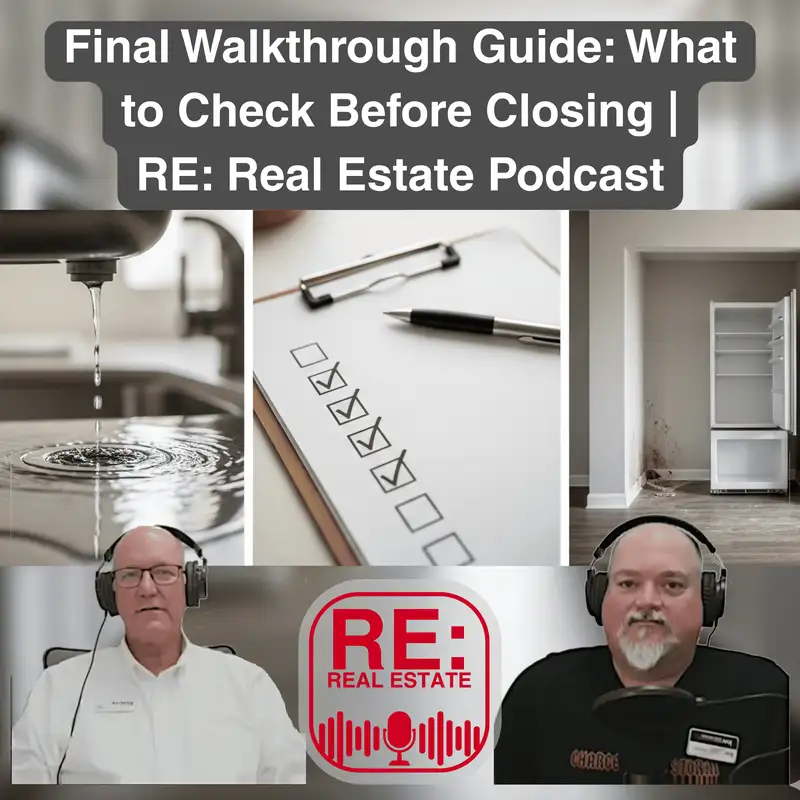
You're 24 hours away from owning your dream home. The moving truck's packed and the wire transfer's ready. But when you step inside for that final look, you find a massive puddle under the sink and the refrigerator that you paid for is gone. What do you do? Let's talk about it.
Ben Harang (00:36)
Hi everybody. And welcome to another episode of the already real estate podcast. I'm Ben Harang and I'm here with my cohost, Clint Galliano. Clint, how are doing today?
Clint C. Galliano, REALTOR® (00:50)
I'm doing wonderful, Ben. How you doing?
Ben Harang (00:53)
I'm doing terrific. we're in between cold fronts. We've been freezing at night and tonight I don't think we would get to freezing. And then this weekend it's going to be real cold, like possible teens. so we'll see if they, if they telling us the truth or not, but Saturday night or Sunday morning. so anyway, what, what are we talking about today, Clint?
Clint C. Galliano, REALTOR® (01:04)
That's what I hear.
All right, so today we're talking about the final walkthrough. ⁓ Again, this is our second to last episode in the buyer series. ⁓ And some people don't do a final walkthrough. They just assume everything is good. So kind of briefly touch on what the final walkthrough is. It's basically where you go and ensure that
The home is in the same or better condition than when it was put under contract.
and then it's not a new home inspection, so you're not looking for additional problems, but you're keeping an eye out open for them. It's just verification that everything that is supposed to be there or supposed to not be there has been taken care of. So if there's an ugly old truck in the backyard that was specifically excluded from
from being in the purchase or being left on the property and you know that's basically code for the sellers to get it out the yard then that's the point to make sure that it's gone. ⁓
Ben Harang (02:25)
Mm-hmm.
You mean if the cell
doesn't feel like moving something, they can't just leave it?
Clint C. Galliano, REALTOR® (02:33)
that is correct.
And so basically we're going to cover what's the purpose of it, what the timeline looks like, and the must checked checklist. So why don't you tell us about the why, Ben?
Ben Harang (02:51)
All right. So when we buy the house, the, the contract says the house will be in a, as good a better condition as, as it was when the purchase agreement was accepted and the final walkthrough may be the first time you see the house empty. so you check in for hidden damage, things that were hidden by furniture.
or rugs or something that the inspector didn't see, holes in the wall or damaged floor under a throw rug or something, just to make sure those things are not there.
repair confirmation if there were any repairs agreed to after the purchase agreement was written. Just want to make sure that they were done. The contractual inclusions, this one always makes me nervous, but the movables that are supposed to remain with the house, whether they're appliances, light fixtures, curtains, if you negotiated for a sofa.
something in the house. Whatever you negotiated for, you want to make sure it's there. ⁓
Clint C. Galliano, REALTOR® (04:02)
Yeah, so
all that stuff legally is referred to as chattel
Ben Harang (04:06)
Right. Right. You may have heard the term a chattel mortgage. That's when they put a mortgage on contents. But what makes me nervous about this is it has nothing to do with the house. But if it's included in the purchase agreement, then the sale can be held up because of it. And I'd rather have a separate agreement for all of that. But a lot of time it does gets negotiated into the purchase agreement.
itself. So that's the that's the why. How about the when
Clint C. Galliano, REALTOR® (04:40)
Well, before we move on to the when I just want to touch on that from the seller's point of view, throwing in items like a refrigerator or, you know, certain things, you know, maybe a barbecue pit or whatever, or in some cases, a goat, I think, was negotiated on the ⁓
Ben Harang (05:04)
A donkey.
Yeah.
Clint C. Galliano, REALTOR® (05:06)
No, it was a donkey. You're right. was, don't
know why I was thinking goat. The buyer said, don't worry about fixing anything with the house. Just throw in the donkey in the backyard. And they move forward with that contract. But the main thing is, is that the sellers can use that as kind encouragement for the buyers to proceed with the contract. They don't contribute to the value of the home for loan purposes or sales purposes, but.
Ben Harang (05:15)
Mm-hmm. Mm-hmm.
Mm-hmm.
Clint C. Galliano, REALTOR® (05:35)
If the buyer feels like, this is a good deal and I'm getting this with it and the seller feels like it's a good deal, it's helping me sell the house, then it can be included as part of the sale, just not contributing to the value. And so with that, with the walkthrough, you just want to make sure that if the refrigerator is supposed to be there, that it's still there. And unlike the first time when we recorded the episode covering this topic,
Ben Harang (05:56)
Mm-hmm.
Clint C. Galliano, REALTOR® (06:02)
I was talking about an agent that did a final walkthrough, or actually, I'm sorry, they did a final walkthrough and then they closed. And when the buyer walked into the house, the sellers had removed the dishwasher, even though that's after the final walkthrough. Yeah, so that was kind of nasty.
Ben Harang (06:15)
After the final walkthrough. Yeah.
and borderlines on theft.
Clint C. Galliano, REALTOR® (06:23)
Exactly. All right. So now we're moving on to the win. So typically a lot of people do the final walkthrough between 24 and 48 hours before closing. In our previous discussion we talked about how sometimes it's better that you do it five days to a week before closing.
because that way if there are any issues that gives you time or gives the seller time to get those issues resolved prior to closing. The downside is that if their stuff is still in the house, they may be hiding issues that you won't be able to notice because they're covered up by furniture or boxes or things like that or a rug or what have you. But the...
Ben Harang (06:53)
Hmm.
Mm-hmm.
Clint C. Galliano, REALTOR® (07:09)
The ideal thing is that you want to have the home completely vacant when you do the final walkthrough. Last minute risks, basically like we said, if you do it the day before and there's something major wrong, then everybody's scrambling trying to figure out how to resolve the issue at the risk of derailing the closing.
Alright.
Ben Harang (07:33)
Right.
in the ideal world, like he said, the 24 to 48 hours, one or two days before, or five days even gives you an opportunity to, to find a solution if there's a problem. Um, but the real world is people are moving out the night before or the morning of the closing and you need to.
either do the final walkthrough while there's still some furniture and things in the house, or you do it on your way to the closing and hope that everything is like it should be. Neither of those two options are very good, but they do happen and we do get through them.
Clint C. Galliano, REALTOR® (08:18)
All right, let's move on to the what.
Ben Harang (08:21)
All right. I like this one. Did they take the expensive rose bushes? did they dig up the plants? I have, I have one right now in, in the contract, it says we're going to take some heirloom bulbs, but we're going to leave plenty. Like who, what are they going to take it? What are they going to leave? you know, but the buyer's okay with it. So I guess we'll just take whatever they decided to leave.
Debris removal. If you heard the intro, we talked about problems. What if they left half empty cans or half full cans of paint that are notorious for being difficult to get rid of? The seller should not be leaving things they just did not want to remove.
So don't get caught holding a bag on some problematic things that need to be thrown away.
The appliances, you can do a quick cycle check on them. Make sure the AC and the heater work. Make sure the dishwasher cycles. Washing dryer, if they're included. You might want to turn them on just to see. The refrigerator, open it just to see if it's cooling. And small details.
Flushing the toilets and running the faucets to make sure the water's still on and make sure everything's functioning.
the phone charger test, you can check the outlets to make sure the power is still on maybe and make sure the outlets are still working and opening, closing doors and windows to make sure that nothing got damaged while the seller was moving out. know, especially we, the weather is supposed to be really cold this weekend. The last thing you want to do is buy a house tomorrow morning.
and move in tomorrow afternoon and then find out the heater doesn't work Saturday night. That would be not a pleasant experience. So just be prudent and diligent. 98 % of what we do, we walk in and there's no issues with the final walkthrough. And every now and then we find something that was hidden or covered or something broke.
something along those lines. So just be prudent when you walk in, it shouldn't take long. and a lot of the time reality, the, the walkthroughs are done on the way to the closing.
And even those with it as a problem tend to work themselves out.
Clint C. Galliano, REALTOR® (10:44)
Yeah, everybody's incentivized to get the deal closed. so people are willing to negotiate to, know, if it's needed to take care of whatever issue is there.
Ben Harang (10:47)
Right.
If the issue is real. Now if somebody's coming up with an issue just to come up with an issue, then that's a problem.
Clint, what if something is wrong?
Clint C. Galliano, REALTOR® (11:09)
Alright, so if you do run across some issues and if the house isn't in the condition that it's supposed to be in or if items are missing, don't panic. Look to your real estate agent. If they're sitting there freaking out, you know, maybe you do an I Love Lucy reset for them, but don't sign yet.
you know, bring up the issues. One option to to solve the issue is that the seller puts funds in escrow with the title company until they resolve the issues. Another issue is closing credits. So negotiating a cash credit to resolve the issue, which usually
involves rejuggling the finances and everything and part of the Seller's proceeds get redirected back to the buyer to cover whatever the issue is. The nuclear option, if you don't make any headway with any of these previous options, is to say I'm not closing until this is resolved. It throws everybody's schedule off, but it
Ben Harang (12:08)
Hmm
Clint C. Galliano, REALTOR® (12:24)
also lets them know that you're not just going to roll over and accept what they decided to do or not do that put you in that situation.
Ben Harang (12:34)
Right. And that, not that it's a threat, but that option tends to generally cause the seller to say, you know what, what you asked for is not unreasonable. I think I'll agree to it because they want to close. And you're sitting in the closing room and I've had this happen. You know, people have to make a decision then and there.
Are we going to proceed? Are we going to get up and walk out? And depends how much both buyer and seller are incentivized to make the deal happen. What happens at the closing table? That is never a good idea to plan on that happening. But when it does happen.
Clint C. Galliano, REALTOR® (13:15)
Now
that's more of a back pocket thing as a last resort, but it is an option.
Ben Harang (13:20)
Mm-hmm.
Yeah, I've been in closings where I had to leave with my client to talk about the options if we don't close and the ramifications of not closing and whether we should or should not close. And at the end of the day, the buyer and seller both decided, you know, we need to make, we need to work this out and get it closed. So we closed. But I don't like surprises at the closing table. Those are never fun.
Clint C. Galliano, REALTOR® (13:47)
why don't you summarize what we've talked
Ben Harang (13:50)
All right. A final tip, bring your original contract and the inspection report with you. So, you know, you can kind of remember what, what you're looking for and what the problem areas were. And, you know, like I said before, it should take 15 to 20 minutes. It's not something to lollygag around and do it, get in with a, with a purpose, be on a mission, walk through the house, look around, don't just.
Talk about where we're going to put this and what colors we're going to paint that. Look at the house itself and make sure you're getting what you should be getting and what you think you're getting. So that's, I'm going to take care of So how about if you like what we're doing, you subscribe, whether it's on the audio podcast or the video podcasts on YouTube.
You subscribe to RE Real Estate Podcast for a deep dive into home buying would be the best way to put it and tell your mom and them about it. Share, like, subscribe to the podcast. And we think we provide some valuable content. If you think it's valuable, go ahead and share it. Share it with your friends and help them out too. right. And our next.
Clint C. Galliano, REALTOR® (15:05)
Where
can they do that, Ben?
Ben Harang (15:07)
I think they can do that at rerealestatepodcast.com. That would be rerealestatepodcast.com.
Clint C. Galliano, REALTOR® (15:16)
Sounds like RERealEstatePodcast.com.
Ben Harang (15:20)
All right, now that we've driven that point home. All right, our next episode is gonna be what happens at the closing table, explaining the mountain of paperwork. All right, that wraps it up for today. Appreciate it, Clint, have a good one.
Clint C. Galliano, REALTOR® (15:23)
Ha
Woohoo!
another one in the can.
Ben Harang (15:41)
All right.
See you.
Creators and Guests