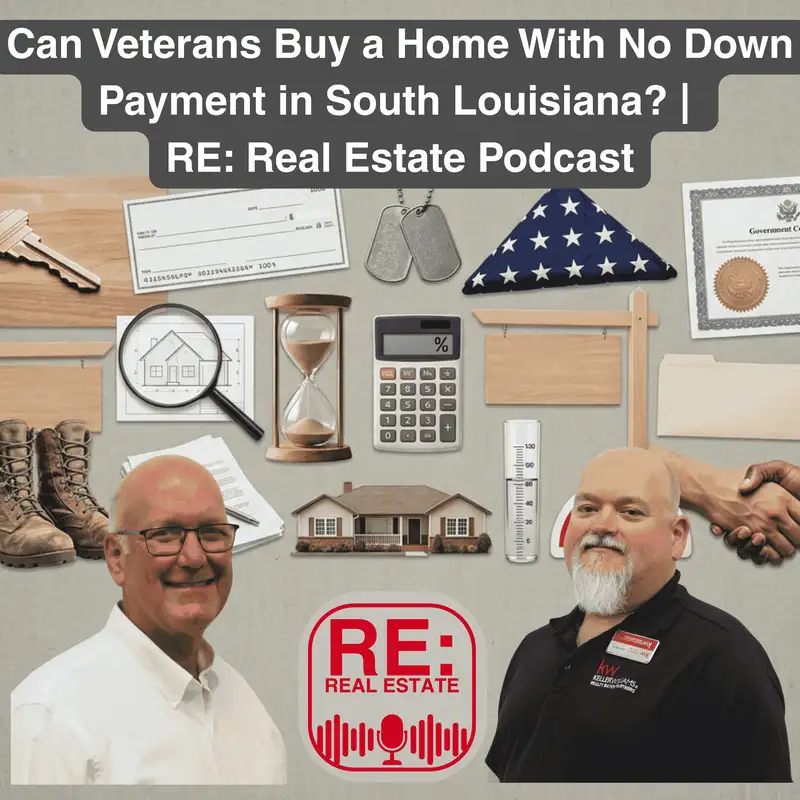
Can Veterans Buy a Home With No Down Payment in South Louisiana? | RE: Real Estate Podcast
Clint C. Galliano (00:00)
There are veterans in South Louisiana right now who could buy a home with zero down, and they're not doing it because somebody told them they couldn't. They're sellers turning away the strongest buyers in the market because of things that simply aren't true. Today, we're busting VA loan myths that are costing people homes. Let's talk about
Ben Harang (00:37)
Hi everybody and welcome to another episode of the RE Real Estate Podcast. I'm Ben Harang, here as usual with my co host, Clint Galliano. How you doing today, Clint?
Clint C. Galliano (00:50)
I'm doing wonderful, Ben. How you doing?
Ben Harang (00:53)
I'm doing terrific today, Clint, on a an afternoon in South Louisiana where it's good and hot. not a whole lot of rain outside today, but they say it's coming back. Afternoon showers. but let's let's get into it. What what are we talking about today?
Clint C. Galliano (01:15)
So today we're talking about VA loans, specifically all the things that people get wrong about them. And I mean veterans, buyers, sellers, and even some agents. The myths around the VA loans are costing people real money and real opportunities. So today we're gonna set the record straight.
Ben Harang (01:36)
Okay. I've heard all before, so let's let's get into it.
Clint C. Galliano (01:42)
All right, so this episode actually serves two audiences equally. Veterans who may not fully understand the benefit they've earned, and sellers and listing agents who may be unfairly dismissing VA buyers. And that may or may not be be dependent on the particular lender that the buyer's using. I don't want to knock anybody or anything, but some people are more laborious on their processing than others. But
The VA loan is one of the most powerful purchase tools available in the market, and it's chronically misunderstood on all sides of the transaction. So Ben, before we get into the myths, have you ever had a seller or a seller's agent push back on a VA offer based on something that turned out to not be true?
Ben Harang (02:30)
I have and it's it's has to do with the basically the appraisal and they they can get out for for no reason from the seller standpoint and what would some people fail to understand that's already in the in the purchase agreement. So there's things like that that that just some people don't understand about the VA loans. so
I'm sure you do you do a few more VA loans than I do. I'm sure you've seen more than that.
Clint C. Galliano (03:03)
I've I've seen a bunch of stuff.
Ben Harang (03:06)
Yeah. All right. Before we before we really get into the myth, let's let's establish who this benefit actually belongs to. Because eligibility is broader than most people assume. And that misunderstanding is is itself one of the biggest barriers to veterans using what they've earned.
Clint C. Galliano (03:28)
Active duty service members qualify after 90 continuous days during wartime or 181 days during peacetime, so basically six months and a day. Honorably discharged veterans qualify based on length and period of service. The specific thresholds vary by era, but the COE or certificate of eligibility will confirm it.
Ben Harang (03:55)
And here's one that a lot of people don't understand. The National Guard and Reserve members qualify after six years of service or after ninety days of active duty service under Title Thirty Two. This surprises a lot of people who served in a reserve capacity and just assume that the benefit did not apply to them.
Clint C. Galliano (04:16)
Yeah, I mean, over the last what, fifteen, twenty years we've had quite a lot of reserve members serve
Ben Harang (04:22)
Yeah.
Clint C. Galliano (04:23)
ac you know, at least three months of active duty.
Ben Harang (04:26)
Absolutely.
Clint C. Galliano (04:27)
So surviving spouses of veterans who died in service or from a service connected disability may also be eligible, provided they haven't remarried. This is one of the most underutilized categories of VA eligibility in the country.
Ben Harang (04:44)
No doubt. The the only way to know for sure is to pull your certificate of eligibility. It's available at no charge through VA.gov and it doesn't obligate you to anything. Know what you have before you need it. And the reason knowing matters is because there are a lot of persistent myths out there that keep eligible veterans from ever trying. So let's get into those now.
Clint C. Galliano (05:12)
here's some myths that veterans believe about eligibility.
The first one is I used my VA loan once, so I can't use it again. This is one of the most persistent and damaging myths out there. VA loan entitlement can be restored after a previous loan is paid off and the property sold. In some circumstances, veterans can carry more than one VA loan simultaneously.
Ben Harang (05:39)
Or people think I was discharged early, so I probably don't qualify. It's not necessarily true. Eligibility depends on the nature and length of your service, not just whether someone completed a firm a full term. The certificate of eligibility process will sort it all out. Assumptions will not sort it out.
Clint C. Galliano (06:02)
Another one is that there's no VA set minimum credit score. The VA itself does not mandate one. Individual lenders set their own overlays, but VA guidelines are significantly more flexible than conventional loan requirements. And the program is specifically designed to serve veterans who may not have perfect credit.
Ben Harang (06:25)
Another one is that getting a certificate of eligibility is a huge process. It isn't. Veterans can request their COE online through VA.gov in minutes, and lenders can pull it on a borrower's behalf. There's no reason for an eligible veteran not to know where they stand.
Clint C. Galliano (06:50)
All right. Zero down is real, but zero down is not zero dollars. So zero down payment is real. A VA loan is a 100% loan for eligible veterans purchasing within their entitlement limit. And just a point on that statement, you're not required to only purchase up to your eligibility limit.
If you've got the funds to purchase over it, you just have to pay the difference between your entitlement limit and what your purchase price is. So ultimately there's no down payment required. That's a genuine earned benefit for our veterans and active duty and one of the only true zero-down purchase loan programs that are still available anywhere in the market.
Ben Harang (07:44)
Okay, but the reality is zero down does not mean zero dollars a closing, and this distinction matters. Closing costs, prepaid items, initial escrow deposits, and homeowners insurance are still due. A veteran who walks in expecting to write no check is gonna be surprised.
Clint C. Galliano (08:08)
Good faith deposit is another real out of pocket cost. It's paid when the offer is accepted and typically applied towards closing costs, but it has to exist first. Veterans need to have liquid funds available when the down payment itself is zero.
Ben Harang (08:28)
Okay, so here's where it gets interesting and where a lot of people, including agents, get it wrong. Seller concessions are available on VA loans, but the four percent cap that everybody talks about doesn't cover what most people think it covers.
Clint C. Galliano (08:44)
That 4% concession applies to specific items, prepaying the veteran's property taxes and insurance, covering the VA funding fee, and paying down the buyer's debt balances and gift items like appliances. Those are concessions, and they're capped at 4% of the purchase price.
Ben Harang (09:05)
All right, so let's talk about what sits outside that four percent cap. And it's fully allowed on top of it. The customary closing costs a seller pays on the buyer's behalf. We're talking about the VA appraisal fee, the credit report, the loan origination fee up to 1%, title insurance, title search, recording fees, survey costs, and the first year of homeowners and flood insurance premiums. A seller can cover every one of those.
without a single dollar counting toward the four percent cap. That's that's a wow when you think about that compared to the rest of the market.
Clint C. Galliano (09:45)
Yeah. And so that's just a little clarification, because there was it did sound like there was some overlap in property taxes and insurance, but that is the the prepaid, that's that's what goes into escrow. So the that sits under or I should say that's your reserves for escrow. So that sits under that four percent cap, but
your insurance and first year's insurance and taxes, that does not. So that that's that's pretty interesting because it opens up for a lot more. I know when I first started working with VA loans, you know, the the four percent, hey, that that's the cap. You know, it's like, well, you
Ben Harang (10:31)
Mm.
Clint C. Galliano (10:31)
get more with an FHA loan. Well, actually it's that's not true. That's a myth.
Ben Harang (10:37)
No, this is
this is the best deal. If you're eligible for it for it, you should be using it.
Clint C. Galliano (10:44)
Exactly. All right, so practically speaking, a seller could pay every customary closing cost on the veteran's behalf, which could be several thousand dollars, and then contribute an additional four percent on top of the per on the of the purchase price on top of that. The total available seller contribution for a VA the total available seller contribution for a VA buyer is significantly higher than most people.
including a lot of agents, used to be myself, realize a well negotiated VA offer can get a veteran generally close to zero out of pocket.
Ben Harang (11:24)
So the the last piece is the VA funding fee. For most first-time VA loan users with zero down, it's two point one five percent of the loan amount. It can be financed into the loan, paid by the seller within the four percent concession allowance, or paid out of pocket. And veterans with a VA related service connected disability are exempt from the funding fee entirely. That exemption is worth knowing about and worth asking about.
Clint C. Galliano (11:59)
All right, so here's some myths that sellers and listing agents believe.
The VA loan takes forever to close.
Ben Harang (12:08)
Ha ha ha.
Clint C. Galliano (12:11)
This myth has some historical basis, but is largely outdated. With a competent, experienced VA lender, timelines are comparable to conventional loans. The variable is the lender, not the loan type, and veterans should choose their lender accordingly. So we actually see this with
with like the DSLD homes, when they do a VA loan, they'll say, well, it takes 60 days to process.
Ben Harang (12:43)
Mm.
Clint C. Galliano (12:43)
And that is a lot of fudge factor on their side to make sure that they get everything processed through the veterans administration.
Ben Harang (12:55)
Yeah.
Clint C. Galliano (12:56)
I've worked with other lenders that have been able to get the loan closed in like 32 days.
Ben Harang (13:04)
Mm-hmm.
Clint C. Galliano (13:04)
You know,
so it's it's definitely not a forty-five to sixty day process, though we generally allow for forty-five days for everything just in case anything pops
Ben Harang (13:15)
Mm.
Clint C. Galliano (13:15)
up.
Ben Harang (13:17)
Okay. So here's here's another myth.
The VA appraisal will kill a deal. Well, the VA appraisal includes minimum property requirements that a conventional appraisal doesn't, but those are primarily health and safety items. Functioning utilities, no exposed wiring, a roof that isn't at the end of its life. Most properties in reasonable condition pass without issue. And when repairs are needed,
They're often negotiated between the buyer and the seller, just like any other loan.
Clint C. Galliano (13:50)
So in practice, at least for my observations, the VA appraisal is much easier to pass than anything but maybe a conventional appraisal. They've got similar limits for FHA and USDA on having a working heat source.
that will automatically heat the house when it gets down to fifty-five degrees. But the the rest of it is a lot more lenient on on literally everything else. I've had one
Ben Harang (14:31)
I've I've never
I've never had an FA VA appraiser kill a deal.
Clint C. Galliano (14:37)
Dad. I well I was gonna talk about a deal from last year where a house was in the middle of being upgraded because the parents were aging, or I guess the remaining parent, and that parent passed away. There was some storm damage to the interior of the house. They wound up
Ben Harang (14:57)
Mm-hmm.
Clint C. Galliano (14:57)
replacing the roof, but the they had a bathroom gutted.
that they never finished installing the shower and and you know
Ben Harang (15:09)
Mm-hmm.
Clint C. Galliano (15:10)
re redoing the plumbing and stuff and there was some damage in the up one of the upstairs rooms from the storm where it it it damaged the roof and we had no issues with the appraisal part of that was was that they had a working bathroom so that wasn't an issue the the heater worked the furnace worked and
they were good to go. And it helped that they were buying it at a a discount to what the after
Ben Harang (15:40)
Mm-hmm.
Clint C. Galliano (15:41)
repair value might be. So all in all, I'd I'd much rather have to worry about passing a VA appraisal than practically any other appraisal.
Ben Harang (15:53)
Right. Right.
Clint C. Galliano (15:54)
All right, next one. I'd rather take a conventional offer. As a listing agent, that's a legitimate business decision only when the offers are otherwise equal. Using VA loan status as a reason to reject an offer raises fair housing concerns that every agent needs to understand. We're not attorneys, but you should know that this is an area worth taking seriously.
Ben Harang (16:23)
So here's another one. The VA buyers are more likely to back out. There's no data to support this. VA buyers go through the same quali qualification process as any other buyer. A pre approved VA buyer with their COE in hand is as serious as any buyer in the market.
Clint C. Galliano (16:48)
Yep. While there are some protections beyond any other loan type for well, not any other loan type, but there's protections for VA buyers that in certain circumstances allow them to back out that some other loans
Ben Harang (17:04)
Mm-hmm.
Clint C. Galliano (17:05)
don't look at. But what it boils down to is that it's legitimate protections for the buyers. most of it related around appraisals and
Lack of meeting the contract price.
Ben Harang (17:20)
Mm.
Clint C. Galliano (17:22)
Okay, now we could talk about some myths about the benefit itself.
And the first one is
VA lending is a government handout. It's not. It's a benefit earned through military service, funded by the VA funding fee paid by the borrowers who use it. And it's designed specifically to help men and women who serve this country access home ownership. Framing it as a charity is both factually wrong and disrespectful to everyone who earned it.
Ben Harang (17:53)
So another one is I have to use a VA specific lender. Any lender approved to originate VA loans can handle a VA loan. Veterans are not restricted to military focused banks or credit unions. Shopping lenders is not just allowed, it's encouraged. Rates and fees vary, and veterans deserve the best deal available.
Clint C. Galliano (18:20)
Yes, indeed. That's why we recommend that everybody try to get at least three pre approvals no matter what type of loan you're using,
Ben Harang (18:29)
Mm.
Clint C. Galliano (18:30)
so that way you can compare rates and fees and APRs and pick the one that best fits your financial situation.
Ben Harang (18:37)
No doubt about it.
Clint C. Galliano (18:40)
All right, and this last one is that Louisiana and well in Louisiana, South Louisiana specifically, it's about flood zones. So VA loans can absolutely be used on properties in flood zones. Flood insurance is required, same as it would be for any other loan type, but the VA does not prohibit flood zone purchases.
Veterans just need to budget for flood insurance the same way any buyer in our market does. And with the right lender and the right agent, that full picture, including the insurance costs, should be clear before they even make an offer.
Ben Harang (19:24)
All right. Now it's time for your homework. So since I don't do homework, I'm gonna give you the homework. find out what
Clint C. Galliano (19:31)
Yeah, yeah, yeah.
Ben Harang (19:35)
you earned. If you're a veteran or active duty service member, or somebody in your family is, go to VA.gov and look up your VA loan eligibility. It takes less than 10 minutes to request your certificate of eligibility online and it costs absolutely nothing.
You don't have to be ready to buy to do this. Know what you have before you need it. And if you're a seller or a listing agent who's ever hesitated on a VA offer, revisit that decision with what you heard today.
Clint C. Galliano (20:13)
VA Loan is one of the most powerful home buying tools available, and it belongs to the people who earned it. If this episode helped clarify anything, share it with a veteran, share it with a seller, share it with an agent who needs to hear it.
Love if you hit like, leave us a comment, subscribe wherever you get your podcasts, and on YouTube, and help us get this information out to the people who need it most. Every episode and our full YouTube channel is available at rerealestatepodcast.com. Got a question? Hit the ask a question button on the site. We'll see you next time.
Ben Harang (21:00)
So Clint, that that website is rerealestatepodcast.com If you have a question, there's a question button you can touch on it to drop us a note and ask it so we can address it on a future episode.
Clint C. Galliano (21:14)
There is. And let me
Ben Harang (21:16)
All right.
Clint C. Galliano (21:16)
clarify, that's R E Real Estate Podcast, all one word dot com. Go to the website and click on ask a question.
Ben Harang (21:26)
All right, you might even see two guys with faces for radio on now. Clint, have a good one.
Clint C. Galliano (21:32)
You too, Ben.
Creators and Guests