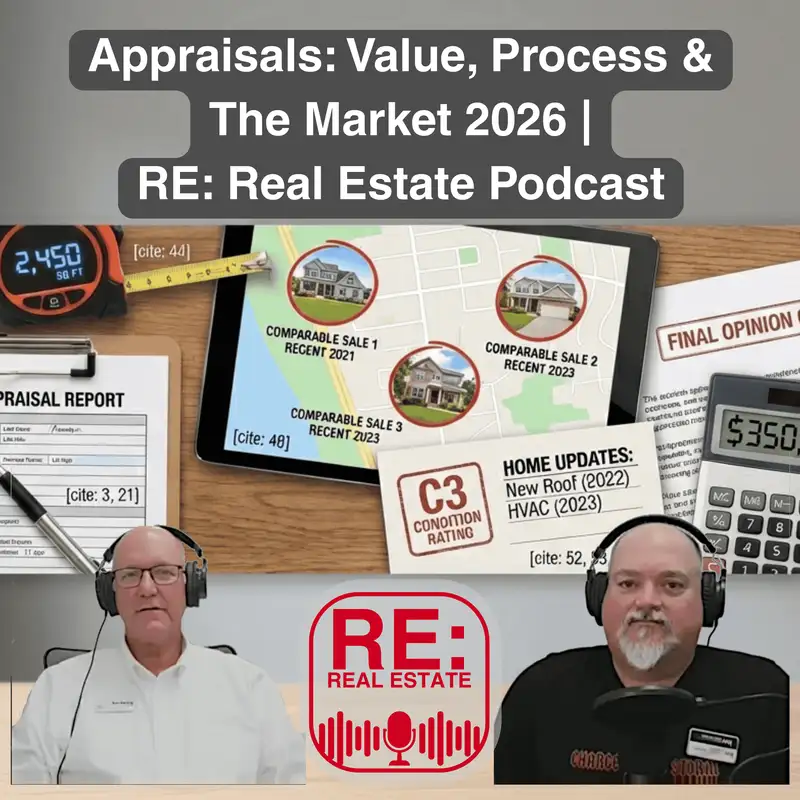
Appraisals: Value, Process & The Market 2026 | RE: Real Estate Podcast | RE: Real Estate Podcast
Clint C. Galliano, REALTOR® (00:00)
The price is agreed upon. The contract is signed. But the deal isn't done until one specific number comes back. Today we're talking about the step that makes everyone hold their breath. The appraisal.
Ben Harang (00:27)
Hello everybody and welcome to another episode of the RE Real Estate Podcast. I'm one of your hosts, Ben Horang with my cohost Clint Galliano. Good afternoon, Clint. How you doing today, man?
Clint C. Galliano, REALTOR® (00:42)
I'm doing wonderful, Ben. How you doing?
Ben Harang (00:45)
doing terrific. Weather's changing a little bit. It's a little cool in the air. We're between cold fronts, sun shining. Things look good here in Thibodaux I was in Houma with you earlier today. About the same weather over there. So no rain, no snow. We good. We're in the middle of January right now. We snowed on January 25th last year. We do not want a repeat of that. At least I don't.
So.
Clint C. Galliano, REALTOR® (01:16)
Well,
they're talking about the possibility of snow on Sunday morning, but I think the majority of it is going to be kind of north and east of us, if that even happens.
Ben Harang (01:25)
Yeah, it looks like
we might, we might get to freezing Sunday morning, maybe.
Clint C. Galliano, REALTOR® (01:32)
Everybody likes the idea of snow until they get 12 inches and can't drive for three days.
Ben Harang (01:38)
you are absolutely right. You're absolutely right. I still have a broken water line outside of my house. Let's know that I never fixed.
all right, what are we talking about today?
Clint C. Galliano, REALTOR® (01:49)
All right, today we're going to be talking about appraisals. We're going to talk about what they are and what they aren't. Unlike inspections, is required to close on a home when purchasing a home. And we're going to go into kind of the details and what's involved with it.
So you want to take on the first part, what is an appraisal and what it's not.
Ben Harang (02:21)
All right, by definition, the appraisal is an unbiased professional opinion of value. Appraisers look at past sales of like kind and quality construction and hopefully in a similar location, if not next door. And they give a value that they think the property is worth. It's valid for one opinion and one opinion only.
They work for the bank. So the bank hires them to cover
Their exposure in the loan. they typically use the sales comparison approach So to see what your neighbors household if you have two houses side-by-side that are exactly alike and One sold last month the one that's selling this month should be approximately the same price So What it's not is another home inspection you had the home inspection earlier probably you're doing the appraisal now
They're not looking to see what works and what does not work. They assume all of the mechanics in the house are working. They're not looking to see if the air condition comes on or the stove comes on or the dishwasher comes on or the toilet flush. They just, they see it, they assume it works and they base their comparison on what they see on the ground.
is not to go ahead.
Clint C. Galliano, REALTOR® (03:37)
And depending
on the loan type, they will check if some appliances work because the FHA and RD require that as part of their appraisal overlay. But that's more of a kind of a check of value rather than a defect.
Ben Harang (03:56)
Right. And that goes along with if it's in the house, it needs to work. And the classic example is the dishwasher. If there's no dishwasher in the house, that's fine. They're going to appraise it without a dishwasher. If there's a place where the dishwasher goes and there's no dishwasher, they will gig the house for not having the dishwasher. So just be cognizant of if it's there, it needs to work.
Yeah, if it's there, it needs to work. I'll leave that part at that. And then it's not a tax assessment either. The tax assessor is charged with assessing the value of property. Sometimes it's close to the market value, sometimes it's not. So just because it's assessed at a value does not mean it's worth that on the open market. And there's no, it's not a risk assessment.
about maybe whether or not the house will flood. That has to do with the flood insurance and what flood zone you're in and things like that. So it's simply the market value of the property in the appraiser's opinion.
Clint C. Galliano, REALTOR® (05:04)
so we're going to talk a little bit about the process of it and what they look at. they do a walkthrough of the home. That's kind of the eyes on phase. The appraiser measures the square footage. They call that gross living area. And so in Louisiana, that's
Typically what you hear referred to as a living area. So screen porches, added on rooms. If you've got a raised home and you've got a nice finished space, but it's not finished to the same level as the rest of the house, like no air conditioning, no tile, or it's a screen porch, then that gets added as a, you it has contributory value as an amenity, but that's not considered part of the gross living area.
Ben Harang (05:51)
you
Clint C. Galliano, REALTOR® (05:52)
They do some desktop work, that's the data phase. They go through and select comps, finding at least three to five homes that have sold ideally within the last three to six months, either within the subdivision or within a mile radius. They will go further out if they need to, but to find homes that are comparable to get a comparable price.
And then the actual drivers. So they look for, and this is what they're looking for in their comparable homes. They're looking for a gross living area that are similar. They are looking for a condition. And they kind of have that, they call that the C rating. And that can be from C1 to C6. C1 is brand new. C4 is some updates, but with some wear. To C3 is fully updated.
And then also amenities, so pools, workshops, generators, outdoor kitchens. Now we talked about this before, some of these amenities, while they add value, I'd say 99 % of the time, it's not gonna be dollar for dollar value. A $50,000 pool is only gonna add $15,000 to $20,000 if you're lucky to an appraisal value. As far as market sales,
Ben Harang (07:09)
Right.
Clint C. Galliano, REALTOR® (07:13)
Ultimately, it's the market speaking. The homes in the neighborhood are selling for $150 a square foot. That's the baseline, and that's regardless of what the homeowner feels like the home is worth.
Ben Harang (07:28)
Okay, so just some takeaways. In summary, the appraisal protects the lender. the lender owns the appraisal, but the buyer has the right to a copy of it. It validates the buyer's investment for the buyer, so it kind of gives the buyer peace of mind that they're not overpaying for the property.
It's strictly about the numbers, the size, condition, and comparable sales. It's not about feelings. It's not about what you think it's worth. It's not about what it could be worth. It's about what is.
Don't get hung up on what if somebody shows up and wants to pay you more than that for your house. Get caught up on what the market is actually paying for houses so you can sell your house. I tell people all the time, we can make your house the next house to sell. It's a matter of how aggressively you want to price it. So, being in a slow market, we can still make your house the next one to sell.
Advice for sellers. You might want to have a brag sheet ready for the appraiser just to list the new updates, the roof, the HVAC renovations. Don't let them guess about the condition. If they have to guess, they're going to probably take a mid-range years on it. If they don't know how old the roof is, they'll probably assume it's about 10 years old. If you can tell them you changed it in 2022 after Ida,
you'll be better off on the value of the appraisal.
So in closing, you're in the suburbs or the urban areas,
knowing the numbers of what the value of the property are puts you in control of the situation. If you're realistic on a price, there should be no surprise on the appraisal. I've had appraisers physically measure the house wrong. That's a problem that can be corrected. But if you're realistic, the appraisal should be a non-event for you. So other than that,
I think that's about it Clint if you if you see value in these podcasts that Clint & I've been doing for a little over a year now like subscribe share it with your mom and them Get it Go back and listen to what the topics that you you're interested in We've done a seller series a buyer series We've done a lot about insurance a lot about flood insurance
If you don't want to listen to all of it, pick and choose what you want to listen to. But I think we have some valuable content for people that are in the market to buy and sell real estate.
Clint C. Galliano, REALTOR® (10:12)
Right now we're in the middle of redoing the buyer series and we're gonna likely redo the seller series Just as we're more comfortable doing this because when we first started last year We started out doing the buyer series and then the seller series And we're we're more comfortable doing this we feel we have a better approach to this so either way you can listen to
Ben Harang (10:28)
Yeah.
Clint C. Galliano, REALTOR® (10:38)
Listen to all of them. Pick and choose. You know, whatever floats your boat. But the main thing is listen, share, like, subscribe, comment, all that fun stuff.
Ben Harang (10:52)
What's the website Clint?
Clint C. Galliano, REALTOR® (10:54)
That's RERealEstatePodcast.com.
Ben Harang (10:58)
I I heard you say re real estate podcast.com.
Clint C. Galliano, REALTOR® (11:03)
Yes, you did. rerealestatepodcast.com.
Ben Harang (11:05)
All right.
All right. think that's it. Y'all have a good one. Thanks for watching.
Clint C. Galliano, REALTOR® (11:11)
another one
in the can.
Creators and Guests