10 Commandments of Mortgage Lending: What Not to Do Before Closing | RE: Real Estate Podcast
Clint C. Galliano, REALTOR® (00:00)
We've seen deals die in the final week of closing. Not because of the house. Not because of the seller. Because of something the buyer did after they got pre-approved. Let's talk about it.
Ben Harang (00:27)
Hello everybody and welcome to another episode of the RE Real Estate Podcast. I'm Ben Harang and with me as usual is my cohost, Clint Galliano. Clint, how are doing today,
Clint C. Galliano, REALTOR® (00:42)
I'm doing wonderful, Ben. How you doing?
Ben Harang (00:45)
Clint, I'm doing terrific. Had a little technical difficulty this morning, got a little frustrated, but all that seems to have worked itself out, because I'm not smart enough to work it out, everything's working. So here we are, on to another episode. What are we going to talk about today, Clint?
Clint C. Galliano, REALTOR® (01:07)
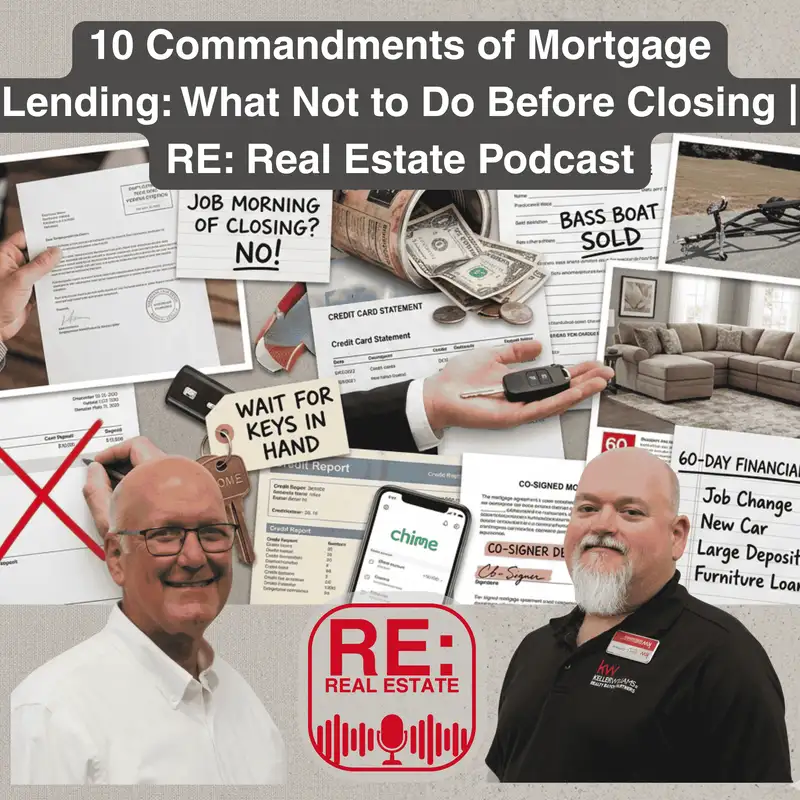
Today we're going to talk about the 10 commandments of mortgage lending. So this is something that every buyer needs to hear before they get into the loan process. And even if you're already into it, this is still an episode to listen to. This is things that your loan officer and your agent should caution you about.
It's things that we've observed happening across deals. So let's get into it.
Ben Harang (01:45)
All right. The first commandment. Don't change jobs. Don't quit your job. And don't become self-employed between the clear to close and
The closing. Just whatever you whatever you were doing, whether you like the job or don't like the job, whatever you were doing, keep doing that at least until the house closes. I've had had somebody actually quit their job the morning of the closing. The lender verified the employment and the employer said, well, he's not working here anymore. They did not buy the house.
So keep your job status the same throughout the process.
Clint C. Galliano, REALTOR® (02:35)
Yeah, so just to give you an idea about that, and it's not a random one-off where they decided to check to see if the buyer was still employed. All the lenders are like this. I had the opportunity to visit one of the largest wholesale mortgage lenders operations up in Michigan.
Ben Harang (02:48)
Mm-hmm.
Clint C. Galliano, REALTOR® (03:02)
They've got, they took over an old car manufacturing plant and built out their mortgage operations in there. They've got a whole section of a building that their only purpose is to, on the day of closing, to call up the buyer's employers and verify that they're still employed. And that's all these people do.
Ben Harang (03:22)
Mm-hmm.
Well, and in the thought process is they don't want to lend the money to somebody that does not have a job.
So.
Clint C. Galliano, REALTOR® (03:34)
Yep. All right.
Next commandment. Don't buy a vehicle. So new debt changes your debt to income ratio. Lenders notice. Modern lenders have direct access to your bank account. So they see that. So if you're anywhere close to your debt to income ratio, any additional debt, they're going to have to recalculate and run everything through underwriting again. And if you're
Ben Harang (04:01)
Mm-hmm.
Clint C. Galliano, REALTOR® (04:02)
over your debt to income ratio, then that's gonna set you back until things get straightened out.
Ben Harang (04:10)
And it may or may not allow you to close down the road, but you're not going to close when you thought you would. All right. How about leave your down payment money alone? Whether whether it's your money, a gift, retirement money, whatever it is, don't spend it thinking you can put it back. Even though you can put it back and do put it back, if you spend it down and come back up, it runs up red flags.
and they have to run it through the process again. So if you have the down payment money and the cash to close in an account somewhere, leave it there. know, life and death and you have to spend it. When you spend it, know you're not going to buy the house. But get set up and don't do anything foolish to mess up the loan closing.
Clint C. Galliano, REALTOR® (05:02)
All right, next commandment, don't run up the balance on your cards or miss any payments. The lenders pull your credit again right before closing. Most buyers don't know that, but they're verifying again, like they verify that you're still employed. They wanna make sure that everything is still straight. So do you run up a balance?
Ben Harang (05:19)
Mm-hmm.
Clint C. Galliano, REALTOR® (05:26)
that changes your credit score and that may knock you out of qualification for the particular loan you're getting, the rate you're getting or anything else. And that may halt your closing. And that ties into the next commandment.
Ben Harang (05:43)
The next one is don't let anybody pull your credit. Don't go shopping for a car knowing, okay, I'm not going to buy the car until I close on the house, but I'm going to test ride one and I'm going be ready to go so we can leave the attorney's office and go to the car lot and buy that $80,000 F-150 I've been wanting. Do not do that. Don't let them run your credit. Don't let them pull your credit because it runs up red flags to the underwriter.
that you're about to spend a whole bunch of money after you close and they get a little nervous. So just chill. Don't make any long-term plans. Go to work, go home, get your boxes, get packed. And once you close, you can start whatever process you want. Don't start any process before you close.
Clint C. Galliano, REALTOR® (06:34)
And in addition to that, every time somebody pulls your credit, that affects your credit score. So if your score is marginal, just like missing your payments or running up your cards, that's going to affect your credit score and may knock you out of what you're qualified for. All right. Don't buy furniture before the closing. Financing that sectional is going to are opening
Ben Harang (06:54)
Mm-hmm.
Clint C. Galliano, REALTOR® (07:03)
a new credit account mid-loan process, that's going to do the same thing. That's adding additional money owed that's going to affect your credit score again. Don't do it. Wait until after you're closed, then you take care of that.
Ben Harang (07:12)
Mm-hmm.
Okay, don't make any undocumented deposits. They ask for bank statements, they'll look at them. You want your paycheck going in there, you want your revenue, whatever it is you do, you want it going in there. If you're going to sell your $12,000 bass boat, keep the cash somewhere else. Don't put it in that bank account because then you have to explain where that cash came from.
So just be real careful about any abnormal activity in and out of the bank account that the lender's looking at.
Clint C. Galliano, REALTOR® (08:01)
True story, had a house listed, buyer was under contract. He had his down payment money in a coffee can in his closet. And he said, I'm buying a house. I'm going to put the, I don't know, nine, $10,000 or so, whatever it was, I'm going to put that in my bank account so it'll be there when I'm ready to buy the house.
Ben Harang (08:12)
Mm-hmm.
Mm-hmm.
Clint C. Galliano, REALTOR® (08:27)
That just killed his financing right there because he couldn't document where the money came from. There was no paper trail. And so that just killed the whole deal.
Ben Harang (08:35)
Right.
There's a term about the money has to be seasoned. It's got to be in there and there has to be a plausible explanation about where it came from. If you've just been sitting on a bunch of cash for years and you just put it right back into the bank, that's going to run up a red flag when you do it because they're going to question where you got it from, how did you get it, were there any illicit...
things you're doing, like where did this come from? And, I sold my bass boat. Well, you got a bill of sale. Well, it wasn't in good shape, so I didn't get anything. He just gave him the money I gave him the boat. You know, don't do things like that. So just be real careful. I like to tell people, just chill. Your job right now is to buy a house. Go to work and go home and get ready to move. Don't do anything.
anything extra right now.
Clint C. Galliano, REALTOR® (09:35)
So here's another big one, don't change bank accounts. Lenders need a clean, consistent financial history that they can trace. And kind of a corollary to this, have a real bank account. I worked with a client that had a Chime account. They had their payroll deposited into this Chime account.
They paid everything through that Chime account and everything was there. And there were no statements like you get from a bank account. You couldn't go and print out a statement or everything. Everything was accessed through his phone. So it was a nightmare for the lender to document everything. It literally took us six months to get that buyer closed because of everything he had to go through. Luckily, he was able to
Ben Harang (10:24)
Mm-hmm.
Clint C. Galliano, REALTOR® (10:27)
He was able to get a real bank account and swipe over his direct deposit. And once he started getting payments in there for about a month and they could show consistent deposits and everything and that he was paying his bills out of that account, we were able to close within another couple of weeks. know, but so for those of you that don't operate with a bank account, here's a tip.
get a bank account and start running your payroll, getting paid and your expenses out of that account.
Ben Harang (11:03)
All right, here's one that people don't think twice. Don't co-sign a note for anybody. If you co-sign the note, you may as well borrow the money yourself because the reason they want you to co-sign the note is because the lender, whether it's for furniture or a car or whatever the case may be, they're not comfortable making a loan to whoever you're going to co-sign the note for.
So that becomes your debt when you co-sign a note. And it's used in a calculation of your debt to income ratio. And may or not kick you out, but it'll certainly slow things down. So just don't do it. If you want to help somebody out, wait till after you close. But I suggest co-signing for somebody other than a blood family member is really not a good idea.
Clint C. Galliano, REALTOR® (12:01)
All right, and that's the Ten Commandments of Mortgage Lending.
Ben Harang (12:09)
Yeah, you know, we we try to keep it light, but if buying a house is probably the biggest financial investment you're going to make in your life or could be, just take it slow. Get some advice before you do something. If it has to do with spending money or making money.
You can make all the money you want spending it. Just slow the roll on spending. Don't buy anything. If it's, if it's Christmas time, I know it's hard. Just, just slow your roll. Don't go over the top this year, maybe. Buy the kids something after Christmas, but don't do anything that would jeopardize the, the closing on the house. And if you have a question and you want to do something, check with the lender.
Those people are so non-judgmental, it's black and white to them. If you tell them, want to take the kids to Disney World while they're for Christmas, and it'll cost $8,000, and it doesn't affect whether you're to close on the house and go to Disney World. If it affects whether or not you're going to close on the house, don't go to Disney World.
until after you close. So just some practical tips on how not to stub your toe at the last minute. Once you're in the process and once you've found that perfect house for you, the last thing you want to do is do something foolish and then not be able to close on it because you can't borrow the money.
Clint C. Galliano, REALTOR® (13:47)
And here's a pro tip. If you show up in Orlando and go to Disney and Universal on say the week after New Year's, there's not a lot of crowds and you can have a heck of a good time.
Ben Harang (14:01)
Cause they all skin instead of going to Disney.
Clint C. Galliano, REALTOR® (14:02)
That's right.
All right, if you want some resources to check out annualcreditreport.com, you can pull your credit report before you start the loan process so there's no surprises and it doesn't cost you anything to do that. You're allowed to do that once a year there for free.
Ben Harang (14:24)
All right, consumerfinance.gov slash owning a home. The Consumer Finance Plain Language Mortgage Guide. The Consumer Finance, thank you. The Consumer Finance Protection Bureau's Plain Language Mortgage Guide. It's a solid start for first time home buyers.
Clint C. Galliano, REALTOR® (14:34)
protect.
Finance Protection Bureau.
And if you're a veteran, benefits.va.gov slash home loans. This is the official VA resource for understanding your VA benefits.
Ben Harang (15:03)
All right, here is an outstanding resource, Clint. It's something called rerealestatepodcast.com. Two guys with a face for radio do these podcasts and you can get the audio, the video, the show notes, the past episodes. We have a ton of information over the last almost year and a half that we've been doing this and...
If you have some time, watch some of them and you might pick up a nugget of information and help yourself not create any havoc in a home buying process.
Clint C. Galliano, REALTOR® (15:41)
Yes, indeed. rerealstatepodcast.com. All right.
Ben Harang (15:46)
It's growing
on me, Clint. It's growing on me.
Clint C. Galliano, REALTOR® (15:51)
It's kind of like me and sushi. I'm still not sure I like sushi, but I'm addicted to the wasabi and soy sauce. All right. We've got some homework for you. Before your next conversation with a lender or if you're already in the process, write down every financial move you're thinking about making in the next 60 days.
Ben Harang (15:57)
I'm not, no, I know I don't like sushi.
Clint C. Galliano, REALTOR® (16:16)
job change, big purchases, large deposits, anything, then take that list to your mortgage banker and go through it line by line. And one conversation could save your closing.
Ben Harang (16:29)
the catch-all. Don't purchase anything until after you close.
Clint C. Galliano, REALTOR® (16:34)
Keys in hand first, big purchases second.
Ben Harang (16:38)
and your lender is your partner, they want to make you the loan. Call them before you do anything. Don't call them after you do anything and say, just bought a new pickup truck. Is that going to mess anything up? Well, the answer probably is yes. Call them before so they can say, don't do that. Wait three weeks.
Clint C. Galliano, REALTOR® (16:55)
sure. All right, well that's about it for this episode of the re real estate podcast.com. That one makes number three. Does this help you share it with someone who's in the process of buying right now or if they're thinking about buying it, they need to hear this before it's too late. You can find all our episodes and show notes at re real estate podcast.com and make sure you're subscribed wherever you get your podcasts so you never miss an episode.
Ben Harang (17:05)
All right.
Clint C. Galliano, REALTOR® (17:24)
If you have a question you'd like us to tackle on the show, reach out. We'd love to hear from you. Until next time, see ya. It's another one in the can.
Ben Harang (17:35)
Alright, good job Clint. Have a good one.
Clint C. Galliano, REALTOR® (17:40)
See you, Ben.
Ben Harang (17:40)
Alright.
Creators and Guests